
Real-time communication (RTC) is the exchange of information with little enough delay for people or systems to react while the interaction is still happening.
RTC can include text messaging, voice and video calls, screen sharing, presence information, collaborative editing, live customer support, and real-time application data. It is useful whenever immediate feedback matters more than waiting for a later response.
A chat message, for example, can be part of real-time communication when both participants are actively replying. The same messaging platform can also be used asynchronously when replies arrive hours later. What matters is not only how quickly data is delivered, but whether the interaction is designed around an immediate response.
Real-Time Communication at a Glance
What Is Real-Time Communication?
Real-time communication is communication in which information reaches another person or system quickly enough for the interaction to continue without a meaningful pause.
ETSI describes real-time communication services as services in which users expect information to be shared instantly and continuously. The exchanged information may include text, audio, graphics, video, data, or combinations of these media.
Source: ETSI Real-Time Communication Definitions
Common examples include:
-
voice calls;
-
screen sharing;
-
live customer support;
-
collaborative editing;
-
remote assistance;
-
live application updates.
RTC is not limited to communication between people. It can also connect users with applications, devices with other devices, or software systems exchanging live state.
This is why the term appears both in workplace communication and in software-development contexts.
Real-Time vs Synchronous vs Asynchronous Communication
Real-time, synchronous, and asynchronous communication overlap, but they are not identical concepts.
Voice and video calls are normally both synchronous and real-time.
Text communication is more flexible. If two employees are actively exchanging messages and responding within seconds, their chat behaves like real-time communication. If one employee replies several hours later, the same platform is being used asynchronously.
The technology has not changed. The expected interaction has.
This distinction matters because fast delivery alone does not make communication real-time. The information also needs to arrive quickly enough to support the immediate interaction the user or system is trying to perform.
Main Types of Real-Time Communication
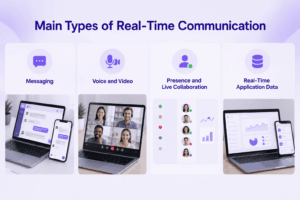
Real-time communication can take several forms depending on what information needs to be exchanged and how quickly participants need to react.
Messaging
Instant messaging provides rapid text communication between individuals or groups.
Business platforms may combine messaging with channels, presence, notifications, file sharing, and delivery states.
Messaging is often the lowest-friction real-time channel because users can handle quick questions or coordination without starting a formal call.
Voice and Video
Voice communication provides continuous two-way audio, while video adds visual information.
Typical uses include:
-
business calls;
-
team meetings;
-
customer consultations;
-
interviews;
-
online training;
-
remote support;
Voice is useful when a topic is too complicated for messaging but does not require visual information. Video becomes useful when participants need demonstrations, visual context, or face-to-face interaction.
Presence and Live Collaboration
Presence shows whether someone is currently available for communication.
Common states include online, offline, available, busy, away, or in a meeting.
RTC platforms may also include screen sharing, presentations, collaborative whiteboards, remote control, and shared application views.
These capabilities help users move from simple communication into active collaboration when the task requires it.
Real-Time Application Data
RTC can also describe live exchange between applications and devices.
Examples include:
-
live dashboards;
-
cursor positions;
-
multiplayer state;
-
delivery tracking;
-
IoT data;
-
synchronized application events.
In each case, information is delivered quickly enough for another person or system to react while it is still relevant.
How Real-Time Communication Works
Although implementations differ, most RTC systems rely on several common functions.
Session Establishment
Before communication begins, endpoints need to establish a session and determine how information will be exchanged.
This process may involve identifying users, checking availability, initiating a connection, applying permissions, and negotiating media or data parameters.
Media and Data Transport
Once a session exists, the actual information needs to move between endpoints.
Depending on the application, this may include:
-
audio;
-
video;
-
messages;
-
screen content;
-
files;
-
live application data.
For voice and video, the delay must remain low enough for natural interaction. Messaging and live application data may tolerate more variation, but updates still need to arrive quickly enough to remain useful.
Presence and Session State
RTC applications frequently maintain information about the current state of a session.
This can include whether a user is online, who has joined a meeting, who is speaking, whether someone is typing, or whether a device has disconnected.
Maintaining current state allows participants and applications to react to changes as they happen.
Network Adaptation and Reconnection
Real networks are imperfect.
Users may move between Wi-Fi and mobile networks, experience packet loss, or lose connectivity briefly.
Practical RTC systems therefore need to adapt media quality, recover from network problems, reconnect sessions, and restore current state after interruptions.
The goal is not zero delay. The goal is to keep the interaction responsive enough that it still feels immediate and usable.
When Real-Time Communication Is Useful
RTC is most valuable when waiting would slow down work or when immediate feedback can resolve uncertainty faster than asynchronous communication.
Real-time interaction is particularly useful for urgent coordination, ambiguous problems, collaborative decisions, visual support, customer assistance, and interactive training.
The common factor is that the value of an immediate response is high enough to justify participants giving attention at the same time.
Real-Time Communication Latency
The term real-time does not mean that information travels with zero delay.
Every RTC system introduces some latency. Delay can come from network propagation, routing, media encoding, buffering, packet-loss recovery, server processing, and endpoint performance.
The acceptable level of delay depends on the interaction.
Text messaging can tolerate more variation than a natural two-way voice conversation. Voice becomes difficult when delay causes participants to talk over each other. Interactive applications such as remote control may be even more sensitive because users expect visible results to follow their actions quickly.
There is therefore no single latency threshold that defines every form of RTC.
The useful question is whether the delay is low enough for the intended interaction to remain natural and effective.
WebRTC and Other Technologies Behind RTC
WebRTC, or Web Real-Time Communication, is one of the most important technologies associated with browser-based RTC.
MDN describes WebRTC as a set of technologies that allows web applications to capture and stream audio or video and exchange arbitrary data between browsers without requiring traditional plug-ins.
Source: MDN WebRTC API
WebRTC can support:
-
browser-based video calls;
-
voice communication;
-
screen sharing;
-
peer-to-peer data exchange;
-
embedded customer communication.
However, WebRTC is not a complete communication platform by itself. A business application built with WebRTC may still need user accounts, authentication, messaging, meeting controls, call routing, storage, moderation, administration, and monitoring.
Other technologies can also form part of an RTC environment.
SIP is widely used to establish and control voice and video sessions, particularly in business telephony and conferencing.
STUN and TURN help applications establish media paths across NAT devices and firewalls.
WebSockets provide persistent two-way browser-to-server connections and are commonly used for messaging, signaling, and live application events.
Messaging systems may also use protocols such as XMPP, Matrix, or proprietary technologies depending on the required communication model.
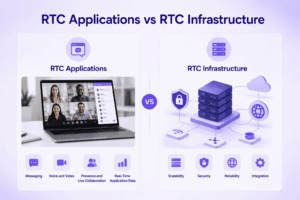
RTC Applications vs RTC Infrastructure
The term real-time communication platform can refer to two different product categories.
RTC Applications
RTC applications are complete communication environments used directly by people.
They may provide:
-
messaging;
-
presence;
-
voice calls;
-
video calls;
-
meetings;
-
screen sharing;
-
file exchange.
Employees can use the application without building the underlying communication system themselves.
RTC Infrastructure
RTC infrastructure is used by developers to add real-time communication to another product.
It can include:
-
WebRTC components;
-
voice or video APIs;
-
messaging APIs;
-
SDKs;
-
signaling;
-
media servers;
-
presence services;
-
session management.
For example, a bank building video support into its mobile application may use RTC infrastructure. A bank whose employees simply need messaging and video meetings would usually choose a finished group communication application.
This distinction matters because the two categories solve different problems and should not be compared as if they were interchangeable products.
Real-Time Communication in Business
Business communication rarely stays inside a single channel.
A conversation may begin with a short message and move into voice or video when the issue becomes harder to explain. Participants may then share a screen, resolve the problem, and return to the original chat where files and context remain available.
This movement from a lightweight channel into a richer one can be described as channel escalation.
A useful RTC environment therefore does not simply provide several communication modes. It should make it easy to move between them without losing participants, context, or ongoing conversation history.
This is particularly useful in support, operations, project work, remote assistance, customer communication, and distributed teams.
Examples of Real-Time Communication Platforms
Business RTC can be implemented through platforms such as TrueConf, Secumeet, Microsoft Teams, Slack, Zoom, and Element.
These platforms are examples rather than a ranking. They show different ways of combining messaging, presence, calling, conferencing, and collaboration within a real-time communication environment.
TrueConf and Secumeet illustrate customer-operated models. Microsoft Teams, Slack, and Zoom primarily use vendor-operated cloud models. Element adds a federated and self-hosted approach through the Matrix ecosystem.
Sources: TrueConf Server · Secumeet · Microsoft Teams · Slack Huddles · Zoom Workplace · Element
When Asynchronous Communication Is Better
Real-time communication is not automatically more productive.
RTC requires people to coordinate their attention at the same time, which creates interruption and scheduling costs.
Asynchronous communication is often a better choice for:
-
detailed status reports;
-
policy documents;
-
project documentation;
-
complex proposals;
-
information that should remain searchable;
-
non-urgent questions;
-
decisions that require research.
Consider a detailed architecture proposal. A live meeting may be useful after participants have reviewed it, but asking everyone to read and analyze the document together during a video call would usually be inefficient.
The goal is not to make every interaction real-time. RTC is most useful when the value of immediate feedback outweighs the cost of synchronous attention.
In many workflows, the strongest approach combines both models: asynchronous preparation followed by real-time discussion when clarification or decision-making is needed.
Frequently Asked Questions
What is real-time communication?
Real-time communication is the exchange of information with little enough delay for users or systems to interact continuously while an event or conversation is happening.
It can include text, audio, video, screen sharing, presence information, and live application data.
What are examples of real-time communication?
Examples include instant messaging, voice calls, video calls, video conferences, live customer support, screen sharing, collaborative editing, remote assistance, and live application updates.
Is instant messaging real-time communication?
It can be.
Instant messaging supports rapid delivery, but the interaction may be real-time or asynchronous depending on how quickly participants respond and whether both sides expect an immediate exchange.
Is video conferencing real-time communication?
Yes.
Video conferencing is a form of synchronous real-time communication in which participants continuously exchange audio, video, and other meeting data.
What is the difference between RTC and WebRTC?
RTC is the broader concept of exchanging information with low enough delay for immediate interaction.
WebRTC is a specific set of technologies that can be used to implement real-time audio, video, and data communication in browsers and applications.
Is real-time communication better than asynchronous communication?
Not always.
RTC is useful when immediate interaction helps resolve a problem, coordinate work, or reach a decision. Asynchronous communication is usually better when people need time to review information, research a topic, document decisions, or work without interruption.
Conclusion
Real-time communication is the exchange of information quickly enough for people or systems to react while the interaction is still unfolding.
It can include messaging, voice, video, presence, screen sharing, and live application data, supported by technologies such as WebRTC, signaling systems, media services, and persistent data connections.
RTC is most useful when immediate feedback moves work forward. When people need time to review, research, or document information, asynchronous communication is often the better choice.
Author
Helga Afon is a technology writer specializing in video conferencing, collaboration software, and workplace communication. She writes articles and reviews that help readers better understand enterprise communication tools and industry trends.