

Group communication is the exchange of information, ideas and feedback among several people connected by a shared purpose.
A project chat is group communication. So is a hiring panel comparing candidates, a classroom discussion, a department meeting or a remote team reviewing a product over video.
What changes when several people interact is not simply the number of participants.
Communication becomes a system.
Different people hold different information. Some participants contribute expertise, others make decisions, and others mainly need to understand the outcome. Communication may begin in writing, move into a live discussion and then return to a persistent channel where the decision can be found later.
That means effective group communication depends on more than speaking clearly.
It also depends on:
-
who needs to participate;
-
how information moves through the group;
-
whether communication should be synchronous or asynchronous;
-
which channel fits the task;
-
who owns the decision;
-
where the outcome is preserved.
Group Communication at a Glance
What Is Group Communication?
Group communication is the process through which three or more people exchange information as part of a shared interaction.
The participants may belong to:
-
a project team;
-
a department;
-
a committee;
-
a class;
-
a leadership group;
-
a customer working group;
-
a temporary task force;
-
an informal community.
Current workplace definitions commonly describe group communication as communication among three or more people working toward a common goal.
The shared purpose matters.
A large audience receiving the same information is not necessarily functioning as a communicating group.
For example:
A CEO sends an announcement to 5,000 employees.
This is primarily one-to-many organizational communication.
But:
Eight employees discuss how to implement that announcement.
This is group communication because participants can respond, influence one another and contribute to a shared outcome.
Why Is Group Communication Important?
Groups communicate for more than information exchange.
The real purpose is often to turn knowledge held by different people into shared understanding and coordinated action.
One participant may understand the customer problem. Another knows the technical limitation. A third controls the budget. Group communication allows those pieces of context to be combined.
Effective communication helps groups:
-
coordinate work;
-
identify missing information;
-
compare different perspectives;
-
resolve uncertainty;
-
make decisions;
-
assign responsibility;
-
keep participants aware of what happens next.
Without that shared process, each person may understand their own part of the problem while the group as a whole remains misaligned.
Why Does Group Communication Get Harder as Groups Grow?
A conversation between two people contains one direct communication relationship.
Add a third person and there are three possible one-to-one relationships.
As membership grows, the number of possible direct relationships increases much faster than the number of participants.
This does not mean everyone must communicate directly with everyone else.
It explains why larger groups need more structure.
A five-person discussion can stay relatively informal.
A 50-person group usually needs mechanisms such as:
-
separate channels;
-
moderators;
-
defined roles;
-
smaller working groups;
-
meeting agendas;
-
one-way announcements;
-
written decisions.
The communication method that works for four people may stop working when the same group becomes forty.
Group Communication vs Interpersonal, Team and Mass Communication

Several related concepts are often used interchangeably.
They describe different communication situations.
Interpersonal Communication
Interpersonal communication usually refers to communication between individuals.
A private conversation between a manager and an employee is interpersonal communication.
Team Communication
Team communication is a specific form of group communication.
Teams usually have:
-
shared objectives;
-
ongoing membership;
-
defined responsibilities;
-
coordinated work.
Every team relies on group communication, but not every communicating group is a formal team.
Mass Communication
Mass communication usually involves one source distributing information to a large audience.
Examples include:
-
public broadcasts;
-
mass email;
-
company-wide announcements;
-
public media.
Recipients may not need to interact with one another.
Group communication normally provides more opportunity for participants to respond and influence the discussion.
Types of Group Communication
There is no single useful classification of group communication.
Different dimensions explain different parts of the interaction.
By Communication Form
A group may use several forms during the same task.
For example, a team can start with written discussion, move into a video meeting and use screen sharing to review a design.
By Timing
Group communication can also be synchronous or asynchronous.
Synchronous Communication
Participants interact at the same time.
Examples include:
-
video meetings;
-
conference calls;
-
workshops;
-
live discussions.
It works well when immediate clarification matters.
Asynchronous Communication
Participants respond at different times.
Examples include:
-
group chats;
-
discussion threads;
-
email;
-
shared notes;
-
project comments.
It works well when participants need time to think, work across schedules or preserve context.
Neither model is universally better.
The question is whether the current task needs immediate interaction or durable context.
By Formality
Formal group communication follows an established organizational process.
Examples include:
-
project reviews;
-
board meetings;
-
training sessions;
-
official project channels.
Informal communication develops more naturally:
-
spontaneous chats;
-
quick calls;
-
informal discussions.
Organizations normally need both.
By Direction
Some groups primarily distribute information.
Others need many participants to interact.
A department announcement may be one-to-many.
A design review may require many-to-many discussion.
The communication format should match that difference.
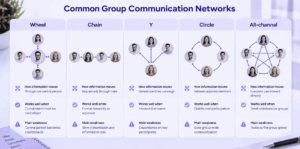
Common Group Communication Networks
Another way to understand group communication is to look at how information moves between participants.
Real organizations rarely use only one structure.
A project may use:
-
an all-channel chat for daily discussion;
-
a chain for approvals;
-
a project manager as the central hub during an incident;
-
a one-way channel for announcements.
The useful question is not which network is theoretically best.
It is which structure fits the decision and the size of the group.
How Group Communication Moves From Message to Decision
One of the most important parts of group communication is the transition between communication modes.
A group does not need to stay in the same channel throughout a task.
A practical communication flow can look like this:
share → discuss → clarify → decide → preserve
1. Share
Someone introduces a question, problem or update.
This often begins asynchronously in:
-
group chat;
-
project comments;
-
email;
-
another persistent channel.
2. Discuss
Other participants add:
-
context;
-
evidence;
-
questions;
-
alternatives.
For simple issues, the group may resolve the problem without leaving written communication.
3. Clarify
Text becomes inefficient when:
-
people repeatedly misunderstand each other;
-
several decisions depend on one another;
-
a screen needs to be demonstrated;
-
participants need rapid back-and-forth;
-
visual context matters;
-
the discussion becomes sensitive.
At this point, a voice or video conversation may be more efficient.
4. Decide
The relevant participants reach an outcome.
This does not necessarily mean everyone in the group makes the final decision.
The important issue is that decision authority is understood.
5. Preserve
The meeting should not become the only place where the outcome exists.
Important information should return to a persistent channel:
-
what was decided;
-
who owns the next step;
-
what deadline applies;
-
which document or file is relevant.
Live communication resolves ambiguity.
Persistent communication preserves the result.
Examples of Group Communication
Group communication takes different forms depending on the work being done.
Project Group Chat
A product team uses a persistent chat for:
-
status updates;
-
blockers;
-
short questions;
-
design changes;
-
links and files.
The communication is mostly asynchronous, although active discussions may become nearly real-time.
Daily Stand-Up
A small team meets briefly to communicate:
-
current progress;
-
next steps;
-
blockers.
The communication is synchronous and highly structured.
Brainstorming Session
Participants propose and combine ideas.
An all-channel structure often works well because interaction between participants creates much of the value.
Cross-Functional Decision
Representatives from engineering, marketing, sales and management discuss a product launch.
Different participants hold different information.
The group must combine that information and convert it into a shared decision.
Participation Does Not Mean Everyone Makes the Decision
A common communication problem appears when a group treats participation and decision authority as the same thing.
They are different.
A six-person discussion may contain:
-
three people providing expertise;
-
one person responsible for the final decision;
-
two people who need the outcome for their work.
All six may need to participate.
Only one may need decision authority.
When this distinction is unclear, discussions often continue because participants do not know whether the goal is:
-
collecting information;
-
reaching consensus;
-
getting approval;
-
making a recommendation;
-
informing the group.
Before an important discussion, it helps to clarify:
Who contributes? Who decides? Who acts? Who needs to know?
That can reduce communication without reducing participation.
Common Barriers to Group Communication

Groups can fail even when individual participants communicate well.
The problem may be structural.
Too Many Participants
Adding people increases available knowledge but also increases communication paths.
A discussion that works with five people may become inefficient with twenty.
One response is to distinguish:
-
decision makers;
-
contributors;
-
reviewers;
-
observers.
Unclear Ownership
If everyone can discuss but nobody owns the outcome, the conversation can continue indefinitely.
Parallel Conversations
The same subject may appear simultaneously in:
-
email;
-
group chat;
-
direct messages;
-
meetings;
-
project comments.
Different participants then hold different pieces of context.
Meeting-Only Decisions
A decision is made verbally but never recorded.
Participants who were absent cannot recover it, while attendees may remember it differently.
Notification Overload
Open groups can generate so much communication that people stop paying attention.
The underlying problem may be poor separation between:
-
urgent communication;
-
discussion;
-
announcements;
-
reference information.
Unequal Participation
A group can technically allow everyone to speak while a few people dominate the discussion.
The goal is not equal speaking time.
It is making sure that relevant information can enter the decision process.
Wrong Channel for the Task
Long arguments in chat and unnecessary meetings are two versions of the same problem.
The communication medium does not fit the work.
What Makes Group Communication Effective?
Effective group communication has several recurring properties.
Shared Context
Participants understand:
-
why the group exists;
-
what is being discussed;
-
what outcome is expected.
Clear Roles
Members know whether they are expected to:
-
contribute;
-
decide;
-
review;
-
approve;
-
stay informed.
Appropriate Channel
Simple coordination remains lightweight.
Complex discussion can move live.
Important decisions become persistent.
Feedback
Participants can confirm whether information has been understood correctly.
Accessible History
The group can later answer:
-
What did we decide?
-
Why?
-
Who owns the next step?
-
Which file were we discussing?
How to Design Group Communication in Practice
Improving group communication does not necessarily mean encouraging more conversation.
Often it means designing the environment around it.
Define the Purpose of the Group
A leadership group, project channel and social group should not operate under identical expectations.
Define:
-
purpose;
-
membership;
-
expected outputs;
-
decision authority.
Separate Announcements From Discussion
Important information should not disappear between hundreds of replies.
Use separate formats where necessary.
Match the Channel to Urgency
Teams can distinguish between:
-
urgent communication;
-
asynchronous discussion;
-
informational updates.
Not every message requires an immediate response.
Reduce Context Switching
A fragmented workflow may look like:
chat in one app → video in another → file somewhere else → follow-up in email
Each transition creates another place where context can be lost.
Record Outcomes Instead of Every Word
Groups rarely need every sentence preserved.
They often need:
-
the decision;
-
the owner;
-
the deadline;
-
the next step.
Review Group Size
If 30 people participate in every operational discussion, better communication technique may not solve the problem.
The group may simply be too large.
Group Communication in Remote and Hybrid Teams
Distributed teams cannot rely on physical proximity to resolve small questions.
That changes the balance between synchronous and asynchronous communication.
Remote groups often need a combination of:
-
persistent messaging;
-
video meetings;
-
screen sharing;
-
shared content;
-
searchable history.
A small uncertainty that would be solved across a desk in an office now needs a deliberate channel.
This makes channel selection more important.
It also makes persistence more important because people may be working at different times.
The objective is not to make every interaction synchronous.
It is to let the group move between communication modes without losing context.
How to Choose Group Communication Tools
Many communication platforms provide similar feature lists.
They may all include:
-
group messaging;
-
video calls;
-
file sharing;
-
screen sharing;
-
notifications.
A feature checklist alone therefore provides limited decision value.
More useful questions are:
Does the Group Need Persistent Communication?
If discussions continue over days or weeks, message history becomes important.
Can Written Discussion Move Into Live Communication?
A complex discussion should not require the group to rebuild all context in another system.
What Happens After the Meeting?
The decision should remain accessible after live communication ends.
Who Controls the Group?
Organizations may require:
-
corporate identities;
-
moderators;
-
group ownership;
-
administrative control;
-
access policies.
Where Does the Communication Environment Run?
Some organizations use cloud services.
Others operate communication infrastructure themselves.
That choice affects administration, infrastructure responsibility and integration with internal systems.
Where Secumeet Fits
Secumeet is relevant when group communication needs to move between persistent messaging and live collaboration.
The platform combines:
-
personal chats;
-
group chats;
-
video meetings;
-
screen sharing;
-
presentations;
-
content collaboration;
-
remote assistance.
This supports a communication flow where a group can begin with written discussion, move into a live meeting when the issue becomes difficult to resolve through text, review shared content and then continue the discussion in a persistent group context.
That makes Secumeet most relevant for organizations whose groups communicate continuously rather than only through isolated scheduled meetings.
Secumeet uses a customer-operated server environment, which also makes deployment and administration part of the communication architecture.
It does not replace dedicated project management, document management or other specialized business systems.
Its role is the communication layer connecting persistent group discussion with real-time collaboration.
Frequently Asked Questions
What is group communication?
Group communication is the exchange of information, ideas and feedback among three or more people connected by a shared purpose, task or context.
Examples include team meetings, group chats, classroom discussions, project workshops and committee meetings.
Why is group communication important?
Group communication allows people with different information and responsibilities to build shared understanding, coordinate work, solve problems and make decisions together.
What are the main types of group communication?
Group communication can be classified as written, verbal, visual or nonverbal.
It can also be synchronous or asynchronous, formal or informal, and one-to-many or many-to-many.
What is an example of group communication?
A project team discussing a launch in a shared group chat is an example of group communication.
If the issue becomes complicated and participants move into a video meeting, the same group shifts from asynchronous to synchronous communication.
What are the five group communication networks?
Five commonly discussed structures are:
-
wheel;
-
chain;
-
Y;
-
circle;
-
all-channel.
They differ in how directly participants communicate and how centralized information flow is.
What is the difference between group communication and team communication?
Group communication describes interaction among several people.
Team communication is a more specific form involving people who normally share ongoing objectives, responsibilities and coordinated work.
What are common barriers to group communication?
Common barriers include:
-
unclear roles;
-
too many participants;
-
fragmented conversations;
-
information overload;
-
missing decision records;
-
poor channel selection;
-
unclear ownership.
How can group communication be improved?
Groups can improve communication by defining the purpose of the group, clarifying who contributes and who decides, matching channels to the task, reducing unnecessary context switching and preserving important outcomes.
Conclusion
Group communication is not only the exchange of messages among several people.
Its real challenge is moving information held by different participants toward shared understanding, a decision and coordinated action.
As groups grow, they need more explicit structures, roles and communication rules.
Written channels preserve context.
Live communication resolves ambiguity.
Effective groups know when to move between the two — and make sure that important decisions remain accessible after the conversation ends.
Author
Helga Afon is a technology writer specializing in video conferencing, collaboration software, and workplace communication. She writes articles and reviews that help readers better understand enterprise communication tools and industry trends.