

Internal communication barriers are obstacles that prevent employees from receiving, understanding or acting on information inside an organization.
They can come from information silos, too many channels, unclear ownership, poor documentation, hierarchy, information overload or differences between office and remote teams.
The problem is often not a lack of communication. Knowledge workers already spend a large part of the workweek exchanging messages, attending meetings and searching for information. Grammarly reported that knowledge workers spend 88% of their workweek communicating, while Microsoft found that 62% of respondents felt they spent too much time searching for information.
What matters is whether information is easy to find, clear enough to act on and connected to the right people.
Internal Communication Barriers at a Glance
Key Takeaways
-
Internal communication barriers are usually structural, not simply the result of employees failing to communicate.
-
Information silos can lead to duplicated work because teams do not always know what others are doing.
-
Channel overload and information overload are different: one creates uncertainty about where communication should happen, while the other creates too much competing information.
-
Unclear ownership often turns understandable messages into unresolved tasks.
-
Poor documentation makes decisions difficult to retrieve and can create conflicting versions of the same information.
-
Hybrid teams need explicit communication rules because remote employees do not have the same access to informal office context.
-
Communication tools can reduce fragmentation, but they cannot solve unclear roles, weak escalation processes or poor management practices on their own.
What the Data Shows
A few numbers help illustrate the scale of the problem.
The takeaway is not that organizations should communicate more. They need to make communication easier to find, understand and act on.
What Are Internal Communication Barriers?
An internal communication barrier is any organizational, technological or human condition that makes it harder for information to move accurately between employees, teams or departments.
A barrier does not necessarily mean communication has already failed.
For example, a department that keeps information inside its own systems creates an information silo. The silo is a communication barrier.
If another department later makes the wrong decision because it never received that information, the barrier has produced a communication failure.
The goal of internal communication is therefore not to maximize message volume. It is to reduce the conditions that make useful information harder to find, understand or act on.
1. Information Silos
Information silos appear when knowledge stays inside one department, team or individual instead of moving to others who need it.
This may happen because teams use separate tools, follow different processes or simply do not realize that another department depends on their information.
For example, product management may change a release date without informing marketing. Marketing continues preparing a campaign around the old schedule, even though both teams are working correctly based on the information available to them.
Atlassian’s State of Teams research found that 55% of knowledge workers found it difficult to track down information, while 50% had worked on a project only to discover later that another team was working on the same thing.
That is why silos are not only a communication issue. They can also create duplicated work.
How to reduce information silos
Organizations should identify which information must cross team boundaries and where that information should live.
Cross-functional projects also need explicit handoffs. Important context should not depend on someone remembering to forward a message manually.
A reliable shared source of current information is usually more useful than adding another communication channel.
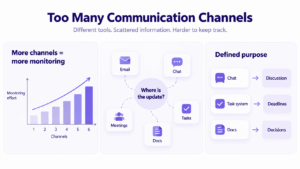
2. Too Many Communication Channels
Adding communication tools can initially make collaboration easier.
Over time, employees may need to monitor email, corporate messaging, project tools, departmental chats, meeting platforms and shared documents.
The problem is not necessarily that there is too much information. Sometimes the problem is that employees are unsure where communication is supposed to happen.
If one team uses email for updates, another uses chat, and project decisions are stored somewhere else, employees may know that information exists without knowing where to look for it.
How to reduce channel overload
Each communication channel should have a defined purpose.
For example, chat can handle day-to-day discussion, a task system can remain the source of truth for deadlines, and formal decisions can be stored in project documentation.
The objective is not necessarily to reduce everything to one platform. It is to make communication predictable.
3. Information Overload
Information overload is different from channel overload.
The problem here is that too much information competes for limited attention.
Microsoft found that employees spent 57% of their Microsoft 365 work time communicating in meetings, email and chat.
This can make it difficult to distinguish routine communication from information that genuinely needs attention.
Information overload can lead to:
-
missed priorities;
-
constant context switching;
-
unnecessary meetings;
-
delayed responses to important messages;
-
lower focus.
How to reduce information overload
Priority should be visible.
Not every update needs the same notification level, and not every issue requires a meeting.
Teams can also move routine communication to asynchronous formats so employees have more control over when they process it.
Channel Overload vs Information Overload vs Tool Fragmentation
These three barriers are related but not identical.
A company can experience all three at once, but they require different fixes.
4. Hierarchical Barriers
Hierarchy can slow communication when employees hesitate to question decisions, report problems or raise risks.
The message itself may be clear, but the organizational structure makes people less willing to send it.
For example, an employee may recognize that a deadline is unrealistic but wait until the problem is certain before escalating it.
This creates a communication imbalance: information moves downward more easily than upward.
How to reduce hierarchical barriers
Managers should define clear escalation paths and make it acceptable to raise emerging risks before they become confirmed problems.
Employees should know who to contact, what level of uncertainty is acceptable and when escalation is expected.
Regular feedback also helps reduce the perception that communication only flows one way.
5. Unclear Ownership
A message can be perfectly understandable and still fail if nobody knows who should act on it.
Consider:
We need to update the customer presentation before tomorrow.
Everyone may understand the request, but each person may assume somebody else owns it.
This is not mainly a wording problem. It is an accountability problem.
How to reduce ownership ambiguity
Important requests should make three elements clear:
-
what needs to happen;
-
who owns it;
-
when it is due.
For example:
Anna will update the pricing slides and send the final version by 15:00 today.
That turns information into an actionable request.
6. Poor Documentation
A large amount of internal communication happens verbally or inside fast-moving chats.
That is useful for discussion but weak as a permanent record.
A team may make an important decision during a meeting and later discover that different participants remember different outcomes.
Microsoft found that 62% of respondents struggled with spending too much time searching for information during the workday.

Poor documentation makes this worse because employees may need to reconstruct decisions from meetings, emails and long chat histories.
How to improve documentation
Not every conversation needs formal minutes.
But important decisions should leave behind a short record containing:
-
what was decided;
-
who owns the next step;
-
the relevant deadline;
-
any changed assumptions.
The record should be easier to find than the conversation that produced it.
7. Remote and Hybrid Communication Gaps
Remote and hybrid work introduce a specific problem: employees do not always have equal access to informal context.
An office employee may hear about a change during an informal conversation. A remote colleague may receive that information hours or days later.
Gallup found that 48% of hybrid workers said their team had not discussed a formal or informal plan for how to collaborate effectively in a hybrid environment.
This shows why hybrid communication works better when it is designed rather than left to habit.
How to reduce hybrid communication gaps
Important information should be distributed through channels that all team members can access.
Teams should agree on where decisions are documented, which discussions need meetings, how asynchronous communication works and how employees who miss meetings receive updates.
The goal is to avoid creating two information layers: one for people in the office and another for everyone else.
8. Language and Terminology Differences
Employees do not need to speak different native languages for language to become a barrier.
Departments often develop their own terminology.
A technical team may use abbreviations that marketing does not understand. A manager may use words such as “urgent” or “soon” without defining what they mean.
This creates room for different interpretations of the same message.
How to reduce language barriers
Use precise language when ambiguity affects action.
Instead of:
We need this soon.
write:
Please send the approved version by Tuesday at 14:00 CET.
Internal terminology should also be explained when communication crosses departments or professional functions.
9. Tool Fragmentation
Tool fragmentation occurs when different parts of one workflow live in separate systems.
For example:
-
a task is stored in a project-management tool;
-
discussion happens in chat;
-
files are stored elsewhere;
-
the decision is made during a meeting;
-
follow-up arrives by email.
The employee technically has access to all of the information, but reconstructing the full context requires switching between applications.
How to reduce tool fragmentation
Organizations should distinguish between systems that genuinely need to remain separate and unnecessary duplication.
Integrations, searchable communication histories and clear ownership of each information type can reduce how much context employees have to reconstruct manually.
10. Lack of Feedback and Confirmation
One of the simplest communication barriers is assuming that sending information means it has been understood.
The sender may believe a request is clear while the recipient interprets it differently or misses part of the message.
Not every message needs a reply, but high-impact communication should include some form of confirmation.
That may mean acknowledging responsibility, confirming a deadline, restating the expected action or asking a clarifying question.
The more costly a misunderstanding would be, the more important the feedback loop becomes.

Which Internal Communication Barriers Cause the Most Friction?
There is no universal ranking because the impact depends on the organization.
However, three issues appear repeatedly in workplace research:
-
difficulty finding information;
-
excessive communication volume;
-
weak coordination between distributed teams.
These barriers often reinforce one another.
An employee may receive too many messages, spread across too many systems, while still being unable to find the one piece of information they actually need.
This is why internal communication problems often come from high communication volume combined with weak information structure.
What Do Internal Communication Barriers Cost?
Communication friction can show up as lost time, duplicate work, missed deadlines and rework.
Grammarly previously estimated that ineffective communication could cost U.S. businesses as much as $1.2 trillion per year in wasted labor hours. Atlassian separately estimated 25 billion work hours lost annually to ineffective collaboration across the Fortune 500.
These figures come from different studies and methodologies, so they should be treated as indicators of scale rather than directly comparable estimates.
Operationally, communication barriers usually create costs through:
-
time spent searching for information;
-
duplicated work;
-
missed handoffs;
-
decisions based on outdated information;
-
meetings required to reconstruct missing context.
Internal Communication Barriers in Remote and Hybrid Teams
Remote work does not automatically create poor communication.
It removes some informal information channels and therefore makes explicit processes more important.
In an office, employees can often resolve small information gaps through spontaneous conversations. In distributed teams, those gaps need to be handled through messaging, meetings or documentation.
A useful hybrid communication model should answer questions such as:
-
Which information must always be written down?
-
Where is the current decision recorded?
-
When should a discussion move from chat to a meeting?
-
How are employees in different time zones updated?
-
What happens when somebody misses a meeting?
The objective is to make access to information independent of physical location.
How to Overcome Internal Communication Barriers
Solving internal communication problems does not usually require more communication.
It requires better structure.
Clarify Channels and Ownership
Employees should know which channel is appropriate for each type of communication and who owns important actions.
A message should not only explain what happened. When action is required, it should make responsibility clear.
Create a Reliable Source of Truth
Teams need a predictable place for current information.
This may include project status, approved documents, final decisions or operational instructions.
The goal is to reduce the need to reconstruct the current state from several conversations.
Reduce Overload and Document Decisions
Not every update needs a notification or meeting.
Routine communication can often be asynchronous, while important decisions should be summarized in a searchable form.
This helps teams reduce noise without losing context.
Create Clear Escalation and Feedback Paths
Employees should know how to raise emerging risks and how important messages are confirmed.
This is especially important when communication crosses departments or management levels.
How to Measure Internal Communication Barriers
Communication problems should not be evaluated only through anecdotes.
Organizations can track measurable signals that reveal where communication is creating friction.
The goal is not to maximize or minimize every metric.
For example, shorter response times are not automatically better if employees feel pressured to interrupt focused work for low-priority messages.
Metrics are most useful when they reveal recurring friction inside a specific workflow.
How Communication Tools Can Help
Technology can reduce some internal communication barriers, but it cannot remove all of them.
Communication platforms are most useful for structural problems such as fragmented conversations, delayed access to information and difficulty moving between text and live discussion.
Tools cannot solve unclear ownership, poor leadership or weak escalation processes on their own.
Those problems still require organizational decisions.
Where Secumeet Fits
Secumeet combines personal and group chats with file sharing and video communication in one organizational environment.
For internal communication, the relevant value is the ability to keep several communication modes closer together.
A team can discuss an issue in a group chat, share related files, move to a live meeting when the discussion becomes too complex for text and continue the conversation afterward.
This can reduce some forms of context fragmentation and make it easier for distributed teams to keep communication in one environment.
Secumeet does not solve organizational barriers such as unclear responsibilities, hierarchical hesitation or poor documentation discipline. Those still require process and management changes.
Internal Communication Barrier Checklist
A short audit can help identify whether internal communication problems are structural rather than isolated.
Ask:
-
Can employees quickly find current information?
-
Do teams know which channel to use?
-
Does every important action have an owner?
-
Are key decisions documented?
-
Can employees escalate risks before they become incidents?
-
Do remote employees receive the same information as office employees?
-
Are people expected to monitor too many channels?
-
Can employees distinguish urgent messages from routine updates?
-
Is communication history searchable?
-
Are recurring misunderstandings measured?
Several “no” answers usually indicate a process problem rather than a single bad message.
Frequently Asked Questions
What are internal communication barriers?
Internal communication barriers are organizational, technological or human conditions that make it harder for employees and teams to exchange, understand or act on information.
Examples include information silos, communication overload, unclear ownership and poor documentation.
What are the most common barriers to internal communication?
Common barriers include information silos, too many communication channels, information overload, unclear responsibilities, hierarchy, remote-work gaps, fragmented tools and weak feedback processes.
How does poor internal communication affect productivity?
Poor communication can increase the time employees spend searching for information, cause duplicated work and create missed deadlines.
Microsoft found that 62% of respondents struggled with too much time spent searching for information.
Why are information silos a communication barrier?
Information silos keep knowledge inside one team or department.
This prevents other employees from accessing information they need and can lead to duplicate work, delayed decisions or conflicting actions.
How does remote work affect internal communication?
Remote and hybrid teams have fewer informal information exchanges, so they rely more heavily on explicit communication processes.
Without shared rules for documentation, meetings and asynchronous updates, remote employees may receive information later than office-based colleagues.
Can communication tools solve internal communication barriers?
They can reduce some structural barriers, including fragmented conversations and difficulty accessing communication history.
They cannot independently solve unclear ownership, poor management practices or environments where employees hesitate to raise problems.
Conclusion
Internal communication barriers are not simply caused by employees failing to communicate.
Modern knowledge workers already spend a large part of the workweek exchanging information. The challenge is making that communication useful.
Information silos, channel overload, poor documentation, unclear ownership and fragmented work systems can all prevent information from producing the intended action.
A better internal communication system focuses on measurable outcomes: information should be easy to find, responsibilities should be clear, important decisions should remain accessible and employees should know where and how to raise problems.
The goal is not more communication.
It is less friction between information and action.
Author
Helga Afon is a technology writer specializing in video conferencing, collaboration software, and workplace communication. She writes articles and reviews that help readers better understand enterprise communication tools and industry trends.