
Formal and informal communication are two ways information moves between people inside and outside an organization.
The difference is often described too simply.
Formal communication is not just “professional language,” and informal communication is not simply “casual conversation.”
The more useful distinction is this:
Formal communication carries organizational authority, follows an accepted process, or creates a record that people may need to rely on later. Informal communication prioritizes speed, flexibility, and direct human interaction.
Both are necessary.
A company that relies only on formal communication can create unnecessary process. A company that relies only on informal communication can lose decisions, create conflicting versions of events, and make responsibilities unclear.
The real challenge is knowing when a conversation should remain informal and when it needs to become formal.
Formal vs Informal Communication at a Glance
The two forms are not opposites in the sense that one is better than the other.
They solve different communication problems.
What Makes Communication Formal?
Communication becomes formal when the message is recognized as part of an official organizational process or has an authoritative effect.
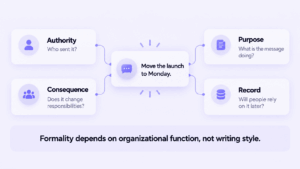
That may happen because of the channel, the sender’s authority, the purpose, or the consequences of the message.
Examples include:
-
a company policy;
-
an official announcement;
-
a contract;
-
a performance review;
-
meeting minutes;
-
an approved project decision;
-
a client proposal;
-
a manager assigning responsibility;
-
an incident report;
-
an HR notification.
Formal communication often creates something other people can rely on later.
For example:
“The project deadline is now November 14.”
If that message is issued by the project owner in an official project channel and is expected to guide the team’s work, it is functioning as formal communication even if the sentence itself is short and conversational.
That leads to an important distinction:
Formality is determined more by organizational function than by writing style.
Formal Communication Does Not Have to Be Written
Formal communication is often associated with emails, reports, policies, and documents.
But it can also be spoken.
Examples include:
-
an official team briefing;
-
a performance review;
-
a board meeting;
-
a manager communicating an approved decision;
-
a disciplinary conversation;
-
an executive presentation.
A spoken message can still be formal if it represents an authorized organizational position.
The difference is not:
written = formal
and
spoken = informal
The real question is:
Does the communication have official organizational meaning?
What Makes Communication Informal?
Informal communication does not depend on an official organizational route.
It usually develops naturally between people.
Examples include:
-
a quick direct message;
-
a spontaneous call;
-
a hallway conversation;
-
a short chat before a meeting;
-
colleagues exchanging ideas;
-
an employee asking another employee for help;
-
an unofficial discussion about a possible project change.
Informal communication usually optimizes for:
-
speed;
-
low friction;
-
relationships;
-
quick clarification;
-
early-stage thinking.
It is especially useful when people do not yet need a formal record or final decision.
For example:
“Do you think we should delay the release?”
This may be an informal question between colleagues.
Nothing has been decided yet.
The conversation is exploratory.
Informal Communication Does Not Mean Unimportant
Some of the most useful information inside an organization moves informally.
Employees often discover problems through informal conversations before those problems appear in reports.
Ideas may emerge in chats, short calls, spontaneous discussions, or conversations between departments.
Informal communication also helps people build trust.
A company where every question requires an official email, ticket, or scheduled meeting would create unnecessary friction.
But speed has a trade-off.
Informal information may be:
-
incomplete;
-
misunderstood;
-
remembered differently;
-
forwarded without context;
-
mistaken for an official decision.
That is why informal communication is excellent for exploration, but weaker when people need authority or traceability.
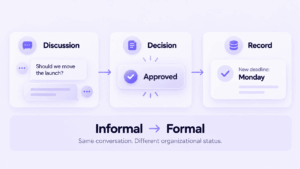
The Same Message Can Be Informal or Formal
Consider this message:
“We should move the launch to Monday.”
Its status depends on context.
Scenario 1: Informal
Two colleagues discuss the project in a private chat.
One says:
“We should move the launch to Monday.”
This is a suggestion.
No official decision has been made.
Scenario 2: Formal
The project owner posts:
“Approved. Move the launch to Monday.”
The wording is still conversational.
But now it changes:
-
responsibilities;
-
deadlines;
-
expectations;
-
project execution.
The communication has become formal because of its organizational effect.
This creates one of the most important rules for modern workplace communication:
A message can sound informal while functioning as a formal decision.
When Informal Communication Becomes Formal
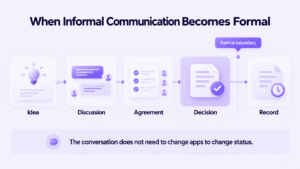
Many business decisions do not begin in formal channels.
They develop gradually.
A common path looks like this:
Idea → Discussion → Agreement → Decision → Record
For example:
Step 1: Idea
A developer messages a project manager:
“The release may need another week.”
Informal.
Step 2: Discussion
The team discusses technical risks in a group chat or call.
Still mainly informal.
Step 3: Agreement
The team concludes that postponement is necessary.
The conversation is becoming more consequential.
Step 4: Decision
The responsible manager approves the change.
Now it becomes formal.
Step 5: Record
The deadline is updated in the project system and communicated to stakeholders.
The formal decision becomes traceable.
This is why the most useful question is sometimes not:
Is this formal or informal communication?
but:
At what point does this conversation need to become formal?
Four Questions That Decide Which Communication Type to Use
A practical decision can often be made with four questions.
1. Does the Message Create an Obligation?
If someone is expected to take action because of the message, formal communication becomes more important.
Examples include:
-
approving a budget;
-
assigning responsibility;
-
changing a deadline;
-
approving leave;
-
modifying a contract;
-
authorizing a purchase.
A quick conversation can start the process.
The final obligation should usually be recorded formally.
2. Will Someone Need to Prove What Was Decided?
If the answer is yes, the communication should be traceable.
This applies to:
-
project decisions;
-
compliance;
-
HR;
-
financial approvals;
-
customer commitments;
-
incident response.
The issue is not bureaucracy.
It is preserving one reliable version of the decision.
3. Is Speed More Important Than Permanence?
If people are still exploring ideas, informal communication is usually more efficient.
Examples include:
-
brainstorming;
-
quick troubleshooting;
-
asking for clarification;
-
checking availability;
-
testing an idea with a colleague.
Formalizing every early-stage conversation slows communication without creating much value.
4. Could Misunderstanding Have Serious Consequences?
If misunderstanding could create legal, financial, operational, or employment consequences, communication should become more formal.
A useful rule is:
The higher the consequence of misunderstanding, the stronger the need for an authoritative record.
Formal Communication Can Still Be Fast
Formal communication is often associated with slower processes.
Digital communication has changed that.
A formal decision can now be communicated in seconds.
For example:
Manager → Official Project Channel
“Approved. Proceed with Option B.”
The communication is:
-
short;
-
immediate;
-
digital;
-
conversational in tone;
but still formal because it is authoritative and traceable.
Speed is therefore not a reliable way to distinguish formal from informal communication.
The process around the message matters more.
Digital Tools Blur the Formal/Informal Boundary
Modern workplace tools have made formal and informal communication harder to separate by channel.
In the past, the distinction seemed clearer:
Formal: memo, letter, report, official meeting
Informal: hallway conversation, phone call, personal discussion
Today, the same business messenger can contain:
-
jokes between colleagues;
-
quick questions;
-
technical troubleshooting;
-
project approvals;
-
management instructions;
-
company announcements;
-
customer decisions.
The same is true for other technologies.
Email Can Be Informal
“Are you free for coffee after the meeting?”
The channel is email, but the communication is informal.
Chat Can Be Formal
“Your budget request has been approved for Q4.”
If it comes from an authorized manager and is intended as the final decision, the chat message functions formally.
Video Meetings Can Be Either
A spontaneous call between colleagues may be informal.
A board meeting where decisions are approved and recorded is formal.
The technology does not determine the communication type.
The purpose, authority, consequences, and record do.
Digital communication has separated communication style from communication status.
A message can be casual in tone and formal in effect without ever leaving the same application.
What Goes Wrong When the Wrong Mode Is Used
Problems often appear not because communication is formal or informal, but because the mode does not match the consequence of the message.
This creates an important principle:
Communication quality depends not only on what is said, but on whether the communication mode matches the consequence of the message.
When Informal Communication Goes Too Far
Informal communication becomes risky when people start treating unconfirmed information as authoritative.
Examples include:
-
rumors becoming assumed decisions;
-
approvals existing only in private chats;
-
different teams receiving different versions;
-
important context disappearing.
The problem is not that informal communication occurred.
The problem is that the communication remained informal after the outcome became important.
When Formal Communication Goes Too Far
Formal communication creates a different problem when every interaction becomes a process.
Examples include:
-
too many approvals;
-
simple questions becoming meetings;
-
employees delaying early warnings because reporting feels burdensome;
-
teams creating unofficial channels because the formal process is too slow.
The goal is therefore not to maximize formal communication.
It is to formalize the right information at the right moment.
Traceability Matters More as Consequences Increase
Formal communication becomes especially valuable when people need to establish:
-
who made the decision;
-
what was decided;
-
when it changed;
-
who was expected to act;
-
where the surrounding context can be found.
This is why traceability matters for project changes, approvals, customer commitments, compliance, and other consequential communication.
The more important the outcome, the less useful it is to rely on memory alone.
Formal vs Informal Communication Is Not the Same as Synchronous vs Asynchronous
These concepts describe different dimensions.
Formal vs informal describes organizational status and structure.
Synchronous vs asynchronous describes timing.
That creates four possible combinations.
A formal message does not need to happen in real time.
An informal conversation does not need to be synchronous.
Keeping these dimensions separate makes workplace communication easier to classify.
Types of Formal Communication by Direction
Formal communication can also be classified by how information moves through an organization.
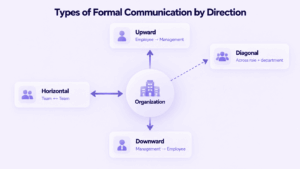
Downward Communication
Information moves from management toward employees.
Examples include:
-
policies;
-
instructions;
-
objectives;
-
announcements.
Upward Communication
Information moves from employees toward management.
Examples include:
-
reports;
-
feedback;
-
escalation;
-
performance information.
Horizontal Communication
Information moves between people or teams at similar organizational levels.
Examples include:
-
department coordination;
-
project updates;
-
resource planning.
Diagonal Communication
Communication crosses both departmental and hierarchical boundaries.
For example:
an engineer communicates directly with a finance manager about a project requirement.
Modern organizations increasingly rely on horizontal and diagonal communication because work does not always follow a strict chain of command.
Informal Communication and the Grapevine
Informal organizational communication is sometimes described as the grapevine.
Information moves according to relationships rather than official reporting lines.
That can happen through:
-
private chats;
-
personal conversations;
-
social groups;
-
informal calls;
-
conversations after meetings.
The grapevine can move information very quickly.
That makes it useful as an early signal.
But it can also change information as it spreads.
A useful management response is not to try to eliminate informal communication.
Instead:
When informal information begins affecting behavior, the organization should decide whether it needs a formal response.
If employees are acting on a rumor, silence itself can become part of the communication problem.
How Formal and Informal Communication Work Together
Healthy workplace communication often follows a cycle:
Informal exploration → Formal decision → Informal coordination → Formal record when needed
For example:
Product Team
A problem appears.
Employees discuss it informally.
↓
Several solutions emerge.
↓
The product owner formally approves one.
↓
The team coordinates implementation through chat.
↓
The final change is recorded in the project system.
Neither communication type replaces the other.
Informal communication helps work move.
Formal communication gives important outcomes organizational weight.
A Simple Decision Framework
Before sending a message, ask:
Is this exploratory?
Use informal communication.
Is this a final decision?
Formalize it.
Is this quick coordination?
Keep friction low.
Does someone need to rely on this later?
Create a record.
Does the message change responsibility, money, policy, employment, or customer commitments?
Use an authoritative channel.
Is the information still uncertain?
Avoid presenting it as official.
This is more useful than assuming that “email is formal” and “chat is informal.”
Formal and Informal Communication in Business Messaging
Business messaging platforms increasingly carry both communication types.
A private chat may contain informal coordination.
A project group may contain both discussion and final decisions.
A company-wide channel may carry formal announcements.
A video meeting may begin as an informal discussion and end with an official decision.
The challenge is therefore not to force formal and informal communication into separate applications.
It is to maintain enough context that people can understand when a conversation changed status.
That requires capabilities such as:
-
persistent history;
-
verified user identity;
-
groups and channels;
-
searchable communication;
-
access controls;
-
file exchange;
-
meetings and calls;
-
centralized administration.
The important requirement is not simply message delivery.
It is context continuity.
Supporting Both Communication Modes With Secumeet
Secumeet can support both informal and formal workplace communication within the same persistent environment.
For example:
Informal Discussion
Employees explore an issue in a group chat
↓
Agreement
The team identifies the preferred action
↓
Formal Outcome
An authorized manager confirms the decision
↓
Follow-Up
The same group retains the discussion, decision, files, and subsequent communication
Secumeet does not determine whether a message is formal or informal.
That remains an organizational decision.
Its relevance is that an informal discussion can become a traceable formal outcome without moving into a disconnected communication history.
Personal messages, group chats, video meetings, files, and administration can remain part of the same managed communication environment.
This becomes especially useful when teams need both:
low-friction everyday interaction
and
persistent context around consequential decisions.
When a Formal System of Record Is Still Better
Not every formal communication should live primarily in a messenger.
Some processes need specialized systems of record.
Examples include:
-
signed contracts;
-
payroll documents;
-
regulatory filings;
-
legally required notices;
-
formal HR records;
-
structured financial approvals.
A business messaging platform can support discussion and coordination around these processes without replacing the authoritative system.
This distinction matters:
A communication platform can preserve context without becoming the official record for every business process.
FAQ
What is the difference between formal and informal communication?
Formal communication follows recognized organizational channels or carries official authority. Informal communication develops more freely between people and is usually optimized for speed, flexibility, and direct interaction.
What is an example of formal communication?
Examples include company policies, official announcements, project approvals, performance reviews, reports, meeting minutes, and management instructions.
What is an example of informal communication?
Examples include quick chats between colleagues, spontaneous calls, hallway conversations, unofficial discussions, and early-stage brainstorming.
Is email formal or informal communication?
It can be either. An official management announcement sent by email is formal, while a casual email between colleagues may be informal. The channel alone does not determine the communication type.
Is workplace chat formal or informal?
Both are possible. A chat can contain informal coordination or an official decision. Authority, purpose, consequences, and the need for a record determine whether the communication functions formally.
Can verbal communication be formal?
Yes. Official briefings, performance reviews, board meetings, management instructions, and other authorized conversations can all be formal verbal communication.
Why is informal communication important?
Informal communication supports fast coordination, relationship building, early problem identification, clarification, and idea sharing. It complements formal communication rather than replacing it.
When should informal communication become formal?
It should usually become formal when a discussion produces a decision, obligation, policy change, customer commitment, financial consequence, or another outcome that people need to rely on later.
Conclusion
Formal and informal communication are not competing systems.
They perform different jobs.
Informal communication helps people:
explore → coordinate → clarify → connect
Formal communication helps organizations:
decide → authorize → document → establish accountability
The most important distinction is therefore not whether a message sounds professional or casual.
It is whether the communication needs authority, traceability, speed, or flexibility.
Modern digital tools make the boundary less visible because the same chat, email, or meeting platform can carry both informal discussion and formal organizational decisions.
A conversation can even cross that boundary without changing the application or writing style.
That makes one question especially useful:
When does this conversation become important enough to formalize?
Organizations that answer that question well can keep everyday communication fast without losing the decisions and context that matter.
Author
Helga Afon is a technology writer specializing in video conferencing, collaboration software, and workplace communication. She writes articles and reviews that help readers better understand enterprise communication tools and industry trends.