
Hybrid work is a working model in which employees collaborate across more than one work setting, usually combining office-based and remote work.
The simplest definition is “partly in the office, partly remote.” But in practice, hybrid work is broader than location alone.
A hybrid environment usually combines three things:
-
different locations;
-
different ways of interacting;
-
different timing of collaboration.
That means a hybrid team may work across offices, homes and other locations, communicate both in person and digitally, and combine real-time work with asynchronous communication.
The main challenge is not simply where employees sit. It is how the organization keeps communication, decisions and responsibilities consistent when people do not share the same location or schedule.
Hybrid Work at a Glance
Key Takeaways
-
Hybrid work combines more than office and home. It also mixes face-to-face and digital interaction, plus synchronous and asynchronous work.
-
A team can be hybrid even if some employees are always in the office and others are always remote.
-
There is no single standard hybrid schedule.
-
Hybrid work depends on coordination more than location.
-
Important information should not depend on physical presence.
-
Hybrid meetings need to work for remote and in-room participants equally.
-
Too many meetings, weak documentation and fragmented tools are common failure points.
-
Technology supports hybrid work, but the operating model determines whether it works well.
What Is Hybrid Work?
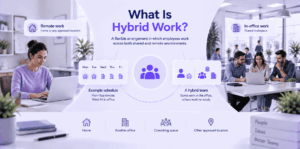
Hybrid work is a flexible arrangement in which employees work across both shared and remote environments.
The remote location is often home, but it can also be another office, a coworking space or another approved workplace.
A simple example is an employee who works:
-
Monday and Tuesday remotely;
-
Wednesday through Friday in the office.
But hybrid work does not always follow a fixed weekly pattern.
An employee may work remotely when focusing on individual tasks and come to the office for workshops, planning sessions or customer meetings.
A team can also be hybrid even if individual employees themselves do not move between locations.
For example, some employees may work permanently from an office while others work remotely. The team is still hybrid because collaboration takes place across different environments.
Hybrid Work Is More Than Office vs Home
Hybrid work is often described too narrowly.
Location is only one dimension.
A more useful way to understand hybrid work is through three dimensions:
This matters because two companies can both say they use hybrid work while operating in very different ways.
One organization may require everyone in the office three days a week and run most meetings live.
Another may have employees spread across several cities and rely heavily on asynchronous communication.
Both are hybrid, but their operating models are very different.
Can a Team Be Hybrid Without Hybrid Employees?
Yes.
Hybrid work can exist at the team level.
Imagine a team of ten people:
-
five work from the office every day;
-
three work fully remotely;
-
two alternate between home and office.
Even though only two employees personally switch between locations, the team itself is hybrid.
This distinction is important because hybrid work is ultimately about coordination across different work contexts.
The organization still needs to solve the same questions:
-
How do people communicate?
-
Where are decisions documented?
-
How do remote employees participate in meetings?
-
How is information shared across locations?
How Does Hybrid Work Work?
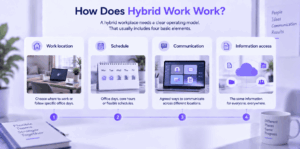
A hybrid workplace needs a clear operating model.
That usually includes four basic elements.
Work location
Employees need to know whether they can choose where to work or whether specific office days are required.
Schedule
The company may define office days, core collaboration hours or flexible schedules.
Communication
Teams need agreed ways to communicate when not everyone is physically present.
This may include messaging, video meetings and shared documentation.
Information access
Employees should be able to find the same information regardless of location.
A hybrid model becomes difficult when important decisions are available only to people who happened to be in the office.
Main Hybrid Work Models
There is no universal hybrid model.
The right model depends on the type of work, team structure, office infrastructure and how much flexibility the organization can support.
Hybrid Work vs Remote Work
Hybrid and remote work are related, but they are not the same.
A fully remote employee may never visit a company office.
A hybrid employee typically works across more than one setting.
Hybrid Work vs Flexible Work
Hybrid work mainly concerns where people work.
Flexible work is broader.
It can include:
-
flexible hours;
-
compressed workweeks;
-
part-time schedules;
-
job sharing;
-
flexible start and finish times.
A company can therefore offer flexible hours without allowing remote work.
Likewise, a hybrid employee may still work a fixed schedule.
Example of Hybrid Work
Consider a marketing team with eight employees.
Three are in the office on Monday while the rest work remotely.
The team starts the day with a video meeting, and everyone joins through the same communication platform.
Tasks and decisions are documented in shared systems instead of being available only to people who were physically present.
On Wednesday, the whole team meets in the office for workshops and planning.
On Thursday and Friday, most employees work remotely.
This is hybrid work because collaboration continues across both physical and digital environments.
What Are the Benefits of Hybrid Work?
Potential benefits depend on how the model is designed.
Hybrid work can also make it easier to separate tasks that benefit from quiet focus from tasks that benefit from face-to-face interaction.
However, these benefits are not automatic.
A poorly designed hybrid model can simply move office problems into digital channels.
What Are the Challenges of Hybrid Work?
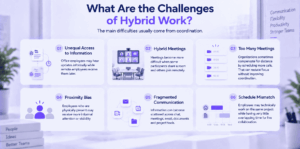
The main difficulties usually come from coordination.
Unequal Access to Information
Office employees may hear updates informally while remote employees receive them later.
Important information should therefore be documented and accessible digitally.
Hybrid Meetings
Meetings become more difficult when some participants share a room and others join remotely.
Remote participants may struggle to hear, interrupt or see what is happening in the room.
Too Many Meetings
Organizations sometimes compensate for distance by scheduling more calls.
That can reduce focus without improving coordination.
Proximity Bias
Employees who are physically present may receive more informal attention or visibility.
Fragmented Communication
Information can become scattered across chat, meetings, email, documents and project tools.
Schedule Mismatch
Employees may technically work on the same project while having very little overlapping time for live collaboration.
Why Hybrid Work Fails
Hybrid work usually fails because of structural coordination problems, not because employees are physically apart.
These problems often reinforce each other.
For example, weak documentation creates more meetings because employees need to reconstruct missing context.
More meetings then increase communication load.
How to Design a Hybrid Operating Model
Hybrid work becomes easier when organizations define how work should happen instead of leaving every team to improvise.
Clarify When Physical Presence Matters
Office attendance should have a purpose.
Examples include:
-
workshops;
-
customer meetings;
-
team planning;
-
access to specialized equipment;
-
activities that benefit from face-to-face discussion.
Employees should understand why they are expected in the office.
Decide What Must Be Asynchronous
Not every discussion should require everyone to be available at the same time.
Routine updates, decisions and background information can often be documented asynchronously.
Define the Source of Truth
Teams need to know where final decisions, responsibilities and deadlines are stored.
This prevents important information from disappearing inside chat threads or meetings.
Set Rules for Hybrid Meetings
If even one participant is remote, the meeting should be designed for distributed participation.
That means remote employees need to hear, see and contribute directly.
Make Ownership Explicit
Hybrid teams benefit from clear responsibility.
A task should have:
-
an owner;
-
a deadline;
-
a visible status;
-
a place where the decision is recorded.
How Communication Changes in Hybrid Teams
Hybrid teams cannot depend as heavily on spontaneous office communication.
More communication becomes intentional.
A quick question that would normally be asked across a desk may become a chat message.
A complex discussion may move from messaging into a video meeting.
An important decision may then need to be documented so people in other locations can find it later.
This means hybrid work relies on both synchronous and asynchronous communication.
Synchronous communication happens in real time, such as audio calls, video meetings and live discussions.
Asynchronous communication allows people to respond later, such as messages, project updates and documented decisions.
A strong hybrid model uses both instead of forcing every interaction into a meeting.
What Technology Does Hybrid Work Require?
Technology supports hybrid work, but the exact stack depends on the organization.
The important point is not to use as many tools as possible.
Too many disconnected systems can create the opposite problem by making context harder to find.
How Secumeet Fits Into Hybrid Work
Communication is one part of a hybrid operating model.
Secumeet combines personal and group messaging with audio and video meetings, file sharing and screen sharing.
For hybrid teams, this can support common workflows where employees move between asynchronous communication and live discussion.
A team can coordinate in chat, start a video meeting when an issue needs real-time discussion and continue the conversation afterward.
This can be useful when some employees are working from an office while others are remote.
However, a communication platform does not define a hybrid work policy.
Organizations still need to decide:
-
when employees work remotely;
-
when office attendance is required;
-
how decisions are documented;
-
how responsibilities are assigned;
-
how remote employees participate in meetings.
What the Data Says About Hybrid Work
Hybrid work has become a common model for roles that can be performed remotely.
Gallup reports that roughly half of remote-capable employees work in hybrid arrangements, while a majority of remote-capable workers prefer a hybrid model.
More importantly, formal coordination appears to matter.
Gallup has also reported that teams with a defined hybrid collaboration plan are more likely to report higher engagement and lower burnout than teams without such a plan.
The useful lesson is not that one number proves hybrid work is better.
It is that structure matters.
A hybrid model works differently when teams explicitly agree on schedules, meetings, communication and documentation.
How to Measure Whether Hybrid Work Is Working
Office attendance alone is not enough.
Organizations can monitor several signals.
These metrics should be interpreted in context.
For example, fewer meetings are not automatically better if teams stop communicating effectively.
The goal is to identify friction, not optimize one number.
Common Hybrid Work Mistakes
Several mistakes appear when companies adopt hybrid work without changing how work is organized.
Treating remote employees as exceptions
If processes are designed mainly for people in the office, remote employees depend on others for context.
Requiring office attendance without a clear purpose
Employees may commute to the office only to spend the day in video meetings.
Using meetings as the default communication method
Simple updates can often be handled asynchronously.
Using too many communication tools
More applications can make information harder to find.
Ignoring meeting-room audio
A hybrid meeting can fail even with a good camera if remote participants cannot hear clearly.
Is Hybrid Work Better Than Office or Remote Work?
There is no universal answer.
Different roles and industries have different requirements.
A software developer, customer-support employee and laboratory technician may need very different levels of physical presence.
The more useful question is not whether hybrid work is generally better.
It is whether the chosen model matches the work employees actually need to perform.
A successful hybrid model should make it possible for employees to access information, communicate and make decisions without creating unnecessary disadvantages based on location.
Hybrid Work Checklist
Before introducing or revising a hybrid model, answer these questions:
-
Which roles can work remotely?
-
How often is office attendance required?
-
Who decides where employees work?
-
Are common collaboration hours needed?
-
Where are final decisions documented?
-
Which communication channels should employees use?
-
Can remote employees participate fully in meetings?
-
Do meeting rooms support hybrid participation?
-
Can employees access the same information from different locations?
-
How will the organization measure whether the model is working?
If these questions do not have clear answers, the issue is usually not hybrid work itself.
The operating model is simply not defined enough.
Frequently Asked Questions
What is hybrid work?
Hybrid work is a model that combines office-based and remote work.
It can also involve a mix of in-person and digital communication, as well as synchronous and asynchronous collaboration.
What is an example of hybrid work?
An employee may work remotely on Monday and Friday and from the office Tuesday through Thursday.
Another company may allow employees to choose their location depending on the task.
How does hybrid work work?
Organizations define rules for work location, office attendance, communication, availability and information access.
Employees then collaborate across different locations according to those rules.
What are the main types of hybrid work?
Common models include fixed hybrid, flexible hybrid, office-first, remote-first and team-based hybrid work.
Can a team be hybrid if some employees are always remote?
Yes.
A team is hybrid if collaboration happens across different work environments, even if individual employees themselves do not alternate locations.
Is hybrid work the same as remote work?
No.
Remote work is primarily performed away from a shared workplace.
Hybrid work combines office and remote environments.
What is the difference between hybrid work and flexible work?
Hybrid work mainly concerns where people work.
Flexible work is broader and can also include flexible hours, compressed schedules and other arrangements.
What are the benefits of hybrid work?
Potential benefits include less commuting, greater location flexibility, a wider hiring area and more intentional use of office space.
What are the disadvantages of hybrid work?
Common challenges include unequal information access, difficult hybrid meetings, proximity bias, tool fragmentation and schedule mismatch.
What tools are needed for hybrid work?
Typical tools include messaging, video conferencing, shared documents, project management software and meeting-room systems.
Does hybrid work mean employees can work anywhere?
Not necessarily.
Each organization defines its own rules about approved locations and office attendance.
Conclusion
Hybrid work is not simply a schedule that divides the week between home and office.
It is an operating model for coordinating people who may work in different locations, interact through different channels and collaborate at different times.
That is why successful hybrid work depends less on the number of office days and more on how communication, meetings, documentation and responsibilities are organized.
The strongest hybrid models make information accessible regardless of location, use synchronous communication only when it adds value and avoid making remote employees secondary participants.
Technology supports this environment, but structure matters more.
The real question is not how many days employees spend in the office.
It is whether the organization can make work function consistently across locations.
Author
Helga Afon is a technology writer specializing in video conferencing, collaboration software, and workplace communication. She writes articles and reviews that help readers better understand enterprise communication tools and industry trends.