
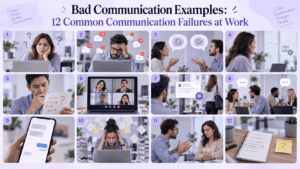
Bad communication at work is not limited to unclear emails or missed messages.
Communication problems can appear when employees receive incomplete information, use the wrong channel, misunderstand responsibilities, cannot find previous decisions or fail to escalate an issue at the right time.
Some communication failures are obvious. Others look like normal workplace interactions until they cause delays, duplicated work or incorrect decisions.
Below are 12 common examples of bad communication in the workplace, along with explanations of why they happen and how teams can avoid them.
What Is Bad Communication?
Bad communication happens when information is not transferred clearly enough for the recipient to understand what they need to know, decide or do.
The problem may occur at different stages:
sender → message → channel → recipient → interpretation → action
A failure at any point can create miscommunication.
For example:
-
the sender provides incomplete information;
-
the message is ambiguous;
-
the wrong communication channel is used;
-
the recipient misses the message;
-
two people interpret the same statement differently;
-
nobody confirms the resulting action.
This means communication quality depends on more than wording alone.
Bad Communication Examples at a Glance
1. Giving Vague Instructions
One of the simplest examples of bad communication is assigning a task without explaining the expected result.
For example:
Please update the report before Friday.
Several important details are missing:
-
Which sections need to be updated?
-
What information should be added?
-
Which version of the report should be used?
-
Who should approve it?
-
Does “before Friday” mean Thursday evening or Friday morning?
The employee may complete the task correctly according to their interpretation while still producing something different from what the manager expected.
Why it fails
The sender assumes that context already exists.
Better approach
Define:
-
expected result;
-
owner;
-
deadline;
-
required inputs;
-
approval process.
A clearer task might be:
Update sections 2 and 4 of the Q3 report using the latest sales data and send the draft to the finance team by Thursday at 16:00.
2. Sending Information Without Context
Another common example of poor communication is sending correct information without explaining why it matters.
Consider this message:
Customer X changed the delivery date.
The recipient may not know:
-
whether action is required;
-
which project is affected;
-
whether the change is final;
-
who else has been informed.
Why it fails
The message transfers data but not meaning.
Better approach
Use a simple structure:
what changed → why it matters → what happens next
For example:
Customer X moved delivery from September 12 to September 18. This affects the installation schedule. Please update the project calendar and notify the installation team.
3. Using the Wrong Communication Channel
Not every message belongs in the same channel.
An urgent infrastructure incident sent by email may go unnoticed for an hour.
A complex technical decision discussed entirely through short chat messages may become difficult to follow.
A simple status update turned into a 30-minute video meeting wastes time.
Why it fails
The communication channel does not match the task.
Better approach
Good communication is partly about choosing the right medium.
4. Assuming That Silence Means Understanding
A common miscommunication example occurs when someone sends instructions and assumes that no response means everything is clear.
The recipient may actually:
-
misunderstand the request;
-
miss part of the message;
-
be unsure what to do;
-
assume somebody else is responsible.
Why it fails
Information delivery is treated as communication completion.
But:
message sent ≠ message understood
Better approach
Important instructions should have some form of confirmation.
For example:
Can you confirm that you’ll handle the customer response by 15:00?
For complex tasks, the recipient can briefly restate the expected action.
5. Losing Information During a Team Handoff
Communication failures frequently happen when responsibility moves from one team to another.
For example, a sales employee agrees to a custom requirement with a customer.
The project team receives only:
Customer requested a custom configuration.
Missing information may include:
-
what was promised;
-
why it was requested;
-
deadline;
-
technical limitations;
-
commercial conditions.
Why it fails
The original conversation and the operational task exist in different places.
Better approach
Use structured handoffs that contain:
-
decision;
-
context;
-
responsible person;
-
dependencies;
-
deadline.
The receiving team should not have to reconstruct an earlier conversation from fragments.
6. Not Making Responsibility Clear
Consider a group chat message:
We need to send the revised proposal today.
Everyone sees the message.
Nobody knows who is responsible.
At the end of the day, the proposal has not been sent.
This is an example of ineffective communication even though the message itself was understood.
Why it fails
The communication defines the problem but not ownership.
Better approach
Use:
task + owner + deadline
For example:
Alex, please send the revised proposal to the customer by 16:00 today.
7. Working With Different Versions of Information
Another communication failure happens when different teams use different documents, spreadsheets or message threads as the current source of information.
For example:
-
finance uses version 5 of the budget;
-
operations uses version 4;
-
management discusses numbers copied into an earlier email.
Everyone may communicate clearly while still working with conflicting information.
Why it fails
The problem is not message clarity but information synchronization.
Better approach
Define:
-
where the current information lives;
-
who can modify it;
-
how changes are communicated;
-
which version is authoritative.
8. Letting Important Decisions Disappear in Group Chats
Group chats are useful for fast communication, but long conversations can hide important decisions.
A team may exchange dozens of messages and eventually agree:
We’ll launch on Monday instead of Friday.
Two days later, somebody who missed the discussion still works toward the Friday deadline.
Why it fails
A decision exists inside conversation history but was never turned into an explicit record.
Better approach
After an important discussion, summarize:
-
decision;
-
owner;
-
deadline;
-
next step.
For example:
Decision: launch moved to Monday, September 21. Chris will update the customer schedule today.
9. Delaying the Escalation of a Problem
Not all communication failures are caused by unclear messages.
Sometimes employees communicate too late.
For example, an engineer notices that a delivery deadline may be missed but waits until the problem is certain before notifying the project manager.
By that point, there may be no time to adjust the schedule.
Why it fails
Employees may fear escalating uncertain information or assume they should solve the problem first.
Better approach
Teams should distinguish between:
-
confirmed incident;
-
emerging risk;
-
routine issue.
An early message can say:
There is currently a risk that delivery will move by 1–2 days. It is not confirmed yet, but we are investigating.
10. Discussing Everything in Meetings but Documenting Nothing
A team holds a productive meeting and agrees on several actions.
Three days later, nobody remembers exactly:
-
what was decided;
-
who owns each task;
-
which deadline was agreed;
-
whether a decision was final.
Why it fails
Verbal communication is treated as a permanent record.
Better approach
Important meetings should produce a short written outcome:
decision → owner → deadline
The summary does not need to be long.
It only needs to preserve what people need after the meeting ends.
11. Creating Information Silos Between Departments
Communication can work well inside individual teams while failing across the organization.
For example:
Marketing launches a campaign without knowing that the product team has delayed a feature.
Sales promises a delivery date without knowing that operations has a capacity problem.
IT changes a system without informing employees who depend on it.
Why it fails
Each department communicates internally but important information does not cross organizational boundaries.
Better approach
Identify workflows where information must move between teams.
For example:
sales → project team → operations → support
Communication processes should reflect these dependencies.
12. Using Too Many Communication Tools
Employees may receive work information through:
-
email;
-
personal messenger;
-
project-management system;
-
shared documents;
-
separate departmental channels.
More communication tools do not necessarily mean better communication.
An employee may know that an important message exists without knowing where it was sent.
Why it fails
Communication becomes fragmented.
The problem shifts from:
What did they say?
to:
Where did they say it?
Better approach
Organizations should define the purpose of each communication channel.
For example:
-
chat → daily communication;
-
project system → tasks;
-
video → live discussions;
-
email → formal external communication.
The goal is not necessarily to use one tool for everything, but to make communication predictable.
Communication Failure vs Miscommunication vs Bad Communication
These terms overlap, but they are not identical.
A message can therefore be clear in wording and still fail if it is sent through the wrong channel or reaches the wrong person.
Examples of Miscommunication in the Workplace
Miscommunication happens when people receive the same information but interpret it differently.
Example 1
Manager:
Finish this as soon as possible.
Employee interprets this as:
By the end of the week.
Manager means:
Within the next hour.
Example 2
A message says:
We don’t need to change the configuration yet.
One employee interprets “yet” as:
A change will probably be required later.
Another interprets it as:
No change is planned.
Example 3
A manager says:
Let’s revisit this after the release.
One team member schedules the discussion immediately after deployment.
Another assumes it means during the next quarterly review.
In each case, the wording leaves enough room for different interpretations.
What Causes Communication Failures?
Most communication failures fall into four broad categories.
Unclear Information
The message lacks context, detail or precise wording.
Unclear Responsibility
The team understands the problem but does not know who should act.
Wrong Communication Channel
The information is sent through a channel that is too slow, too fragmented or unsuitable for the situation.
Missing Confirmation
The sender assumes that delivery means understanding.
These problems often overlap. A vague message in the wrong channel with no defined owner is especially likely to fail.
How to Prevent Bad Communication
Improving workplace communication does not require making every message longer.
A useful structure is:
context → action → owner → deadline → record
For example:
The customer moved the installation date to September 18. Maria, please update the deployment plan and notify the engineering team by 14:00 today.
The message gives the recipient:
-
context;
-
required action;
-
owner;
-
deadline.
For important decisions, the final step is to preserve the outcome somewhere the team can find later.
How Communication Tools Can Reduce Communication Failures
Technology cannot fix unclear thinking, but communication tools can reduce some structural causes of miscommunication.
Useful capabilities include:
-
persistent personal and group chats;
-
searchable message history;
-
channels or structured communication spaces;
-
file sharing;
-
read status;
-
user and group management;
-
voice and video calls;
-
screen sharing.
The value of these features is easier to see when mapped to specific communication problems.
A useful communication flow can be:
message → discussion → meeting → decision → follow-up
The goal is to preserve context as the conversation moves between different stages.
Where Secumeet Fits

Secumeet combines messaging, file sharing and video communication in one organizational environment.
For example:
-
personal and group chats can preserve discussion history;
-
files can remain attached to the communication context;
-
teams can move from text discussion into a video meeting when an issue becomes too complex for chat;
-
the conversation can continue after the meeting.
This can help reduce fragmentation between separate messaging and meeting tools.
However, software cannot automatically prevent bad communication.
Organizations still need clear rules for:
-
which channels should be used;
-
who owns decisions;
-
when issues should be escalated;
-
where important outcomes should be recorded.
Bad Communication vs Good Communication Examples
Frequently Asked Questions
What is an example of bad communication?
A simple example of bad communication is assigning a task without specifying who is responsible or when it should be completed.
For example:
We need to finish the presentation soon.
A clearer version would identify the owner and deadline.
What are some examples of miscommunication?
Common miscommunication examples include:
-
unclear deadlines;
-
ambiguous instructions;
-
missing context;
-
misunderstood responsibilities;
-
different interpretations of the same wording.
What is an example of poor communication in the workplace?
A manager sending an urgent request through a channel that employees rarely check is an example of poor workplace communication.
The information itself may be correct, but the communication method prevents it from reaching the recipient effectively.
What are examples of ineffective communication?
Examples include:
-
vague instructions;
-
undocumented decisions;
-
unclear task ownership;
-
poor team handoffs;
-
delayed escalation;
-
information silos;
-
fragmented communication channels.
What is the difference between miscommunication and communication failure?
Miscommunication occurs when people interpret a message differently.
A communication failure is broader: the intended information or action does not successfully reach its goal.
For example, an urgent message that nobody sees is a communication failure even if the wording itself is perfectly clear.
How can teams reduce miscommunication?
Teams can reduce miscommunication by making context, required action, ownership and deadlines explicit and by confirming important instructions when misunderstanding would create risk.
Conclusion
Bad communication is not limited to saying the wrong thing.
Communication can fail because information is incomplete, arrives through the wrong channel, lacks ownership, disappears in a long conversation or is interpreted differently by different people.
Most workplace communication problems can be traced to a small set of missing elements:
context → clarity → ownership → confirmation → record
Recognizing these patterns helps teams identify communication failures before they turn into missed deadlines, duplicated work or incorrect decisions.
The goal is not to communicate more.
It is to make sure the right information reaches the right person, through the right channel, with enough context to know what should happen next.
Author
Helga Afon is a technology writer specializing in video conferencing, collaboration software, and workplace communication. She writes articles and reviews that help readers better understand enterprise communication tools and industry trends.