
Financial organizations use messaging systems for two very different purposes.
The first is transaction messaging: payment instructions, settlement information, account statements and other structured financial data exchanged between banks, payment networks and market infrastructures.
The second is human communication: conversations between employees, departments, fraud teams, compliance specialists, executives and external partners.
These two messaging layers solve different problems.
Systems built around SWIFT, ISO 20022 and payment messaging infrastructure process structured financial data. Secure messaging software for financial services addresses a different layer: how people inside and around a financial organization communicate through chats, files, calls and meetings.
This distinction matters because employee communication software does not replace SWIFT or a payment messaging hub. Likewise, financial transaction messaging software does not replace the tools employees use to coordinate decisions, investigate incidents or communicate across branches.
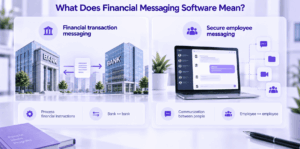
What Does Financial Messaging Software Mean?
The phrase financial messaging software can refer to two different categories.
Transaction messaging
Transaction messaging systems process structured financial data such as:
-
payment instructions;
-
settlement messages;
-
account statements;
-
securities messages;
-
treasury information;
-
confirmations.
These systems are part of financial infrastructure.
Employee messaging
Secure employee messaging serves a different purpose.
Employees may need to:
-
discuss a payment exception;
-
escalate suspected fraud;
-
share an internal report;
-
contact compliance;
-
coordinate between branches;
-
start a video meeting;
-
communicate during an incident.
This article focuses on that second category.
What Is Secure Messaging Software for Financial Services?
Secure messaging software for financial services is a communication platform designed for employees and teams working in banks, insurance companies, investment firms, fintech companies and other financial organizations.
Typical capabilities include:
-
personal chats;
-
group conversations;
-
file exchange;
-
message history;
-
voice calls;
-
video meetings;
-
centralized user management;
-
administrator controls.
The main difference between a general workplace messenger and an enterprise communication platform for financial services is not simply encryption.
Financial organizations usually need to evaluate the complete communication lifecycle:
identity → approved channel → conversation → file or message → retention → review
A message can be encrypted during transmission and still create risk if the wrong employee can access it, if an account cannot be disabled quickly, or if communication records cannot be managed according to internal policy.
7 Requirements for Financial Services Messaging Software
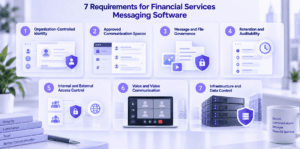
1. Organization-Controlled Identity
Business communication should be tied to organizational accounts rather than personal identities.
Important capabilities may include:
-
centralized account management;
-
corporate directories;
-
role-based permissions;
-
account deactivation;
-
authentication policies;
-
administrator roles.
The goal is to make communication access follow the employee lifecycle.
If someone changes department, changes responsibilities or leaves the organization, access should change accordingly.
2. Approved Communication Spaces
Financial organizations may need to define where business discussions are allowed to take place.
Typical spaces may include:
-
private employee chats;
-
department groups;
-
compliance rooms;
-
fraud investigation channels;
-
executive groups;
-
incident-response spaces.
The organization should be able to control membership rather than relying entirely on users creating unmanaged communication spaces.
3. Message and File Governance
Messages are only part of the communication record.
Employees may also exchange:
-
internal reports;
-
spreadsheets;
-
screenshots;
-
customer-related documents;
-
transaction details;
-
investigation materials.
File handling therefore belongs in the same governance review as message storage.
Organizations should understand:
-
where files are stored;
-
who can access them;
-
whether they remain available after an employee leaves;
-
whether deletion can conflict with retention requirements.
4. Retention and Auditability
Financial organizations may need to preserve communication records according to internal or regulatory requirements.
Relevant capabilities can include:
-
configurable retention policies;
-
searchable message history;
-
audit logs;
-
administrator access controls;
-
backup and recovery processes.
Auditability does not automatically make a platform compliant with every regulation.
It gives the organization the information and controls needed to implement its own governance policies.
5. Internal and External Access Control
Financial communication does not always remain inside the organization.
Employees may need to communicate with:
-
customers;
-
auditors;
-
advisers;
-
contractors;
-
technology partners.
External access creates additional questions:
-
How are guests identified?
-
Can their permissions be limited?
-
Can access expire automatically?
-
Can external participants see previous history?
-
Can administrators distinguish internal and external users?
A platform should make those boundaries explicit.
6. Voice and Video Communication
Text is not sufficient for every financial workflow.
A conversation may begin in chat and then require immediate escalation to a voice or video meeting.
For example:
message → investigation → call → decision → follow-up
Using one unified communication environment for messaging and meetings can reduce the need to move sensitive context between unrelated services.
7. Infrastructure and Data Control
Organizations should understand where the communication platform operates.
Important questions include:
-
Where are messages stored?
-
Where are files stored?
-
Where are recordings stored?
-
Who operates the servers?
-
Which external services are required?
-
Who controls software updates?
This becomes especially important for organizations with specific infrastructure, residency or business continuity requirements.
Financial Communication Workflows
Banking Operations
Operations teams may use secure messaging to coordinate:
-
payment exceptions;
-
processing errors;
-
settlement issues;
-
customer escalations;
-
branch requests.
Persistent chat keeps the context available, while voice or video can be used when the issue requires faster discussion.
Fraud and Security Teams
Fraud investigations often involve several groups at once:
-
fraud analysts;
-
security;
-
IT;
-
compliance;
-
management.
A communication platform can provide a dedicated space for incident coordination instead of spreading discussion across email, consumer messengers and separate meeting applications.
Compliance Teams
Compliance employees may need controlled communication spaces for:
-
internal reviews;
-
investigations;
-
policy discussions;
The platform should fit the organization’s requirements for identity, access, retention and communication history.
Branch Networks
Banks with multiple offices may need to connect:
-
local branches;
-
regional teams;
-
headquarters;
-
IT support;
-
central operations.
Centralized account and group management become more important as the number of locations and employees grows.
Executive Communication
Senior management may discuss information such as:
-
financial results;
-
acquisitions;
-
risk events;
-
strategic decisions.
These conversations may require tighter membership and access boundaries than ordinary team communication.
Messaging Governance in Financial Organizations
For financial organizations, communication governance should cover the entire message lifecycle.
A useful model is:
user identity → approved channel → conversation → attachment → retention → investigation
This creates several practical questions:
-
Are employees allowed to discuss business matters outside approved communication tools?
-
Can the organization preserve conversations when an employee leaves?
-
Can administrators distinguish internal and external participants?
-
Can access be revoked centrally?
-
Can message deletion conflict with retention policies?
-
Can files, chats and meeting artifacts follow the same governance rules?
This is one of the main differences between a consumer messaging app and an enterprise communication environment.
Business Continuity and Incident Communication
Financial organizations should also consider what happens when normal communication channels are affected.
Possible scenarios include:
-
corporate email is unavailable;
-
cloud connectivity is disrupted;
-
an identity service is inaccessible;
-
an employee account is compromised;
-
internal systems are under investigation.
Questions to evaluate include:
-
Can communication continue if Internet access is restricted?
-
Does the platform depend on external authentication services?
-
Can compromised accounts be disabled quickly?
-
Can dedicated incident groups be created?
-
Can employees move from chat to voice or video without switching platforms?
The right architecture depends on the organization’s threat model and continuity requirements.
Cloud vs Customer-Operated Messaging
Financial organizations can choose between different deployment models.
Neither model is automatically more secure.
A poorly maintained private deployment can create more risk than a properly operated cloud service.
The main advantage of customer-operated infrastructure is control, not automatic security.
Financial Messaging Software vs Secure Employee Messaging
The two systems may coexist inside the same institution.
Transaction messaging handles structured financial data.
Employee messaging handles communication between people who operate around those systems.
Where Secumeet Fits
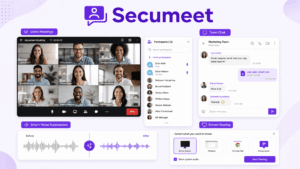
Secumeet addresses the human communication layer.
It combines persistent messaging with voice, video and collaboration capabilities inside an organizational communication environment.
For a financial institution, the relevant workflow may look like:
employee identity → private/group chat → file exchange → video discussion → continued chat
Secumeet is not positioned as a replacement for SWIFT, ISO 20022 infrastructure or payment-message processing systems.
Its role is communication between the people who work around those financial systems.
How Secumeet Maps to Financial Communication Requirements
This makes Secumeet relevant when a financial organization wants messaging and live communication to remain part of the same managed communication environment.
Where Secumeet Can Be Relevant
Internal Banking Communication
Employees communicate through managed personal and group conversations instead of relying on personal messaging accounts.
Distributed Financial Organizations
Branches and departments can communicate through the same organizational environment.
Incident Coordination
Teams can begin with text communication and move into a live meeting when an operational or security issue requires faster coordination.
Customer-Controlled Communication Infrastructure
Organizations that want more control over where their communication platform runs can evaluate a customer-operated deployment rather than relying entirely on a shared public communication cloud.
How to Evaluate Secure Messaging Software for Financial Services
Before choosing a platform, evaluate five areas.
Identity
-
Are accounts controlled by the organization?
-
Can accounts be provisioned and disabled centrally?
-
Can the platform integrate with corporate identity systems?
-
Can administrators assign roles and permissions?
Communication
-
Does it support personal and group chats?
-
Can teams create controlled communication spaces?
-
Can users move from chat to voice or video?
-
Can external participants be separated from internal users?
Data
-
Where are messages stored?
-
Where are files stored?
-
Where are recordings stored?
-
Can retention policies be applied?
-
Can communication records be searched or reviewed?
Administration
-
What administrator roles exist?
-
Can access be limited by group or department?
-
Can user access be revoked centrally?
-
Are administrative actions logged?
Deployment and Continuity
-
Is the service SaaS only?
-
Can it operate on customer-controlled infrastructure?
-
Does core communication depend on external cloud services?
-
What happens during an Internet or identity-provider outage?
-
How are updates and backups handled?
Financial Services Messaging Checklist
Before procurement, verify:
-
centralized identities;
-
user provisioning and deprovisioning;
-
private chats;
-
managed group conversations;
-
file exchange;
-
searchable message history;
-
access controls;
-
guest and external-user controls;
-
audit capabilities;
-
retention options;
-
voice and video;
-
directory integration;
-
deployment model;
-
storage location;
-
backup architecture;
-
update process;
-
external service dependencies.
The exact requirements should come from the organization’s security, compliance and operational policies.
Frequently Asked Questions
What is financial messaging software?
The term can describe two different categories.
In banking infrastructure, financial messaging software usually refers to systems used to exchange, validate, transform or route structured financial messages such as SWIFT or ISO 20022 messages.
It can also refer more broadly to communication software used by employees inside financial organizations.
This article focuses on employee and team communication.
What is the difference between financial transaction messaging and employee messaging?
Financial transaction messaging processes structured payment and financial data.
Employee messaging supports communication between people through chats, files, voice and video.
The two systems solve different problems and may operate alongside each other.
What messaging software do banks use for internal communication?
Banks may use enterprise communication platforms that support managed organizational accounts, group chats, file sharing, administration and, in some cases, voice and video meetings.
The appropriate platform depends on security, governance, deployment and integration requirements.
Can financial institutions host messaging software on their own infrastructure?
Yes, if the selected platform supports customer-operated deployment.
This gives the organization more control over infrastructure, data location and update schedules, but also creates responsibility for maintenance, monitoring and availability.
What should banks evaluate when choosing secure messaging software?
Key areas include:
-
identity management;
-
access control;
-
message and file governance;
-
retention;
-
auditability;
-
external access;
-
infrastructure model;
-
business continuity.
Can secure messaging software support both chat and video meetings?
Yes.
Some enterprise communication platforms combine persistent messaging with voice and video meetings, allowing teams to move from text discussion into live communication without changing tools.
Conclusion
The phrase financial messaging software covers two distinct technology layers.
One handles structured financial data:
payment instruction → financial network → processing → settlement
The other handles communication between people:
employee → team → discussion → decision → record
Financial institutions may need both, but they should not be evaluated as the same type of software.
For employee communication, the key question is not simply whether a platform encrypts messages.
A better evaluation model is:
Who controls identity → where communication happens → who can access it → where data is stored → what is retained → who operates the infrastructure
Secumeet fits this second layer by combining messaging, file exchange and live communication for organizational teams rather than processing financial transaction messages.
For banks, insurers, fintech companies and other financial organizations, this distinction provides a clearer basis for selecting secure messaging software that fits operational, security and governance requirements.
Author
Helga Afon is a technology writer specializing in video conferencing, collaboration software, and workplace communication. She writes articles and reviews that help readers better understand enterprise communication tools and industry trends.