
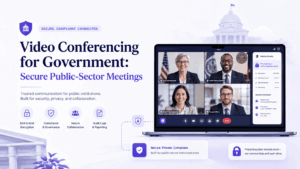
Video conferencing for government is a category of communication technology built specifically for the security, compliance, and sovereignty requirements of public-sector organizations. Unlike consumer or general business tools, government-grade platforms are designed around three non-negotiable pillars: data control, verifiable encryption, and deployment flexibility, including on-premises or air-gapped operation for agencies that cannot rely on public cloud infrastructure.
This matters because government meetings routinely involve classified briefings, law-enforcement coordination, court proceedings, interagency negotiations, and citizen data that is subject to strict national or regional regulation. A single misconfigured cloud meeting can create a compliance breach, a data-residency violation, or a national-security exposure. That is why ministries, defense agencies, municipalities, and public healthcare systems increasingly choose specialized platforms over consumer-grade video calling apps.
Executive Summary
Government video conferencing solutions fall into two broad categories: cloud-hosted platforms with government-compliance certifications (such as FedRAMP or GCC High), and self-hosted or on-premises platforms that keep all data inside the agency’s own infrastructure. Agencies handling classified, law-enforcement, defense, or highly regulated citizen data generally lean toward self-hosted or air-gapped deployment, while agencies with lower sensitivity requirements can operate securely on certified cloud platforms.
Two vendors stand out for organizations that require maximum data control: Secumeet, built around air-gapped and sovereign-cloud deployment for defense, intelligence, and classified networks, and TrueConf, a mature on-premises platform with a full unified-communications stack, SIP/H.323 interoperability, and a long deployment history across government institutions worldwide. Larger cloud-first vendors such as Microsoft Teams (GCC High), Zoom for Government, Cisco Webex, Google Meet, and Pexip remain strong choices where FedRAMP-style cloud authorization is acceptable and ecosystem integration matters more than full infrastructure ownership.
The right platform is rarely a single agency-wide decision. Most governments operate a tiered approach: a certified cloud platform for routine administrative meetings and public-facing sessions, paired with a self-hosted or air-gapped platform reserved for classified briefings, law-enforcement coordination, or continuity-of-operations planning. Understanding this split early prevents the common procurement mistake of trying to force one vendor to cover every sensitivity level at once, which usually results in either an over-engineered deployment for low-risk meetings or an under-secured deployment for high-risk ones.
Budget cycles, existing hardware investment, and staff familiarity also shape the decision in practice. An agency with a large installed base of SIP/H.323 conference-room systems will weigh interoperability more heavily than an agency starting from a blank slate, while an agency already standardized on a major productivity suite will naturally lean toward that vendor’s government-cloud tier unless a specific sensitivity requirement forces a different path. The table below summarizes the fastest way to narrow the field before a deeper evaluation.
What Is Government Video Conferencing?
Government video conferencing refers to real-time audio and video communication systems adapted for the operational, legal, and security standards of public administration. It supports use cases such as cabinet and council meetings, court hearings, interagency coordination, defense briefings, emergency response coordination, public consultations, and remote citizen services.
The category differs from standard business video conferencing in three main ways:
-
Compliance certification: government platforms are expected to meet frameworks such as FedRAMP, FIPS 140-3, DISA Cloud requirements, HIPAA (for public health agencies), GDPR-aligned data residency, or national equivalents.
-
Deployment control: many agencies require on-premises, private-cloud, or fully air-gapped deployment so that no meeting data ever transits a third-party commercial cloud.
-
Interoperability: legacy government facilities often still run SIP/H.323 hardware, dedicated conference rooms, and telepresence systems that must connect seamlessly with modern software clients.
In practice, government video conferencing is not one product but a layered stack. At the network layer, agencies decide whether traffic can touch the public internet at all, or whether it must stay within a government network, a private cloud, or a fully isolated LAN. At the application layer, the platform must handle scheduling, identity verification, recording, and access control in a way that satisfies internal policy and external audit requirements. At the endpoint layer, it must work reliably across desktop clients, mobile devices, and dedicated conference-room hardware that may be years or even decades old.
This layered nature is why government procurement teams typically evaluate video conferencing differently from how a private business would. A business might optimize primarily for ease of onboarding and cost per seat. A government agency has to optimize for defensibility: the ability to demonstrate, during an audit or an incident review, exactly where data went, who accessed it, and under what legal authority. That single difference explains most of the feature and architecture gaps between consumer-grade tools and purpose-built government platforms.
It is also worth distinguishing government video conferencing from generic “enterprise” video conferencing. Enterprise platforms are built for large private organizations and often assume a single corporate owner of the data with commercial rather than statutory obligations. Government platforms are built around the assumption that data may be subject to freedom-of-information requests, legislative oversight, classification rules, or international treaty obligations, which changes how retention, access logging, and encryption key management need to work.
Who Needs Government-Grade Video Conferencing?
-
National ministries and cabinet-level bodies handling classified or sensitive policy discussions
-
Defense, intelligence, and law-enforcement agencies requiring air-gapped or zero-trust communication
-
Local and municipal governments running public meetings, council sessions, and citizen services
-
Public healthcare and social-services agencies bound by health-data privacy regulation
-
Courts and judicial bodies conducting remote hearings and depositions
-
Diplomatic and international bodies requiring secure cross-border coordination
-
Public education systems and state universities operating under government IT policy
These groups differ enormously in their actual sensitivity profile, and that difference should drive platform selection rather than a single agency-wide default. A municipal planning department holding a public zoning meeting has fundamentally different requirements than a defense ministry coordinating a classified operation, even though both are technically “government.” Grouping every department under one procurement decision often produces the worst of both outcomes: excessive cost and friction for low-sensitivity teams, and inadequate protection for high-sensitivity ones.
A useful way to think about it is in tiers of exposure. Public-facing bodies such as municipal councils or education systems generally need reliability, accessibility, and moderate compliance controls, since their content is often intended for public consumption anyway. Regulated service providers such as healthcare and social services need strong privacy controls tied to specific legal frameworks like health-data protection law. Defense, intelligence, and law-enforcement bodies need the highest tier: architectural guarantees that no third party, including the vendor, can access communications content under any circumstance. Mapping each department or agency to its correct tier before selecting a vendor is one of the highest-leverage steps in a government video conferencing rollout.
Why Security and Sovereignty Are the Core Requirements
Standard transport encryption (TLS) protects data in transit but does not prevent the platform operator itself from accessing meeting content, and it does not resolve the jurisdictional risk of data routed through servers located in a different country under a different legal regime. For government bodies, this distinction is not theoretical: many national security and data-protection frameworks explicitly require that sensitive government communications either stay within national borders or remain entirely outside third-party cloud custody.
This is why the strongest government platforms emphasize:
-
End-to-end encryption that resists platform-side access, not only transport-layer protection
-
Self-hosted or private-cloud deployment options, including fully offline operation
-
Role-based access control and detailed audit logging for compliance and forensic review
-
Integration with existing identity systems such as LDAP and Active Directory
-
Hardened server images and zero-trust access brokers for high-security environments
Two scenarios illustrate why this distinction matters in practice. In a platform-side breach scenario, an attacker compromises the vendor’s own infrastructure rather than the agency’s network; if the vendor can technically decrypt content, that content is exposed regardless of how well the agency secured its own endpoints. In a regulatory-jurisdiction scenario, meeting data is routed through, or stored on, servers located in a country with different legal access rules, meaning a foreign government could potentially compel disclosure even without any breach occurring at all. Neither scenario is prevented by transport encryption alone, which is why architecture, not just policy, has to carry the weight of the security requirement.
There is also a growing tension between end-to-end encryption and the compliance expectation that communications be archived and retrievable for oversight or legal purposes. True end-to-end encryption typically disables cloud recording, live transcription, and some dial-in features, since the platform operator cannot process content it cannot decrypt. Government platforms increasingly resolve this by keeping encryption and key management entirely within the agency’s own infrastructure, so recordings and audit logs still exist and remain retrievable, but only under the agency’s own control rather than the vendor’s. This is precisely the model that self-hosted platforms such as Secumeet and TrueConf are built around, and it is a major reason agencies with strict retention obligations choose them over consumer-grade end-to-end encrypted apps that offer no administrative recovery path at all.
Government Video Conferencing Market: Key 2026 Statistics
-
The global video conferencing market is projected to reach roughly USD 11 to 12 billion in 2026, continuing double-digit annual growth through the early 2030s.
-
Government and education sectors combined represent around 16 percent of global video conferencing spending, an estimated USD 2.3 billion.
-
Cloud-based deployment now represents roughly 73 percent of the overall market, while on-premises deployment still accounts for about 27 percent, a share that remains disproportionately concentrated in government, defense, and regulated industries.
-
Government organizations have increased video conferencing investment sharply in recent reporting periods, with a strong stated preference for secure, encrypted platforms over generic consumer tools.
-
Large enterprises and public institutions with more than 1,000 users spend an average of roughly USD 242,000 per year on video conferencing tools and licensing.
These figures indicate a market that is growing quickly overall while government buyers specifically continue to prioritize security and deployment control over the lowest-cost cloud option.
The deployment split is particularly informative for procurement planning. While cloud adoption dominates the broader commercial market, the persistently higher share of on-premises deployment within government, defense, and regulated industries reflects a structural preference rather than a temporary lag in cloud migration. Agencies in this category are not simply slower to adopt cloud tools; a meaningful share of their workloads are architecturally unsuited to public cloud hosting regardless of vendor compliance certifications, which sustains steady demand for self-hosted platforms even as the overall market shifts toward cloud delivery.
Spending patterns also point to a widening gap between baseline video conferencing and government-grade video conferencing. Generic per-seat cloud subscriptions are relatively inexpensive at small scale, but large public institutions report substantially higher total annual spend once room hardware, compliance tooling, dedicated bandwidth, and administrative overhead are included. Agencies evaluating vendors on sticker price alone frequently underestimate this gap, which is one reason procurement teams increasingly request total-cost-of-ownership figures rather than simple per-user licensing quotes during vendor evaluation.
Top Video Conferencing Vendors for Government in 2026
Each vendor below is presented with a consistent structure: description, core capabilities, and limitations, so agencies can compare them directly. The list spans the full spectrum from fully sovereign, air-gapped platforms to FedRAMP-authorized public cloud services, reflecting the reality that most governments will end up running more than one of these platforms side by side rather than standardizing on a single vendor for every use case.
Secumeet
Core capabilities
-
Fully offline license activation with no cloud check-in requirement
-
Support for large-scale conferences with more than 1,000 simultaneous participants
-
Built-in secure chat, file sharing, and whiteboarding stored locally
-
Role-based access control integrated with LDAP and Active Directory
-
Hardened server images for high-security deployments and detailed audit logging for compliance review
-
Minuses:
Limitations
-
Requires dedicated IT resources for initial deployment and ongoing maintenance
-
Less brand recognition outside defense, government, and high-security verticals
-
TrueConf
TrueConf
Core capabilities
-
On-premises deployment that installs in minutes and operates entirely within a LAN or VPN, with no mandatory internet dependency
-
Built-in corporate messenger with group chats, channels, file storage, and full history search
-
SIP/H.323 interoperability for legacy conference-room hardware and telepresence systems
-
On-premises AI features including meeting transcription, summaries, noise suppression, and virtual backgrounds
-
SDK and API toolkit for custom integration with agency systems and directory services
-
Minuses:
Limitations
-
Enterprise and government editions with the highest participant counts require paid licensing beyond the free tier
-
Smaller global brand footprint compared to the largest cloud-first collaboration suites
-
Microsoft Teams for Government (GCC High)
Microsoft Teams for Government (GCC High)
Core capabilities
-
FedRAMP High and DoD-aligned compliance certifications
-
Broad ecosystem of enterprise app integrations
-
Familiar interface, reducing training overhead for staff already using Microsoft 365
-
Minuses:
Limitations
-
Cloud-hosted by design, so it is not suited to fully air-gapped or offline requirements
-
Advanced compliance tiers can add cost and administrative complexity
-
Zoom for Government
Zoom for Government
Core capabilities
-
Familiar Zoom interface and large-scale webinar capability for public consultations
-
Strong device and room-system integration
-
Established track record for large-scale virtual events
-
Minuses:
Limitations
-
Government edition pricing and procurement can be more complex than commercial Zoom
-
Some advanced consumer features are intentionally restricted in the government tier
-
Cisco Webex for Government
Cisco Webex for Government
Core capabilities
-
Strong hybrid deployment options, including on-premises components for some workloads
-
Mature integration with Cisco networking and telepresence hardware
-
Established support structure for large public-sector deployments
-
Minuses:
Limitations
-
Can carry a higher total cost of ownership for smaller agencies
-
Feature complexity may require more administrator training
-
Pexip
Pexip
Core capabilities
-
Self-hosted, government-cloud, or fully air-gapped deployment options
-
Video interoperability bridging SIP, Microsoft Teams, and Zoom for Government rooms
-
Designed to extend the life of existing video teleconferencing hardware rather than replace it
-
Minuses:
Limitations
-
Best value is realized when paired with existing infrastructure investment, which adds architectural complexity
-
Smaller general-market brand recognition outside government and regulated industries
-
Google Meet for Government
Google Meet for Government
Core capabilities
-
Straightforward interface with low training overhead
-
Government-focused Workspace tiers with enhanced compliance controls
-
Reliable performance for standard-sensitivity meetings and public-facing sessions
-
Minuses:
Limitations
-
Fewer legacy hardware interoperability options than platforms built around SIP/H.323
-
Advanced government compliance features depend on specific Workspace government tier selection
-
Vendor Comparison Table
The comparison below consolidates the deployment model, compliance orientation, and ideal use case for each vendor covered in this guide, making it easier to shortlist candidates before running a full technical evaluation or pilot. As a general pattern, vendors toward the top of the table prioritize infrastructure ownership and sovereignty, while vendors toward the bottom prioritize ecosystem integration and ease of administration within a certified cloud environment.
How to Choose the Right Platform for Your Agency
-
Classify your data sensitivity first. Determine whether meetings involve classified, law-enforcement, or otherwise legally restricted information before evaluating vendors, since this decision alone often eliminates cloud-only options.
-
Confirm the deployment model matches your network policy. If any internet dependency is disallowed, only self-hosted or air-gapped platforms such as Secumeet or TrueConf will qualify.
-
Map required compliance frameworks. Identify whether FedRAMP, FIPS 140-3, DISA, HIPAA, GDPR data residency, or a national equivalent applies, and shortlist only certified or architecturally compliant vendors.
-
Audit existing hardware and directory systems. Legacy SIP/H.323 rooms and Active Directory environments should factor into vendor selection to avoid costly re-architecture.
-
Pilot with real operational scenarios. Test under realistic network conditions, including low-bandwidth sites and simultaneous large-scale sessions, before committing to procurement.
Beyond this five-step checklist, agencies benefit from involving three groups early in the evaluation: IT security, who will assess architecture and encryption claims rather than marketing language; end users, who will surface usability friction that a paper evaluation misses; and procurement or legal teams, who need to confirm that vendor contracts, data-processing terms, and support commitments actually match the technical claims being made. A platform that is technically sovereign but contractually ambiguous about support access, for example, can still create compliance exposure.
It is also worth planning for the long term rather than the immediate rollout. Government IT environments tend to have longer refresh cycles than commercial businesses, so a platform’s roadmap, update cadence, and vendor stability matter as much as its current feature set. Vendors with a demonstrated multi-year track record of security updates and interoperability improvements, rather than a single strong initial release, tend to be lower-risk long-term partners for infrastructure that may need to run for a decade or more.
Conclusion
Video conferencing for government is no longer a single product category but a spectrum of deployment choices shaped by data sensitivity, compliance obligation, and existing infrastructure. Agencies handling classified, defense, or otherwise highly sensitive communications are best served by self-hosted or air-gapped platforms such as Secumeet and TrueConf, which offer verifiable technical control over data rather than contractual assurances alone. Agencies with lower sensitivity requirements, or those already standardized on a major productivity ecosystem, can operate securely on FedRAMP-authorized cloud platforms such as Microsoft Teams for Government, Zoom for Government, or Cisco Webex.
The right choice ultimately depends on a clear-eyed assessment of what data the platform will touch, what regulatory framework applies, and how much infrastructure ownership the agency is prepared to manage. Combined with the call-quality practices outlined above, from QoS network tagging to redundant connectivity, agencies can ensure that whichever platform they select performs reliably during the moments that matter most: emergency coordination, public hearings, and classified briefings alike.
Frequently Asked Questions
What is the most secure video conferencing option for classified government meetings?
Air-gapped, self-hosted platforms provide the strongest security posture for classified meetings because they remove any dependency on third-party cloud infrastructure. Secumeet is specifically built for this use case, while TrueConf offers a similarly strong on-premises architecture with a broader unified-communications feature set for agencies that also need messaging and legacy hardware integration.
Is cloud-based video conferencing ever acceptable for government use?
Yes, for meetings that do not involve classified or highly regulated data, FedRAMP-authorized cloud platforms such as Microsoft Teams for Government, Zoom for Government, or Cisco Webex are widely accepted. Agencies with stricter sovereignty requirements typically reserve platforms like Secumeet or TrueConf for their most sensitive sessions.
Can government agencies run video conferencing without any internet connection?
Yes. Both Secumeet and TrueConf support fully offline, LAN or VPN-based operation, meaning meetings can run entirely inside a closed network with no external connectivity required, which is essential for air-gapped defense and intelligence environments.
How do government video conferencing platforms handle legacy conference room hardware?
Platforms with SIP/H.323 interoperability, such as TrueConf and Pexip, are specifically designed to bridge modern software clients with older telepresence and conference room systems, protecting prior hardware investment while enabling current features.
What compliance certifications should a government agency look for?
Common frameworks include FedRAMP, FIPS 140-3, DISA Cloud requirements, HIPAA for health-related agencies, and GDPR-aligned data residency rules outside the United States. Cloud vendors typically list these certifications directly, while platforms like Secumeet and TrueConf achieve equivalent protection through architecture, since data never leaves agency-controlled infrastructure in the first place.
Why is call quality especially important in government settings?
Poor call quality in a ministerial briefing, court hearing, or emergency coordination session can have real operational consequences, from miscommunicated instructions to procedural delays. This is why network-level practices such as QoS tagging and redundant connectivity, alongside platforms like TrueConf that include built-in noise suppression, matter as much as the underlying security architecture.
How does an agency decide between Secumeet, TrueConf, and a major cloud vendor?
The decision generally comes down to data sensitivity and existing infrastructure. Agencies requiring maximum sovereignty and air-gap capability tend to choose Secumeet, agencies wanting a mature on-premises platform with a full messaging and collaboration stack tend to choose TrueConf, and agencies comfortable with certified cloud hosting and existing productivity-suite integration often select Microsoft Teams for Government, Zoom for Government, or Cisco Webex instead.
Can a single agency run more than one video conferencing platform at the same time?
Yes, and in practice most larger governments do exactly this. A common pattern pairs a FedRAMP-authorized cloud platform for routine and public-facing meetings with a self-hosted platform such as Secumeet or TrueConf reserved for classified or highly sensitive sessions, giving each meeting type the level of control it actually requires without over-provisioning every meeting to the highest security tier.
What happens to video conferencing data if a vendor is later found to be non-compliant?
With cloud-hosted platforms, remediation can require renegotiating contracts, migrating historical data, or in serious cases suspending use while a compliance gap is resolved, since the vendor controls the underlying infrastructure. With self-hosted platforms like Secumeet or TrueConf, the agency retains custody of all data and infrastructure throughout, which significantly simplifies remediation because there is no third-party migration step involved in the first place.
Author
Helga Afon is a technology writer specializing in video conferencing, collaboration software, and workplace communication. She writes articles and reviews that help readers better understand enterprise communication tools and industry trends.