
A secure communication platform for enterprises should protect more than messages.
Employees exchange confidential information through chat, video meetings, files, screen sharing, voice calls, and external collaboration. Enterprise security therefore has to cover the entire communication lifecycle:
identity → access → content → storage → administration → infrastructure
This changes how platforms should be compared. Encryption remains important, but enterprises also need account lifecycle management, guest controls, retention, centralized policies, auditability, and an appropriate deployment model.
Quick Summary
-
Secumeet is a strong fit for organizations that want messaging, meetings, and collaboration inside a private communication environment they control.
-
TrueConf Server suits enterprises that need self-hosted messaging and video integrated with private networks, room systems, SIP/H.323, and existing corporate infrastructure.
-
Wire focuses strongly on end-to-end encrypted enterprise communication.
-
Element is relevant for federation, open standards, and data sovereignty.
-
Mattermost fits sovereign technical and operational collaboration.
-
NetSfere provides centrally governed enterprise communication as a managed service.
-
Pexip is particularly relevant when secure video must interoperate with existing conference rooms and video infrastructure.
-
The most useful security questions are not only whether communication is encrypted, but what is protected, who controls access, where data remains, and who operates the infrastructure.
A secure messenger protects conversations. A secure enterprise communication platform also governs the environment around them.
Best Secure Communication Platforms for Enterprises at a Glance
This is not a ranking. Each platform is strongest under a different enterprise communication model.
1. Secumeet
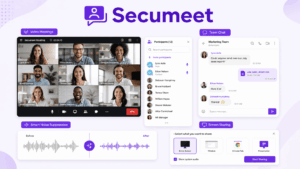
Best for: organizations that want messaging, meetings, and collaboration inside a private communication environment
Secumeet is most relevant when security requirements extend beyond individual conversations to the surrounding communication environment.
A typical enterprise workflow can move from chat to video, file exchange, screen sharing, and back to persistent messaging. If these functions are spread across several providers, the organization also inherits several identity systems, storage locations, administrative models, and data boundaries.
Secumeet brings these communication modes into one controlled environment.
Relevant requirements include:
-
private business messaging;
-
internal video meetings;
-
file collaboration;
-
organization-managed accounts;
-
centralized administration;
-
customer-controlled infrastructure;
-
reduced dependence on public communication services.
Its strongest fit is therefore organizations asking:
Where should our communication environment operate, and who should control it?
This can be particularly relevant for regulated industries, government, critical infrastructure, and other organizations with strict infrastructure requirements.
2. TrueConf Server

Best for: enterprises that need secure communication integrated with broader self-hosted communications infrastructure
TrueConf Server addresses a related but more infrastructure-oriented problem.
It is relevant when messaging and video need to fit existing enterprise systems such as:
-
Active Directory or LDAP;
-
private corporate networks;
-
meeting rooms;
-
SIP/H.323 endpoints;
-
IP PBX systems;
-
corporate directories.
Its communication environment includes messaging, group chats, channels, file exchange, video conferencing, and centralized administration.
3. Wire

Best for: enterprises that prioritize end-to-end encrypted communication
Wire is particularly relevant where confidentiality of message, call, video, and file content is the main requirement.
Its enterprise positioning combines end-to-end encrypted communication with organizational administration and deployment options intended for corporate environments.
Typical strengths include:
-
E2EE messaging;
-
protected voice and video;
-
secure file exchange;
-
enterprise administration;
-
deployment flexibility.
Wire is therefore a strong option when the primary question is:
How much access should communication infrastructure have to the content itself?
Organizations should still evaluate how stronger encryption interacts with archiving, integrations, compliance workflows, and other services that may need access to communication data.
4. Element

Best for: organizations that need federation, open standards, and data sovereignty
Element uses the Matrix ecosystem, where independently operated servers can communicate through a shared federated protocol.
This allows organizations to operate their own communication infrastructure without necessarily isolating users from other independently managed environments.
Relevant scenarios include:
-
cross-organization communication;
-
self-hosting;
-
data sovereignty;
-
open standards;
-
federated collaboration.
This model is particularly useful for governments, multinational organizations, consortia, and environments where different parties need independent infrastructure control.
The trade-off is operational complexity. Federation adds additional considerations around administration, metadata, moderation, domain trust, and policy enforcement.
5. Mattermost

Best for: sovereign technical collaboration and operational environments
Mattermost is particularly strong when secure communication is closely connected to technical and operational workflows.
It combines messaging with calls, screen sharing, workflows, and integrations and can operate in customer-controlled environments.
Typical use cases include:
-
DevOps;
-
incident response;
-
defense;
-
regulated technical teams;
-
critical operations.
Mattermost is especially relevant when collaboration needs to remain close to internally operated technical systems instead of being separated into a conventional public SaaS workspace.
Its focus is more operational than general-purpose unified communications.
6. NetSfere
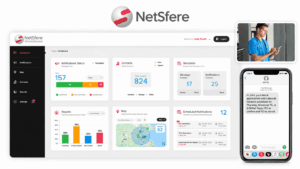
Best for: regulated organizations that prefer centrally governed cloud communication
Some enterprises need corporate governance without operating their own communication servers.
NetSfere represents this managed-service model, combining business messaging, voice, video, and centralized administration.
It is particularly relevant when organizations need:
-
managed employee identities;
-
centralized controls;
-
corporate messaging;
-
voice and video;
-
compliance-oriented governance.
Its role in this comparison is important because infrastructure ownership is not the only path to enterprise control.
7. Pexip

Best for: secure enterprise video communication with complex interoperability requirements
Pexip is more video-focused than the other platforms in this list.
It becomes relevant when enterprise communication involves:
-
conference rooms;
-
SIP/H.323 systems;
-
Microsoft Teams environments;
-
existing video endpoints;
-
private or hybrid conferencing infrastructure.
Large organizations often cannot replace every room or legacy system at once. Pexip therefore addresses the interoperability layer between secure video environments.
Its strength is enterprise video integration rather than persistent business messaging.
What Is a Secure Communication Platform?
A secure communication platform is an enterprise environment for business communication that combines communication tools with organizational controls.
Depending on the platform, it may include:
-
direct and group messaging;
-
channels;
-
voice;
-
video meetings;
-
file sharing;
-
screen sharing;
-
external collaboration.
What distinguishes it from a consumer messenger is the management layer around those tools.
Enterprises may need to control:
-
employee identities;
-
group membership;
-
guest access;
-
stored communication;
-
retention;
-
administrative privileges;
-
integrations;
-
deployment.
That makes communication security an organizational problem as much as a cryptographic one.
Secure Messenger vs Secure Communication Platform
The difference becomes more important as the number of employees, devices, external users, files, and communication channels grows.
The Six Layers of Enterprise Communication Security
A useful evaluation framework is to separate six control layers.
1. Identity
The platform should establish who a user is and how their account is managed.
Relevant capabilities include:
-
SSO;
-
MFA;
-
LDAP or Active Directory;
-
automated provisioning;
-
account recovery;
-
session management;
-
offboarding.
2. Access
Authentication answers who the user is. Authorization determines what they may access.
Enterprises may need separate policies for:
-
groups;
-
channels;
-
meetings;
-
files;
-
guests;
-
contractors;
-
external organizations;
-
administrators.
3. Content
Determine how each communication type is protected:
-
messages;
-
voice;
-
video;
-
files;
-
screen sharing;
-
recordings.
Different content types may use different encryption and processing models.
4. Storage
Communication often remains after the live interaction ends.
Evaluate where the platform stores:
-
message history;
-
files;
-
recordings;
-
transcripts;
-
AI summaries;
-
relevant metadata.
Then determine who can access those assets and how long they remain.
5. Administration
Enterprise security needs enforceable policies.
Important controls include:
-
administrator roles;
-
centralized settings;
-
audit logs;
-
retention policies;
-
guest management;
-
data-loss prevention;
-
export permissions.
6. Infrastructure
Finally, determine who operates the communication environment and where data flows.
The main deployment models are:
-
vendor cloud;
-
private or sovereign cloud;
-
self-hosted infrastructure;
-
isolated or air-gapped environments.
Where Does Your Trust Boundary End?
Deployment determines which parties remain inside the operational trust model.
Vendor Cloud
The provider operates the platform infrastructure while the enterprise manages users and policies.
This generally reduces operational burden but leaves the service provider responsible for the underlying environment.
Private or Sovereign Cloud
These models can provide stronger requirements around tenancy, region, jurisdiction, or dedicated infrastructure while retaining cloud-style operations.
Self-Hosted
The organization operates the communication platform within its own infrastructure.
This provides greater control over network design, data location, and system configuration, while also transferring operational responsibility to the customer.
Air-Gapped or Isolated
Some environments require communications to operate without public network dependencies.
This offers the narrowest external infrastructure boundary but also places the greatest operational burden on the organization.
Deployment changes who must be trusted, not simply where the server is located.
Three Questions to Ask About Encryption
Instead of asking only whether a platform “uses encryption,” ask three more specific questions.
What Is Encrypted?
Check messages, calls, video, files, recordings, backups, and other stored communication separately.
Where Does Encryption Terminate?
Determine whether content is decrypted at:
-
user endpoints;
-
communication servers;
-
gateways;
-
cloud processing services.
This shows which systems can potentially process communication content.
Who Controls the Keys?
Keys may be controlled by:
-
the provider;
-
the enterprise;
-
communicating endpoints;
-
an external key-management system.
These answers reveal more about the security model than an encryption algorithm name alone.
Security vs Governance
Security and governance solve related but different problems.
Security focuses on preventing unauthorized access.
Governance determines how legitimate access should change over time.
Governance questions include:
-
How long should messages remain?
-
When should guest access expire?
-
Who can export data?
-
Which administrators can change policies?
-
What happens to communication when someone leaves?
-
Which actions must be logged?
Security controls access. Governance controls whether that access remains appropriate.
What Happens When an Employee Leaves?
Offboarding is a useful practical test of an enterprise communication platform.
When an employee leaves, administrators should be able to address:
-
account deactivation;
-
active sessions;
-
device access;
-
group and channel membership;
-
shared files;
-
retained communication history;
-
workspace ownership.
A platform that handles these centrally provides substantially more organizational control than one where work communication remains tied to personal accounts.
What Happens During a Security Incident?
Security requirements become clearer when normal operations fail.
Compromised Account
Can administrators revoke sessions, force reauthentication, reset access, and review recent activity?
Stolen Device
Can communication access be revoked without waiting for physical recovery of the device?
Contractor Departure
Can external access be removed without disrupting internal communication history?
Service Outage
Does the organization accept losing communication until the provider returns, or is local continuity required?
Internet Outage
For private-network environments, determine whether internal messaging and meetings can continue without public internet connectivity.
These scenarios help distinguish security features from operational resilience.
Cloud vs Private vs Self-Hosted vs Air-Gapped
The appropriate model depends on business requirements rather than on a universal security ranking.
Enterprise Integrations That Matter
Communication platforms often need to connect with existing enterprise systems.
Common requirements include:
-
Active Directory;
-
LDAP;
-
SSO;
-
MFA providers;
-
MDM;
-
SIEM;
-
DLP;
-
calendars;
-
PBX systems;
-
SIP/H.323 room systems;
-
APIs.
Each integration should be evaluated for both functionality and access.
Useful questions include:
-
Which data can the integration access?
-
Can administrators disable it?
-
Does communication leave the primary platform?
-
Where are integration credentials stored?
-
Are actions logged?
More integrations are not automatically better if they cannot be governed centrally.
How to Choose a Secure Communication Platform for Your Enterprise
1. Define the Communication Scope
Determine whether employees need:
-
chat;
-
voice;
-
video;
-
files;
-
external collaboration;
-
meeting rooms.
This establishes whether a secure messenger is enough or a broader platform is required.
2. Define the Trust Boundary
Decide which environments are acceptable:
-
public SaaS;
-
sovereign or private cloud;
-
self-hosted infrastructure;
-
isolated networks.
3. Define the Threat Model
Identify the risks that matter most, such as:
-
account compromise;
-
unauthorized external access;
-
provider dependency;
-
stolen devices;
-
data leakage;
-
outages;
-
metadata exposure.
4. Define Identity Requirements
Check:
-
SSO;
-
MFA;
-
AD/LDAP;
-
onboarding;
-
offboarding;
-
guest accounts;
-
administrator roles.
5. Define Data Governance
Determine where messages, files, recordings, and transcripts are stored and how long they remain.
6. Define External Collaboration
Decide how customers, partners, and contractors should access communication and how that access expires.
7. Define Infrastructure Requirements
If the enterprise uses private networks, PBX systems, SIP/H.323 devices, or meeting rooms, interoperability may materially affect the platform choice.
Enterprise Secure Communication Procurement Checklist
FAQ
What is a secure communication platform for enterprises?
A secure communication platform for enterprises is a managed environment for business messaging, voice, video, files, and collaboration with organizational controls for identity, access, storage, administration, and deployment.
What is the difference between a secure messenger and a secure communication platform?
A secure messenger primarily focuses on protecting conversations. A secure communication platform also manages employee identities, meetings, files, guest access, retention, administration, integrations, and infrastructure.
What is the best secure communication platform for enterprises?
The best choice depends on the organization’s requirements. Secumeet is relevant for private organization-controlled communication, TrueConf Server for self-hosted enterprise communications infrastructure, Wire for E2EE-focused collaboration, Element for federation and sovereignty, Mattermost for technical collaboration, NetSfere for governed cloud communication, and Pexip for enterprise video interoperability.
Is end-to-end encryption necessary for enterprise communication?
Not always. It is particularly useful when content should remain inaccessible to intermediary infrastructure. Other organizations may prioritize centralized governance, archiving, interoperability, or infrastructure control.
Is self-hosted communication more secure than cloud communication?
Not automatically. Self-hosting provides more infrastructure control, while cloud platforms reduce operational responsibility. The appropriate model depends on the organization’s threat model and ability to operate the system securely.
What security features should an enterprise communication platform have?
Common requirements include encryption, MFA, SSO, AD/LDAP integration, guest controls, administrator roles, retention policies, audit logs, centralized offboarding, secure file sharing, and suitable deployment options.
Why is employee offboarding important for communication security?
Offboarding allows the organization to disable identities, revoke sessions, remove access to communication spaces and files, and preserve required business history when an employee leaves.
What is the difference between security and communication governance?
Security focuses on preventing unauthorized access. Governance manages how legitimate access, retention, administrative permissions, and external collaboration change over time.
Can secure enterprise communication work without the public internet?
Some self-hosted platforms can operate inside private or isolated networks. This is relevant for organizations that cannot depend on external internet services for internal communication.
What integrations matter for secure enterprise communication?
Common requirements include Active Directory, LDAP, SSO, MFA, MDM, SIEM, DLP, APIs, PBX systems, and SIP/H.323 conferencing infrastructure.
Conclusion
Enterprise communication security is a combination of six control layers:
identity → access → content → storage → administration → infrastructure
Different platforms emphasize different parts of that model.
Secumeet focuses on a privately controlled communication environment. TrueConf Server extends secure messaging and video into existing enterprise communications infrastructure. Wire emphasizes E2EE. Element focuses on federation and sovereignty. Mattermost serves technical and operational collaboration. NetSfere provides managed enterprise governance. Pexip addresses secure video interoperability.
The most useful procurement question is therefore:
Where does the organization need direct control, and where is it comfortable placing trust?
Once that boundary is defined, comparing secure communication platforms becomes considerably easier.
Author
Helga Afon is a technology writer specializing in video conferencing, collaboration software, and workplace communication. She writes articles and reviews that help readers better understand enterprise communication tools and industry trends.