

Assertive communication means expressing your thoughts, needs, opinions or boundaries clearly and directly while respecting the other person’s right to respond or disagree.
It is different from being passive, where your own needs remain unspoken, and aggressive, where your needs are expressed at someone else’s expense.
A useful way to think about assertiveness is:
my needs matter + your needs matter
Assertive communication does not guarantee agreement.
Its purpose is to make your position clear without attacking, manipulating or disappearing from the conversation.
In practice, many assertive conversations follow a simple pattern:
fact → position → request → response
What Is Assertive Communication?
Assertive communication is a communication style based on directness and mutual respect.
An assertive person can:
-
say what they think;
-
ask for what they need;
-
say no;
-
disagree;
-
set a boundary;
-
give feedback;
-
raise a problem;
without assuming that disagreement must become conflict.
For example:
“I can’t take on another task today without delaying the current project. If this is the priority, can we decide which deadline should move?”
The speaker does not avoid the problem.
They also do not blame or attack the other person.
Instead, they state the situation, explain the limit and invite a practical response.
That is the core of assertive communication.
Assertive vs Passive vs Aggressive Communication
Assertiveness is easiest to understand by comparing it with other communication styles.
The defining difference is not confidence or volume.
It is the balance between directness and respect.
Passive Communication
Passive communication avoids stating needs, preferences or disagreement clearly.
A person may:
-
agree when they want to say no;
-
apologize excessively;
-
avoid difficult conversations;
-
let other people make decisions for them.
This can reduce conflict in the moment but create confusion or resentment later.
Aggressive Communication
Aggressive communication expresses a position by overriding, blaming or intimidating the other person.
It may involve:
-
accusations;
-
threats;
-
insults;
-
raised voices;
-
absolute statements such as “you always” or “you never.”
The message may be clear, but the other person’s perspective is treated as irrelevant.
Passive-Aggressive Communication
Passive-aggressive communication avoids direct disagreement while expressing frustration indirectly.
Examples can include:
-
sarcasm;
-
deliberate delay;
-
silent treatment;
-
agreeing verbally but resisting later.
The problem remains unresolved because the real message is never stated clearly.
Assertive Communication
Assertive communication makes the disagreement visible without turning it into a personal attack.
The basic position is:
“This is what I think or need, and I am willing to hear your response.”
Examples of Assertive Communication
The difference becomes clearer through examples.
Assertive language is usually:
-
specific;
-
calm;
-
direct;
-
focused on the issue;
-
clear about what happens next.
A Simple Assertive Communication Formula
A practical assertive message can follow four steps:
1. State the Fact
Describe the situation without adding assumptions about motive.
Instead of:
“You don’t respect my time.”
say:
“The last three meetings started more than 15 minutes late.”
The first sentence interprets intent.
The second gives an observable fact.
2. State Your Position or Impact
Explain what the situation means for you.
For example:
“That makes it difficult for me to keep my next commitment.”
or:
“I don’t have enough time to complete both tasks by Friday.”
3. Make a Clear Request or Boundary
Say what you want to happen.
For example:
“Please let me know beforehand if the meeting needs to move.”
or:
“I can complete one of these projects this week. Which one should be the priority?”
A complaint identifies a problem.
An assertive request gives the other person something concrete to respond to.
4. Allow a Response
Assertiveness is still two-way communication.
The other person may:
-
agree;
-
disagree;
-
explain additional context;
-
suggest another solution.
The goal is not to control the response.
It is to make your own position clear enough for a real discussion to happen.
So the full model is:
fact → position → request → response
Assertive Communication Techniques
Different techniques can make assertive communication easier in difficult situations.
Use “I” Statements
“I” statements can help separate your experience from accusations about another person’s character.
Instead of:
“You never listen.”
try:
“I don’t feel that my concern has been addressed yet.”
But simply putting “I” at the beginning does not automatically make a statement assertive.
For example:
“I think you’re completely incompetent.”
is still an attack.
The useful principle is to describe your experience, need or request rather than label the other person.
Make Requests Specific
Compare:
“You need to communicate better.”
with:
“If the deadline is at risk, please tell me before the day it’s due.”
Specific requests are easier to understand and act on.
Say No Clearly
A clear no is often more useful than an unclear yes.
For example:
“I can’t take this on today.”
If explanation is useful, keep it relevant:
“I can’t take this on today without delaying the report. I can start tomorrow afternoon.”
You do not need to create a long justification for every boundary.
Acknowledge Before Disagreeing
Acknowledging the other person’s position can make disagreement easier without weakening your own.
For example:
“I understand why you want to launch this week. My concern is that testing is not complete.”
Acknowledgment is not the same as agreement.
Stay Focused on the Issue
Assertive communication addresses the current problem rather than attacking character.
Instead of:
“You’re unreliable.”
say:
“The last two reports arrived after the agreed deadline.”
Specific behavior gives the conversation somewhere to go.
Repeat a Boundary When Necessary
Sometimes the other person continues pushing after a clear answer.
You do not always need a new explanation.
For example:
“I understand that it’s urgent, but I still can’t take it on today.”
Calm repetition can prevent the conversation from turning into negotiation over whether your boundary is valid.
The DESC Method
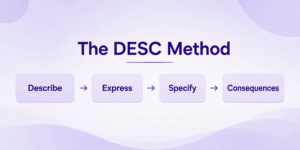
The simple fact → position → request → response model works well for everyday conversations.
For a more structured or difficult discussion, the DESC method can help organize the message:
Describe → Express → Specify → Consequences
Describe
State what happened without judgment.
“The report arrived two days after the agreed deadline.”
Express
Explain the impact or your concern.
“That delayed the customer review.”
Specify
State what you want to change.
“Please tell me as soon as you think the deadline is at risk.”
Consequences
Explain the practical result.
“That gives us time to adjust the customer schedule instead of missing it unexpectedly.”
DESC is useful as a preparation tool for conversations that are important enough to structure in advance.
It does not need to be followed mechanically.
Assertive Communication at Work
Assertiveness is especially useful when work requires people to coordinate priorities, limits and disagreement.
Saying No to Extra Work
“I can take this on, but not alongside both current deadlines. Which task should I deprioritize?”
This makes the tradeoff explicit instead of silently accepting an unrealistic workload.
Disagreeing
“I understand why that option is attractive. I have a concern about the implementation timeline that I’d like to discuss before we commit.”
The disagreement is clear without becoming personal.
Clarifying Priorities
“I have three urgent tasks and enough time to complete two today. Which two should take priority?”
This turns an impossible request into a decision that can actually be made.
Assertive Communication in Personal Relationships
The same principles apply outside work.
For example:
Setting a boundary
“I’m happy to help this weekend, but I’m not available Sunday.”
Expressing a need
“I’d like us to talk before making plans that affect both of us.”
Disagreeing
“I understand why you see it that way, but I don’t agree.”
Assertiveness does not require turning every disagreement into a long explanation.
Sometimes a clear statement is enough.
What Assertive Communication Is Not and Common Mistakes
Understanding assertiveness also means understanding what it is not.
Assertiveness Is Not Bluntness
Direct communication can still consider the impact on the other person.
“This needs revision because the figures are incomplete.”
is different from:
“This is terrible.”
Both are direct, but only one identifies a usable problem.
Assertiveness Is Not Winning
The other person does not have to agree with you for communication to be assertive.
You can express a clear request and still receive:
“No.”
Assertiveness gives you a voice.
It does not give you control over another person’s answer.
Assertiveness Is Not Aggression With Polite Words
A statement can sound calm and still be controlling.
For example:
“I respectfully need you to do exactly what I say.”
The polite wording does not change the underlying demand.
Do Not Over-Explain Every Boundary
A boundary can become less clear when it is buried under repeated apologies and justification.
Sometimes:
“I can’t attend Friday.”
is enough.
Do Not Turn Requests Into Accusations
“Can you stop being so selfish?”
is phrased as a question but functions as an attack.
A useful request focuses on the behavior or change needed.
Do Not Expect Immediate Agreement
A successful assertive message can still produce disagreement.
The goal is clarity, not automatic compliance.
Do Not Use Scripts Mechanically
Frameworks such as DESC help structure thinking.
Natural conversation does not need to sound like a communication worksheet.
The defining principle remains:
my needs matter + your needs matter
Assertive Body Language and Tone
Assertive delivery usually means speaking at a steady pace, using a clear volume and keeping body language consistent with the message.
The goal is not to imitate a fixed “confident” pose, because communication norms vary across people and cultures.
What matters is that delivery does not contradict or unnecessarily escalate the words.
For example, saying:
“I’d like to discuss this calmly.”
while shouting sends conflicting signals.
How to Become More Assertive
Assertiveness is a skill that can be practiced.
1. Notice Your Default Pattern
Ask what you tend to do when disagreement appears.
Do you:
-
become silent;
-
agree too quickly;
-
hint instead of asking;
-
become confrontational;
-
over-explain?
The pattern tells you what to practice.
2. Decide What You Actually Want
Before a difficult conversation, complete:
“The problem is…”
and:
“What I want to happen is…”
If you cannot state the desired outcome clearly, it will be difficult to communicate it clearly.
3. Start With Low-Stakes Situations
Practice where the consequences are small.
For example:
-
correcting an incorrect order;
-
asking someone not to interrupt;
-
declining a minor request;
-
asking for clarification.
Repetition makes direct communication feel less unusual.
4. Prepare Important Conversations
For a difficult conversation, write down:
fact → position → request
You do not need to read a script word for word.
Preparation simply reduces the chance that anxiety or frustration turns the conversation passive or aggressive.
When Assertiveness May Need to Be Adapted
Assertiveness is useful in many situations, but context matters.
Communication norms vary across:
-
cultures;
-
workplaces;
-
families;
-
levels of authority;
-
relationships.
Directness that feels appropriate in one environment may sound unusually confrontational in another.
The core principle can remain the same while the wording changes:
be clear enough to represent your own needs and respectful enough to leave room for the other person.
Safety matters too.
In situations involving threats, coercion, abuse or a serious power imbalance, direct confrontation may not always be safe or appropriate.
Communication technique should not take priority over personal safety.
Frequently Asked Questions
What is assertive communication?
Assertive communication is the clear and direct expression of thoughts, needs, opinions or boundaries while respecting the other person’s right to respond and hold a different position.
What is an example of assertive communication?
If a colleague gives you extra work when you are already overloaded, an assertive response might be:
“I don’t have capacity for another task today. If this is urgent, can we decide which current deadline should move?”
What is the difference between assertive and aggressive communication?
Assertive communication expresses your own needs while respecting the other person.
Aggressive communication expresses your position by dismissing, blaming or overriding the other person.
What are the main techniques of assertive communication?
Useful techniques include specific requests, “I” statements, clear boundaries, calm repetition, issue-focused language, active listening and structured methods such as DESC.
How can I become more assertive?
Start by noticing situations where you stay silent, agree when you want to say no or become confrontational.
Then practice stating the fact, your position and a clear request in lower-stakes conversations.
Is assertive communication always appropriate?
Assertiveness is useful in many everyday situations, but communication should be adapted to context, culture, power relationships and safety.
Direct confrontation may not be appropriate where it could increase personal risk.
Conclusion
Assertive communication means making your position clear without denying the other person’s right to respond.
A practical structure is:
fact → position → request → response
The goal is not to win the conversation.
It is to make your needs, limits or opinion clear enough for a real discussion to happen.
Author
Helga Afon is a technology writer specializing in video conferencing, collaboration software, and workplace communication. She writes articles and reviews that help readers better understand enterprise communication tools and industry trends.