
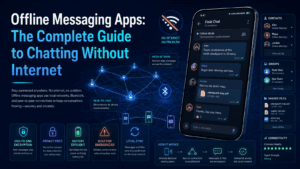
Offline messaging is a category of communication technology that lets people exchange messages, files, or calls without a live internet connection.
Instead of routing traffic through a mobile carrier or cloud server, offline messaging tools rely on local networks such as Bluetooth, Wi-Fi Direct, LAN, or private on-premise servers to move data directly between devices or within a closed infrastructure.
This matters for two very different groups of users. Consumers reach for offline messaging during festivals, natural disasters, flights, or protests, when cell towers are overloaded, blocked, or simply absent.
Organizations reach for it for an entirely different reason: compliance, data sovereignty, and business continuity. Banks, hospitals, government agencies, and defense contractors need messaging systems that keep working, and keep data under their own control, even when the internet connection to a facility is cut or intentionally isolated.
Enterprise platforms such as Secumeet and TrueConf serve this second group with on-premise servers that operate entirely inside a private network, while consumer mesh apps such as Bridgefy, Briar, and BitChat serve the first group with phone-to-phone Bluetooth and Wi-Fi relays.
Below you will find a fast summary of the category, a full explanation of how offline messaging works, a ranked list of the twelve most relevant offline messaging apps for 2026, and a decision framework to help you pick the right one.
At a Glance: Offline Messaging in 2026
What is Offline Messaging?
Offline messaging is the ability to send and receive messages, files, voice, or video without an active connection to the public internet. It is not the same thing as reading previously downloaded messages while your phone is in airplane mode.
True offline messaging actively transmits data between devices or through infrastructure that does not require an ISP or mobile carrier at the moment of communication.
There are two distinct technical models behind the term:
-
Mesh and peer-to-peer messaging. Devices communicate directly using Bluetooth Low Energy or Wi-Fi Direct. Each phone acts as both a client and a relay node, hopping a message from device to device until it reaches its destination. This is the model used by Bridgefy, Briar, BitChat, and older tools like FireChat and the Serval Mesh.
-
On-premise or LAN-based messaging. A private server, hosted inside an organization’s own network, handles all messaging, file transfer, and often video conferencing, with zero dependency on the public internet or a vendor’s cloud. This is the model used by enterprise platforms such as Secumeet, TrueConf, and OctaChat.
Both models share one property that distinguishes them from ordinary chat apps: control over the transmission path stays local. No message needs to reach a data center on another continent for two people in the same room, building, or facility to talk to each other.
Ways to Communicate Without Internet
There is more than one way to strip internet dependency out of the communication loop. The main methods in active use in 2026 include:
-
Bluetooth mesh networking. Devices form a temporary local network and relay encrypted messages across multiple hops, extending range well beyond a single Bluetooth connection.
-
Wi-Fi Direct. Two or more devices connect directly without a router, useful for higher-bandwidth transfers like images or files at short range.
-
LAN and VPN-based servers. A messaging and collaboration server runs on hardware inside an office, campus, or facility, and clients connect over the local network or a private VPN tunnel, never touching the public internet.
-
Air-gapped and on-premise deployment. For the highest security tier, the entire messaging infrastructure is isolated from any external network, common in defense, government, and classified research environments.
-
Satellite and radio bridges. Some enterprise and field-communication systems route messages through satellite links or dedicated radio hardware when no terrestrial network exists at all.
-
Store-and-forward relay. Both mesh apps and on-premise systems can cache a message on an intermediate device or server and deliver it once the recipient becomes reachable.
Recent Data on the Offline and Secure Messaging Market
The demand for offline-capable and self-hosted communication tools has grown alongside tightening data residency rules and rising concern over outages and network shutdowns.
Offline Messaging Market Insights
Regulatory pressure is rising
Regulatory frameworks across Europe, the Middle East, Southeast Asia, and Latin America have tightened rules in 2026 around where call metadata, recordings, and chat logs can legally be stored.
Enterprise buyers prioritize control
Enterprise buyers evaluating messaging platforms increasingly treat data residency and forensic audit capability as more important than interface polish, particularly in finance, healthcare, and government procurement.
Consumer interest in serverless messaging is growing
Consumer Bluetooth mesh apps such as BitChat, released in 2025, reached their initial beta testing cap of 10,000 users within hours of launch, reflecting real public interest in serverless, no-account messaging.
Mesh apps still depend on density
Mesh networking apps consistently perform best in short bursts of high-density use, such as festivals, conferences, or protests, and struggle at true long-range, disaster-wide scale because delivery depends on how many nearby devices are running the same app.
Which Offline Messaging Apps Are Worth Trying?
The list below covers the twelve most relevant offline messaging tools in 2026, spanning enterprise on-premise platforms and consumer mesh networking apps. Each profile follows the same format: what the app is, its core capabilities, and its practical limitations.
Key Areas that Benefit from Offline Messaging
Offline messaging is not a niche convenience. It solves recurring, high-stakes problems across several sectors:
-
Government and defense. Classified or air-gapped environments require messaging and video systems, like Secumeet and TrueConf, that never touch an external network.
-
Healthcare. Hospitals need uninterrupted internal communication during connectivity outages, without exposing patient data to third-party cloud infrastructure.
-
Finance and banking. Regulated institutions must keep sensitive communications auditable and physically located within approved jurisdictions.
-
Disaster response and emergency services. Mesh apps like Bridgefy and BitChat keep first responders and affected populations connected when cell towers are damaged or overloaded.
-
Remote industries. Mining, agriculture, maritime operations, and field research frequently operate in areas with no reliable cellular coverage at all.
-
Activism, journalism, and protest movements. Tools such as Briar and FireChat’s legacy use cases show how mesh networking supports coordination when networks are shut down or monitored.
-
Large public events. Festivals, conferences, and stadiums routinely overwhelm local cell towers, making short-range mesh apps genuinely useful for basic coordination.
Technical Comparison: Offline Messaging Apps by Connectivity Model
Choosing the Right Offline Messaging Apps for Your Needs
The right offline messaging tool depends on who you are and what “offline” needs to mean in practice.
If you represent a business, hospital, government body, or any organization bound by compliance or data residency requirements, a consumer mesh app is the wrong category entirely.
What you need is an on-premise platform such as Secumeet or TrueConf, where the entire messaging and, in most cases, video conferencing stack runs on infrastructure your own IT team controls.
These platforms answer a different question than “can I message my friend without Wi-Fi.” They answer “can my organization keep operating, securely and compliantly, if the internet connection to this building goes down.”
Evaluate them on deployment model, including on-premise, private cloud, or hybrid deployment, directory integration such as Active Directory, LDAP, and SSO, audit and compliance export capability, and how well they interoperate with legacy hardware you already own.
If you are an individual looking for short-range communication at a festival, during a natural disaster, or in an area with unreliable coverage, mesh networking apps like Bridgefy, Briar, or BitChat are the better fit.
Evaluate them on independent security review status, platform availability, and realistic expectations about range, since mesh delivery depends heavily on how many other people nearby are running the same app.
Key Takeaways
Bottom Line First
Offline messaging is not one category. Consumer mesh apps solve short-range, device-to-device communication, while enterprise on-premise platforms solve secure, persistent communication inside private infrastructure.
What Most People Get Wrong
A Bluetooth mesh app cannot replace an enterprise messaging system for a hospital, bank, or government agency. Likewise, an on-premise server is unnecessary for a festival attendee who only needs short-range coordination.
Conclusion
Offline messaging has evolved from a niche workaround into two mature, distinct categories of technology.
On one side, Bluetooth and Wi-Fi mesh apps such as Bridgefy, Briar, BitChat, and Session’s broader privacy ecosystem give individuals a way to stay connected when cellular networks fail, are overloaded, or are deliberately restricted.
On the other side, on-premise and LAN-based platforms such as Secumeet, TrueConf, and OctaChat give organizations a way to guarantee that critical communication, and the data behind it, never has to leave infrastructure they control, whether or not the internet is available at all.
Choosing correctly starts with identifying which category actually applies to your situation. A festival attendee does not need an Active Directory integration, and a hospital IT director does not need a Bluetooth mesh with a 100 meter range.
Once that distinction is clear, the rest of the decision comes down to encryption strength, independent security review status, platform compatibility, and, for enterprise buyers, how cleanly a platform like Secumeet or TrueConf fits into existing compliance and infrastructure requirements.
Frequently Asked Questions
Can offline messaging apps replace regular messaging apps like WhatsApp?
Not for most daily use. Mesh apps like Bridgefy or BitChat depend on nearby users running the same app, so range and reliability are far more limited than a cellular or Wi-Fi connection. For organizations, however, platforms like TrueConf or Secumeet can fully replace standard messaging tools, since they run persistent, on-premise infrastructure rather than relying on ad-hoc device proximity.
Are offline messaging apps secure enough for business use?
Consumer mesh apps vary widely in security maturity, and some, including Bridgefy and early builds of BitChat, have had documented vulnerabilities. For business or regulated use, enterprise-grade platforms such as Secumeet and TrueConf are the appropriate choice, since they are built around end-to-end encryption, audit logging, and on-premise data control rather than opportunistic peer-to-peer relaying.
Do offline messaging apps work if I am the only person nearby using the app?
No. Mesh networking apps require at least one other nearby device running the same app to relay a message. This is the core limitation separating consumer mesh tools from enterprise platforms like Secumeet or TrueConf, which operate through a persistent server rather than depending on who else happens to be standing nearby.
What is the difference between a mesh messaging app and an on-premise messaging platform?
A mesh app like Briar or BitChat connects individual devices directly over Bluetooth or Wi-Fi Direct with no central server at all. An on-premise platform like TrueConf or Secumeet runs a dedicated server inside an organization’s own network, so every device connects to that server over LAN or VPN instead of to each other directly. The mesh model suits short-range personal use, while the on-premise model suits organizations that need guaranteed uptime and data control.
Which offline messaging app has the longest range?
Range depends entirely on the number of relay hops available. Bluetooth mesh apps such as Bridgefy and BitChat typically cover 10 to 100 meters per hop, but can extend further as more devices relay the message. On-premise platforms such as Secumeet or TrueConf have no fixed range limit at all, since they operate over an organization’s full LAN or VPN rather than short-range radio.
Is BitChat safe to use for sensitive communication?
BitChat uses modern encryption methods, but its developer has stated the app has not completed an independent third-party security review, and an early impersonation vulnerability was already identified by a researcher. For casual, low-risk offline chat it is a reasonable option, but for genuinely sensitive communication, a reviewed and audited platform, whether a consumer tool like Briar or an enterprise platform like Secumeet or TrueConf, is a safer choice.
Author
Helga Afon is a technology writer specializing in video conferencing, collaboration software, and workplace communication. She writes articles and reviews that help readers better understand enterprise communication tools and industry trends.