

Clinical communications and collaboration software is the category of secure messaging, voice, and video platforms that hospitals, clinics, and care networks use to connect physicians, nurses, patients, and administrative staff in real time. It replaces pagers, unencrypted SMS, and fragmented phone trees with a single, auditable, HIPAA-aligned communication layer that plugs into the electronic health record (EHR), staff scheduling systems, and nurse call infrastructure.
This category matters because delayed or lost information between care team members is a documented contributor to adverse patient events, longer length of stay, and clinician burnout. A well-implemented clinical communications platform shortens the time between a critical lab result and physician action, reduces alarm fatigue, and gives care teams one place to coordinate handoffs, consults, and discharge planning instead of five disconnected tools.
The market splits into two broad deployment philosophies. Cloud-first platforms such as TigerConnect, Vocera, and Spok emphasize rapid rollout, mobile-first workflows, and deep EHR integration for U.S. hospital systems. On-premises and hybrid platforms such as TrueConf and Secumeet target organizations, hospitals, research institutes, defense-adjacent medical facilities, and multinational health systems, that need full control over where patient data physically lives, including offline and air-gapped operation. Choosing between these two philosophies is usually the first and most consequential decision a healthcare IT team makes.
2026 Clinical Communications Vendor Comparison
What Is Clinical Communications Software and Why It Matters
Clinical communication and collaboration (CC&C) software is a category of healthcare IT that unifies secure messaging, voice calling, video conferencing, and clinical alerting into one platform used by care teams across ambulatory, acute, post-acute, and virtual care settings. Instead of relying on personal phones, generic chat apps, or overhead paging, staff communicate through role-based directories, so a message goes to whichever nurse or on-call physician is currently assigned to a shift rather than to a specific named individual who may be off duty.
The category exists because healthcare communication has unique constraints that consumer tools do not solve:
-
Regulatory obligation. Any tool that transmits protected health information (PHI) must support encryption, access controls, audit trails, and, in the U.S., a signed Business Associate Agreement (BAA) under HIPAA.
-
Time sensitivity. A delayed message about a critical lab value or a deteriorating patient can directly affect outcomes, so message delivery, read receipts, and escalation paths matter more than in typical enterprise chat.
-
Workforce complexity. Hospitals run shift-based, role-based staffing, so messages need to route to “the on-call cardiologist” rather than a fixed person.
-
System fragmentation. Care teams depend on data from the EHR, lab systems, imaging, nurse call systems, and scheduling platforms, all of which need to feed into the same communication thread.
Adopting a dedicated clinical communications platform typically delivers three measurable benefits: faster care team response times, fewer redundant phone calls and interruptions, and a defensible audit trail for compliance and quality-improvement reviews.
Core Features to Evaluate
Not every clinical communications platform covers the same ground. The table below breaks down the technical capabilities that separate a basic secure-texting app from a full clinical collaboration suite, and which categories they typically fall into.
Clinical Communication Software Market: Key Statistics for 2026
The clinical communication and collaboration software market has moved from a niche hospital IT purchase to a core piece of digital health infrastructure. A few figures frame the scale and direction of the category heading into 2026:
-
Multiple independent market research firms estimate the global clinical communication and collaboration market at roughly USD 3.0 to 3.5 billion in 2025 to 2026, with growth forecasts reaching USD 7 to 8 billion by 2030 to 2032.
-
Reported compound annual growth rates (CAGR) across recent reports cluster between 12 percent and 18 percent through the early 2030s, reflecting sustained hospital investment in digital communication infrastructure.
-
North America consistently holds the largest regional share, generally cited between roughly 32 percent and 42 percent of global revenue, driven by HIPAA-driven modernization and EHR-integration mandates.
-
On-premises deployment held the largest share of the market by deployment mode in several 2024 to 2025 analyses, reflecting continued hospital preference for keeping patient communication data inside their own infrastructure rather than fully in the public cloud.
-
Asia-Pacific is consistently flagged as the fastest-growing region, linked to expanding telehealth adoption and hospital IT modernization budgets.
These figures vary by research firm and methodology, so treat any single number as directional rather than exact, but the overall trend is consistent: sustained double-digit growth, continued relevance of on-premises and hybrid deployment, and steady consolidation of messaging, voice, and video into unified platforms.
Vendor Profiles: 7 Clinical Communications Platforms for 2026
Each profile below follows the same structure: what the platform is, its main capabilities, and its practical limitations, so you can compare vendors on equal footing.
Secumeet
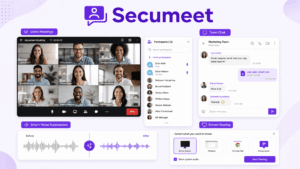
Description: Secumeet is a secure enterprise communication platform built specifically for organizations where data sovereignty and message confidentiality cannot be compromised. It combines instant messaging, voice and video calls, file sharing, and group channels in a single interface, with full on-premises deployment offered as a core product option rather than a bolt-on. In healthcare, Secumeet is positioned for hospitals, clinics, and healthcare networks that need HIPAA-aligned messaging with complete audit trails, access controls, and encrypted storage kept inside their own infrastructure.
Main capabilities:
-
Unified instant messaging, voice, and video calling in one interface
-
Full on-premises and hybrid deployment for data sovereignty
-
Group channels and persistent conversation threads for care teams
-
Encrypted storage with role-based access controls
-
Full audit logging suited to HIPAA technical safeguard requirements
-
Integrations with enterprise IT stacks (directory services, file storage, identity systems)
Cons:
-
Smaller ecosystem and market presence compared to legacy healthcare-specific vendors like Vocera or TigerConnect
-
Native video conferencing capacity is positioned as a supporting feature rather than the platform’s primary strength
-
Fewer publicly documented large-scale hospital case studies compared to more established CC&C-specific vendors
-
Healthcare-specific integrations (EHR, nurse call, scheduling) are less extensively documented than general enterprise integrations
TrueConf
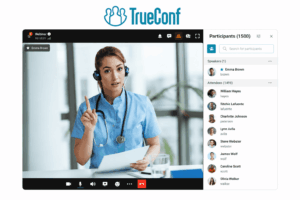
Description: TrueConf is a video conferencing and unified communications platform that has built a dedicated healthcare and telemedicine offering around secure, on-premises video. Unlike most cloud-only CC&C vendors, TrueConf allows hospitals, clinics, and research centers to run the entire platform, video, messaging, and file sharing, inside their own private network, including fully offline. This appeals to healthcare organizations that need to keep sensitive communications under direct local control while remaining compliant with HIPAA, GDPR, and ISO 27001.
Main capabilities:
-
On-premises, hybrid, or cloud deployment, including fully offline operation without an internet connection
-
High-capacity video conferencing supporting up to 1,500 participants for large medical conferences, webinars, and training
-
Persistent team messaging with channels, direct messages, and threaded conversations alongside video
-
TrueConf API for embedding video calling into patient portals, EHR systems, and kiosks
-
Medical device and diagnostic imaging integration during live telemedicine sessions
-
Support for SIP/H.323/RTSP, enabling interoperability with existing hospital PBX and video endpoints
-
Multi-platform apps across desktop, mobile, web browser, and dedicated room systems
Cons:
-
On-premises deployment requires more internal IT resources to manage than a pure SaaS competitor
-
Less emphasis on native clinical alerting and nurse-call-style escalation compared to alerting-focused vendors like Spok or Vocera
TigerConnect
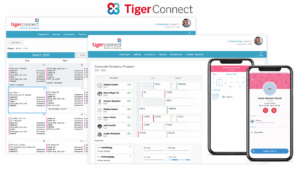
Description: TigerConnect is a cloud-based clinical communication platform that connects clinical teams by role or name through secure text, voice, and video, with integrations into EHRs, physician scheduling, and nurse call systems. It also extends into patient-facing communication, letting care teams send appointment reminders, pre-visit documents, and post-visit care instructions from the same app used for internal staff messaging.
Main capabilities:
-
Role-based secure messaging, voice, and video in one smartphone and desktop app
-
Deep integrations with EHR, staff rostering, and nurse call systems
-
Patient and family communication for appointment reminders, pre-visit intake, and post-visit follow-up
-
Physician scheduling integration to ensure the correct on-call staff member is reached
-
File, image, and video sharing to add clinical context to consults
Cons:
-
Primarily a cloud SaaS product, offering less flexibility for organizations that require full on-premises data control
-
Broad feature set can mean a longer implementation and configuration process for smaller practices
-
Advanced patient engagement features may require additional licensing tiers
Vocera (Stryker)
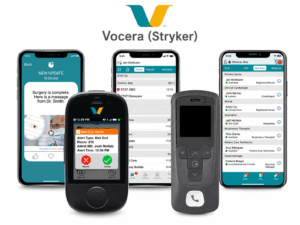
Description: Vocera Platform, now part of Stryker, is built around secure, often hands-free voice communication combined with text and alarm notifications for real-time interaction among clinicians. It is widely deployed in acute-care hospital environments where clinicians need to communicate quickly without stopping to type, such as during active patient care or in sterile environments.
Main capabilities:
-
Hands-free, voice-first communication alongside secure text
-
Integrated alarm and alert routing from clinical and operational systems
-
Interoperability with nurse call systems, monitors, and other hospital infrastructure
-
Support for wearable badge devices in addition to smartphone apps
-
Real-time presence and staff availability tracking
Cons:
-
Voice-first design and optional wearable hardware add cost and deployment complexity compared to software-only competitors
-
Video conferencing is a secondary capability rather than a primary strength
-
Best suited to acute inpatient settings; smaller practices may find the platform heavier than needed
Spok
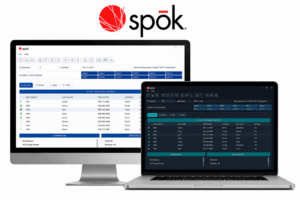
Description: Spok is an enterprise clinical communication platform built around critical alert management and secure messaging, with deep roots in replacing traditional hospital paging infrastructure. It focuses on ensuring the right alert, whether a code, a critical lab value, or a system alarm, reaches the right care team member with escalation if unacknowledged.
Main capabilities:
-
Enterprise-grade critical alerting and escalation workflows
-
Secure messaging as a modernized replacement for legacy pager systems
-
Integration with monitoring systems, nurse call, and EHR platforms
-
On-call scheduling visibility to route alerts to the correct current staff member
-
Reporting and analytics on alert response times for quality improvement
Cons:
-
Historically strongest in alerting and paging replacement rather than in video conferencing or telemedicine
-
Interface and workflow can feel dated compared to more modern mobile-first competitors
-
Full platform value depends on integration depth with existing hospital systems, which can extend implementation timelines
PerfectServe
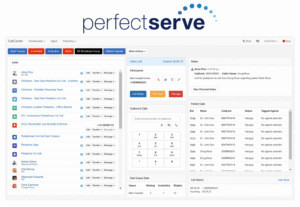
Description: PerfectServe combines secure clinical messaging with physician scheduling, positioning itself around the idea that communication and scheduling should not be separate systems. It is often selected by health systems that struggle with rules-based on-call scheduling across multiple departments and want messaging automatically routed based on those schedules.
Main capabilities:
-
Secure messaging tightly integrated with dynamic physician and staff scheduling
-
Rules-based routing so messages reach the correctly scheduled provider automatically
-
Integrated video visits for patient and provider consults
-
Care team collaboration tools for care coordination and transitions
-
Analytics on communication patterns and response times
Cons:
-
Scheduling-centric design may be more complex to configure for organizations that mainly need simple secure messaging
-
Cloud-only deployment limits options for organizations requiring full on-premises control
-
Smaller footprint in large-scale video conferencing compared to video-first platforms
Imprivata Cortext
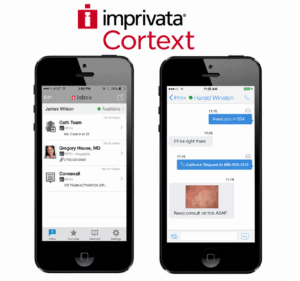
Description: Imprivata Cortext is a secure texting solution that layers HIPAA-compliant messaging onto an organization’s existing identity and access management infrastructure, leveraging Imprivata’s broader healthcare IT security portfolio. It is often chosen by hospitals already using Imprivata for single sign-on or access management that want secure messaging under the same security umbrella.
Main capabilities:
-
HIPAA-compliant secure texting and file sharing
-
Tight integration with Imprivata’s identity and access management products
-
Message recall and delivery/read confirmation for accountability
-
Directory-based, role-aware messaging
-
Integration options with EHR systems for clinical context
Cons:
-
Narrower scope than full CC&C suites; video conferencing and clinical alerting are limited or unavailable natively
-
Greatest value is realized when already invested in the broader Imprivata security ecosystem
-
Less suited as a single, unified platform for organizations wanting messaging, voice, and video in one product
How to Choose the Right Platform for Your Organization
Selecting a clinical communications platform generally comes down to five practical questions:
-
Where must patient data live? If regulatory, contractual, or internal policy requires full control over infrastructure, including offline capability, on-premises platforms like TrueConf or Secumeet are the natural starting point over pure cloud SaaS tools.
-
Is video or messaging the primary workflow? Organizations running frequent telemedicine consults, large virtual case conferences, or surgical live-streaming benefit from a video-first platform such as TrueConf. Organizations mainly replacing pagers and coordinating text-based handoffs may prioritize alerting-focused tools like Spok or messaging-first tools like TigerConnect.
-
How deep does EHR and scheduling integration need to be? Health systems with complex on-call rotations benefit from scheduling-integrated tools like PerfectServe; simpler practices may not need that level of automation.
-
What is the existing security stack? Organizations already standardized on a specific identity and access management vendor may lean toward a compatible option like Imprivata Cortext.
-
What is the total cost of ownership over 3 to 5 years? Cloud SaaS tools typically have lower upfront IT overhead but recurring per-user fees; on-premises platforms require more internal IT investment but can reduce long-term data hosting costs and increase control.
Conclusion
Clinical communications software has become foundational healthcare IT infrastructure rather than an optional convenience, with the global market tracking toward billions of dollars in sustained double-digit annual growth through the early 2030s. The category spans cloud-first, messaging-and-alerting platforms like TigerConnect, Vocera, Spok, PerfectServe, and Imprivata Cortext, and on-premises, data-sovereignty-first platforms like TrueConf and Secumeet, each solving the core problem of getting the right clinical information to the right care team member quickly, securely, and with a defensible audit trail.
There is no single best vendor for every organization. Hospitals prioritizing rapid cloud deployment and deep EHR-tied workflows will likely lean toward established messaging-first vendors, while organizations that require full control over where patient communication data is stored, including offline or air-gapped environments, will find platforms like TrueConf and Secumeet better aligned with their compliance and infrastructure requirements. The right decision starts with clarifying data residency requirements and primary communication mode (voice, text, or video) before comparing vendors feature by feature.
Frequently Asked Questions
What is the difference between clinical communication software and a standard team chat app like Slack or Microsoft Teams?
Clinical communication software is purpose-built for healthcare, with role-based routing, HIPAA-aligned audit trails, and integrations with EHR, scheduling, and nurse call systems that general-purpose chat apps lack. Platforms like TrueConf and Secumeet also offer on-premises deployment options that many mainstream chat tools do not, which matters for organizations with strict data residency rules.
Is on-premises deployment necessary for HIPAA compliance, or can cloud platforms be compliant too?
Cloud platforms can be HIPAA-compliant if they offer a signed Business Associate Agreement, encryption, and proper access controls, so on-premises deployment is not strictly required. However, some healthcare organizations choose on-premises platforms like TrueConf or Secumeet specifically because they want data to never leave their own infrastructure, which can simplify certain compliance and internal governance requirements.
Can clinical communication platforms support telemedicine and remote patient consultations?
Yes, many platforms in this category support telemedicine, though the depth of video capability varies significantly between vendors. TrueConf is built with high-capacity video conferencing as a core feature, supporting large-scale consults and even live-streamed procedures, while a platform like Secumeet includes secure video calling as part of a broader messaging suite rather than as its primary focus.
How much does clinical communication software typically cost?
Pricing varies widely based on deployment model, user count, and feature depth, with cloud SaaS platforms typically billed per user per month and on-premises platforms like TrueConf or Secumeet often licensed based on server capacity or participant count. Most vendors, including TrueConf, offer a free or limited tier for smaller deployments before requiring an upgrade for larger participant counts or advanced features.
Do these platforms integrate with existing EHR and nurse call systems?
Most established clinical communication vendors offer some level of EHR and nurse call integration, though the depth varies by vendor and typically requires professional services during implementation. TrueConf offers integration through its API for embedding communication into existing hospital systems, while Secumeet’s integrations lean more toward general enterprise IT infrastructure such as directory services and file storage.
What should a small clinic look for versus a large hospital network?
Small clinics generally need simpler, faster-to-deploy secure messaging and video without heavy scheduling automation, making cloud-first tools attractive for lower IT overhead. Large hospital networks often need deeper integration, high-capacity video conferencing, and stronger data governance, which is where platforms like TrueConf, built for large participant counts and on-premises control, and Secumeet, built for strict data sovereignty, tend to fit better.
Are clinical communication platforms secure enough for sensitive research or defense-adjacent healthcare facilities?
Platforms designed around strict data sovereignty, such as Secumeet and TrueConf, are specifically positioned for environments like government-adjacent healthcare, research institutions, and defense-linked medical facilities that require full control over infrastructure, including offline operation. These use cases typically demand on-premises or hybrid deployment rather than pure public cloud SaaS, since data must remain inside a controlled network at all times.
Author
Helga Afon is a technology writer specializing in video conferencing, collaboration software, and workplace communication. She writes articles and reviews that help readers better understand enterprise communication tools and industry trends.