
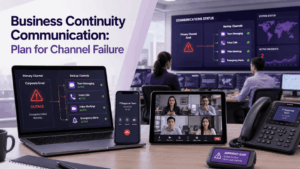
Business continuity communication is the set of people, processes and communication channels an organization uses to keep critical information moving when normal operations are disrupted.
It can become necessary during:
-
IT outages;
-
ransomware incidents;
-
power failures;
-
office closures;
-
natural disasters;
-
telecom disruptions;
-
supply-chain incidents;
-
major infrastructure failures.
The central problem is not simply sending an emergency message.
It is ensuring that communication still works when the systems, locations or people used for normal communication may themselves be unavailable.
A continuity communication process should detect disruption, notify the right audiences, support response coordination, provide regular updates and continue through recovery.
Business Continuity Communication at a Glance
Primary and Backup Channels at a Glance
The backup should not simply be another interface running on exactly the same dependencies.
Two applications may appear redundant while both depend on the same identity provider, internet connection, cloud provider, corporate device or data center.
That is tool redundancy, but not necessarily continuity redundancy.
Continuity Communication Failure Test
The key question for every channel is:
What dependency could make this communication method unavailable during the incident being planned for?
What Is Business Continuity Communication?
Business continuity communication describes how an organization exchanges critical operational information before, during and after a disruptive event.
It forms part of a wider business continuity and resilience plan.
Communication may need to connect:
-
incident-response teams;
-
employees;
-
leadership;
-
suppliers;
-
customers;
-
emergency responders;
-
regulators;
-
media or the public.
The purpose differs by audience.
Incident teams need operational coordination. Employees need clear instructions. Executives need business-impact updates. Customers and partners may need service-status information.
Business continuity therefore needs more than a list of phone numbers.
It needs a communication system that remains usable under the failure scenarios the organization is planning for.
Business Continuity Communication vs Crisis Communication
The terms overlap, but they are not identical.
A single disruption may require all four.
During a ransomware incident, for example:
-
emergency notification may tell employees not to use affected systems;
-
incident communication lets security and IT teams coordinate containment;
-
business continuity communication helps departments continue essential work through alternative processes;
-
crisis communication provides approved information to customers, regulators or the public.
The communication plan should define these responsibilities before an incident occurs.
The Main Continuity Test: What If the Primary Channel Fails?
A common mistake is to build a continuity communication plan around the same infrastructure the disruption is expected to affect.
Corporate Email Is Unavailable
If continuity instructions depend entirely on email, an email outage can disable the plan itself.
Possible alternatives include:
-
another messaging environment;
-
SMS;
-
voice calls;
-
emergency notification services.
Corporate Identity Is Compromised
A cyber incident may require an organization to disable or isolate:
-
Active Directory;
-
SSO;
-
VPN access;
-
employee accounts.
A backup communication platform that requires the same identity infrastructure may then become unavailable as well.
The Office Is Inaccessible
Employees may lose access to desktop devices, local servers, desk phones or printed contact information.
Remote access and alternative communication methods become more important.
Internet Connectivity Is Lost
Cloud communication systems may become unreachable from an affected site.
Alternative connectivity or communication paths may therefore be necessary for critical teams.
Communication Dependencies to Map
Every critical communication method has dependencies.
These dependencies determine whether a channel is actually available when continuity procedures are activated.
Who Needs Information During a Disruption?
Different audiences need different levels of detail and different communication channels.
Operational response communication should usually be two-way.
Mass employee alerts or public statements may be primarily one-way, but response teams need a way to report new findings, request resources and escalate decisions.
What a Business Continuity Communication Plan Should Contain
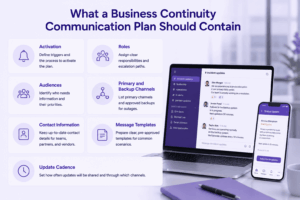
A usable plan should answer several practical questions.
Activation
Define:
-
what events activate the plan;
-
who can activate it;
-
how activation is communicated.
Roles
Identify:
-
communication lead;
-
incident lead;
-
technical representatives;
-
executive contact;
-
external spokesperson;
-
alternates for critical roles.
Audiences
Map all groups that may need information.
Do not assume one message is appropriate for everyone.
Primary and Backup Channels
Define at least one usable communication path for each critical audience and identify what happens if the primary channel is unavailable.
Contact Information
Maintain current details for:
-
employees;
-
leadership;
-
emergency teams;
-
suppliers;
-
critical customers;
-
external authorities.
Critical contact data should remain accessible if ordinary corporate systems are unavailable.
Message Templates
Prepare templates for common events such as:
-
initial incident notification;
-
remote-work activation;
-
service outage;
-
cybersecurity incident;
-
office closure;
-
status update;
-
recovery notification.
Templates reduce the amount of writing and approval required during an incident.
Update Cadence
Define when stakeholders should expect another update.
Even when the situation has not materially changed, a scheduled update can reduce uncertainty and reliance on unofficial information.
Communication Before, During and After a Disruption
Before the Incident
The organization should:
-
identify critical audiences;
-
map communication dependencies;
-
select backup channels;
-
maintain contact lists;
-
assign roles;
-
prepare templates;
-
test the plan.
Employees and response teams should also know where continuity updates will appear if normal communication stops working.
During the Incident
Communication should establish:
-
what happened;
-
who is affected;
-
what employees should do;
-
which systems or processes remain available;
-
who is leading the response;
-
when the next update will arrive.
Information should remain consistent across channels.
During Recovery
As systems return, communication should clarify:
-
which services are restored;
-
which restrictions remain;
-
whether temporary processes should continue;
-
what employees or customers need to do next.
After Recovery
The organization should record:
-
which channels worked;
-
where messages were delayed;
-
which contacts were outdated;
-
whether fallback communication actually functioned;
-
what needs to change before the next exercise or incident.
The plan should then be updated.
Business Continuity Communication During a Cyberattack
Cyber incidents deserve special attention because they may directly affect the organization’s normal communication environment.
A ransomware response, for example, may require administrators to isolate:
-
email;
-
internal messaging;
-
shared storage;
-
VPN;
-
identity systems;
-
corporate endpoints.
If the response plan depends entirely on those services, teams can lose the ability to coordinate at the moment coordination becomes most important.
A fallback environment does not need to replace every collaboration feature.
Its first job is to preserve:
-
contact between critical responders;
-
incident commands;
-
status updates;
-
escalation;
-
recovery coordination.
This is why continuity communication and everyday enterprise collaboration should not automatically be assumed to have identical infrastructure requirements.
Normal Communication vs Continuity Communication
The best everyday communication environment is not automatically the best fallback environment.
In normal operations, integration is often desirable.
In continuity planning, excessive dependency can become a weakness.
Using one identity provider across every communication system may simplify normal administration, but an identity outage can then remove access to multiple communication channels at the same time.
The objective is not to avoid integration.
It is to understand where shared dependencies create common failure modes.
Communication Platforms in Business Continuity
Different technologies solve different parts of the continuity communication problem.
Emergency Notification Systems
These are designed for rapid mass alerts through channels such as:
-
SMS;
-
voice;
-
mobile notifications;
-
email.
They are useful when the priority is reaching a large audience quickly.
Business Messaging Platforms
Persistent messaging can provide dedicated channels for incident teams, leadership, departments and recovery groups.
This is useful when responders need ongoing two-way coordination rather than one-way alerts.
Voice and Video Communication
Voice and video sessions can support:
-
incident command;
-
technical coordination;
-
executive briefings;
-
distributed recovery teams.
Status Pages
Status pages provide a central location for internal or external service updates.
Examples of Communication Platforms
A continuity plan may use an existing business communication environment or maintain a separate platform for specific failure scenarios.
Platforms such as Microsoft Teams, Slack, TrueConf, Secumeet and Zoom can support different combinations of messaging, calling, video meetings and group communication.
TrueConf and Secumeet can be relevant where organizations want customer-operated communication environments.
However, customer-operated deployment alone does not make a platform a continuity solution.
If the fallback platform uses the same identity provider, network path, data center or administrator dependencies as the failed primary environment, the organization may still have a common failure point.
The important test remains:
Will the communication environment still be available under the failure scenario being planned for?
How to Choose a Communication Method for Business Continuity
Evaluate communication methods against the disruption rather than against a generic feature checklist.
The correct answer may differ by audience.
A mass employee alert and an incident-response discussion do not need the same communication technology.
Testing Business Continuity Communication
A communication plan that has never been tested is still an assumption.
Testing should verify more than whether a message can technically be sent.
An exercise can simulate:
-
corporate email unavailable;
-
SSO inaccessible;
-
office network disconnected;
-
main collaboration platform unavailable;
-
incident lead unreachable;
-
employee laptops inaccessible.
Then verify:
-
Were the right people reached?
-
Did they know which channel to use?
-
Were backup contact details current?
-
Could responders communicate in both directions?
-
Did people receive conflicting instructions?
-
Could external stakeholders be contacted?
-
Was the fallback independent enough from the failed service?
Testing should be repeated after meaningful changes to people, infrastructure or procedures.
Common Business Continuity Communication Failures
Frequently Asked Questions
What is business continuity communication?
Business continuity communication is the planned exchange of operational information that helps an organization maintain or restore critical activities during a disruption.
It includes communication between response teams, employees, leadership, suppliers, customers and other stakeholders.
What should a business continuity communication plan include?
It should define activation triggers, responsibilities, audiences, primary and backup channels, contact information, message templates, escalation procedures and update expectations.
What is the difference between business continuity communication and crisis communication?
Business continuity communication primarily supports continued operations and recovery.
Crisis communication has a broader focus on stakeholder information, public messaging and trust during a crisis.
The two often operate together.
Should backup communication use a separate identity system?
Not always, but shared identity dependencies should be evaluated explicitly.
If both the primary and fallback communication platforms become inaccessible when the same SSO or directory service fails, the fallback may not provide meaningful continuity for that scenario.
Can a backup platform use the same cloud provider as the primary system?
It can, but that creates a shared dependency that should be included in the failure analysis.
The important question is whether the disruption being planned for could affect both environments at the same time.
How often should business continuity communication be tested?
Testing should be part of the wider continuity exercise and maintenance process.
It is especially important after meaningful changes to people, communication platforms, identity systems, infrastructure or procedures.
Conclusion
Business continuity communication is not simply a list of people to notify when something goes wrong.
It is the ability to preserve critical information flow while normal systems, locations or processes are disrupted.
For every critical audience, organizations should know who communicates, which channel is used first, what fallback is available and which shared dependencies could cause both options to fail.
The strongest continuity plans therefore do not ask only what communication tools are available.
They ask what could make those tools unavailable, and how critical communication will continue when that happens.
Author
Helga Afon is a technology writer specializing in video conferencing, collaboration software, and workplace communication. She writes articles and reviews that help readers better understand enterprise communication tools and industry trends.