

Verbal communication is the use of words and language to exchange information, ideas, feelings or instructions.
In everyday conversation, people often use the term to mean spoken communication, such as face-to-face conversations, phone calls, meetings and presentations.
In communication theory, however, verbal communication can have a broader meaning and include both spoken and written language.
That distinction explains why different textbooks and guides sometimes give different definitions and different lists of verbal communication types.
In practical terms, good verbal communication depends on more than choosing the right words. It also requires:
clear message → appropriate delivery → listening → feedback → shared understanding
What Is Verbal Communication?
Verbal communication occurs when people use language to create and exchange meaning.
Examples include:
-
talking with a friend;
-
giving instructions to a colleague;
-
participating in a meeting;
-
asking a question;
-
giving a presentation;
-
making a phone or video call;
-
conducting an interview;
-
writing an email or message, under the broader definition of verbal communication.
The central element is language.
When someone says:
“Please send the report by 3 p.m.”
the words communicate a specific request.
But successful communication also depends on whether the listener understands:
-
which report;
-
which day;
-
what format is expected;
-
whether 3 p.m. is a strict deadline.
This is why communication is not complete simply because words have been spoken.
A useful model is:
speaker → message → listener → feedback
Feedback allows the speaker to confirm whether the intended meaning was actually understood.
Is Verbal Communication Spoken or Written?
Both definitions are used.
In everyday business language, verbal communication often means spoken communication and is contrasted with written communication.
For example:
-
face-to-face conversation;
-
phone call;
-
presentation;
-
video meeting.
In communication studies, however, verbal communication usually refers more broadly to communication using words or language, which can include both spoken and written forms.
That produces two useful categories:
Neither usage should be treated as automatically wrong.
The important point is to understand which definition is being used in a particular context.
For the rest of this guide, the focus is primarily on spoken verbal communication, because that is how the term is most commonly used in everyday workplace conversations.
Types of Verbal Communication
Different textbooks classify verbal communication in different ways, so the categories below are one common practical model.
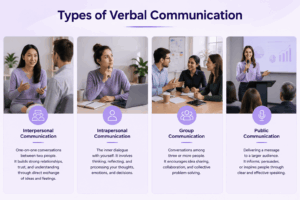
Interpersonal Communication
Interpersonal communication takes place between two people.
Examples include:
-
a conversation between friends;
-
a manager giving feedback to an employee;
-
a customer speaking with a support representative;
-
a job interview;
-
a sales call.
Because both people can respond immediately, interpersonal communication usually has a strong feedback loop.
Intrapersonal Communication
Intrapersonal communication is communication with yourself.
It includes internal dialogue and self-talk, such as thinking through a decision or mentally preparing for a difficult conversation.
Some classifications include intrapersonal communication as a type of verbal communication, while others focus only on communication between people.
Group Communication
Group communication involves several people participating in the same exchange.
Examples include:
-
team meetings;
-
classroom discussions;
-
workshops;
-
brainstorming sessions;
-
project reviews.
Group communication requires more turn management than one-to-one conversation because several people may want to contribute at the same time.
Public Communication
Public communication usually involves one person speaking to a larger audience.
Examples include:
-
presentations;
-
speeches;
-
lectures;
-
company town halls;
-
conference talks.
Feedback is less immediate than in a conversation, so structure and clarity become especially important.
Examples of Verbal Communication
Verbal communication appears in everyday, professional and educational situations.
A single day may include several of these forms, such as a meeting, customer call, presentation and feedback conversation.
Key Elements of Effective Verbal Communication
Effective verbal communication depends on several connected skills.
Clarity
The listener should be able to understand the main point without having to guess what the speaker means.
Compare:
“We probably need to look at this soon.”
with:
“Please review the proposal by Thursday and send me your comments.”
The second message gives the listener clearer information about the required action and timing.
Conciseness
Clear communication does not mean saying as much as possible.
Too much background can hide the important point.
A useful approach is:
context → main point → required action
Give enough information for understanding, but avoid making the listener search for the conclusion.
Tone
Tone influences how spoken words are interpreted.
The same sentence can sound:
-
supportive;
-
impatient;
-
uncertain;
-
enthusiastic;
-
sarcastic;
depending on how it is delivered.
Tone is closely related to nonverbal communication, which is one reason spoken communication cannot be understood from words alone.
Pace and Volume
Speaking too quickly can make complex information difficult to follow.
Speaking too quietly may make the message difficult to hear.
Effective speakers adjust pace and volume to the audience, environment and complexity of the topic.
Listening
Verbal communication is not only speaking.
The listener also needs to:
-
pay attention;
-
identify the main point;
-
ask questions;
-
clarify uncertainty;
-
respond to what was actually said.
Without listening, a conversation can become two people delivering separate messages rather than building shared understanding.
Feedback
Feedback closes the communication loop.
It can be as simple as:
“So you need the final version by Friday, correct?”
or:
“Can you explain what you mean by the second point?”
These responses help detect misunderstanding before it creates a larger problem.
Verbal vs Nonverbal Communication
Verbal and nonverbal communication often occur at the same time, but they use different signals.
Tone creates an interesting overlap.
The words themselves are verbal.
The way those words are delivered, including tone, emphasis, pauses and vocal expression, carries additional nonverbal information.
For example:
“That’s fine.”
can communicate agreement, frustration or reluctance depending on the delivery.
The verbal and nonverbal parts of communication therefore work together rather than as completely separate systems.
Why Is Verbal Communication Important?
Verbal communication is especially useful when people need immediate feedback, clarification, negotiation or discussion.
It allows misunderstandings to be corrected while the interaction is still happening.
In work, education and personal relationships, verbal communication helps people:
-
explain ideas;
-
ask questions;
-
give instructions;
-
resolve uncertainty;
-
provide feedback;
-
make decisions together.
Its main advantage is interaction: the listener can respond, ask for clarification and change the direction of the conversation in real time.
Common Barriers to Verbal Communication
Communication can fail even when both people are trying to communicate clearly.
The main lesson is simple:
communication becomes less reliable when the speaker assumes more than the listener actually knows.
Clear language, appropriate context and feedback reduce that gap.
Verbal Communication in the Workplace

At work, verbal communication is commonly used for instructions, meetings, feedback, customer conversations, problem solving and decision-making.
The main requirement is that the conversation produces shared understanding and, where necessary, a clear next action.
For example, an effective discussion should make it clear:
-
what was decided;
-
who is responsible;
-
what happens next;
-
when it should happen.
This is especially important in meetings and project conversations, where different interpretations can quickly turn into different actions.
How to Improve Verbal Communication Skills
Improvement does not require changing your entire communication style at once.
Focus on a few repeatable habits.
1. Know Your Main Point
Before an important conversation, ask:
What should the listener understand or do after this conversation?
This helps remove unnecessary information.
2. Use Specific Language
Replace vague expressions with clear details.
Instead of:
“We need this quickly.”
say:
“I need the final version by 2 p.m. tomorrow.”
3. Adapt to the Listener
A technical specialist, customer, executive and new employee may need the same information explained differently.
Good communication adapts vocabulary and detail without changing the underlying message.
4. Ask Questions and Check Understanding
Do not guess when something is unclear.
Ask for clarification and confirm important information.
For example:
“Which option are you referring to?”
or:
“Just to confirm, you’re going to send the updated figures tomorrow morning?”
This helps detect misunderstanding before it creates a larger problem.
5. Listen Before Responding
Allow the other person to finish the thought.
Respond to the point they actually made rather than the point you expected them to make.
6. Review Important Conversations
After a meeting, presentation or difficult conversation, ask:
-
Was my main point clear?
-
Did I talk too much?
-
What questions did the other person ask?
-
Where did confusion occur?
-
What could I explain more clearly next time?
Specific reflection is more useful than simply deciding that a conversation went well or badly.
When Is Spoken Communication Better Than Written Communication?
Spoken communication is particularly useful when a topic involves:
-
ambiguity;
-
immediate questions;
-
negotiation;
-
emotion;
-
brainstorming;
-
fast feedback.
Written communication is often better when information needs:
-
a permanent record;
-
precise reference;
-
detailed instructions;
-
asynchronous review;
-
careful wording.
In many situations, the two work best together.
For example:
spoken discussion → decision → written confirmation
A team may discuss an issue in a meeting and then record the decision and next steps in writing.
The question is not whether spoken or written communication is universally better.
It is which form fits the task.
Frequently Asked Questions
What is verbal communication?
Verbal communication is communication through words and language.
In everyday usage, the term often refers specifically to spoken communication. In communication theory, it can include both spoken and written language.
Is verbal communication only speaking?
Not always.
In everyday usage, verbal communication often means spoken communication such as conversations, meetings and calls.
In communication studies, the term can be used more broadly for communication through words and language, including written forms.
What are the main types of verbal communication?
A common classification includes interpersonal, intrapersonal, group and public communication.
Different communication models may classify verbal communication differently, so there is no single universal list.
What are examples of verbal communication?
Examples include conversations, meetings, phone calls, video calls, interviews, presentations, speeches, feedback sessions and discussions.
Under the broader language-based definition, emails, messages and other written communication can also qualify.
What is the difference between verbal and nonverbal communication?
Verbal communication uses words and language.
Nonverbal communication uses signals such as facial expressions, gestures, posture and eye contact.
Spoken conversations usually contain both at the same time.
Why is verbal communication important?
It allows people to exchange information, ask questions, clarify meaning, give feedback, solve problems and make decisions interactively.
Conclusion
Verbal communication uses words and language to exchange meaning.
Depending on the context, the term may refer specifically to spoken communication or more broadly to both spoken and written language.
Effective verbal communication depends on:
clear message → appropriate delivery → listening → feedback → shared understanding
The goal is not simply to speak confidently.
It is to make sure the meaning received matches the meaning intended.
Author
Helga Afon is a technology writer specializing in video conferencing, collaboration software, and workplace communication. She writes articles and reviews that help readers better understand enterprise communication tools and industry trends.