UCaaS: Complete Guide to Unified Communications as a Service in 2026

Unified Communications as a Service

UCaaS stands for Unified Communications as a Service. It is a cloud-delivered model that consolidates voice calling, video conferencing, messaging, file sharing, and presence management into a single platform accessed over the internet. Instead of maintaining separate on-premise PBX hardware, standalone video systems, and disconnected chat tools, organizations subscribe to a UCaaS platform that delivers all of these capabilities through one interface and one vendor relationship.

UCaaS is relevant to virtually every organization with distributed teams, remote workers, or multi-location operations. It eliminates the operational overhead of managing fragmented communications infrastructure and gives IT teams centralized control over provisioning, policy, and analytics. For enterprises evaluating UCaaS in 2026, the key decisions are no longer about whether to adopt unified communications but about which architecture — pure cloud, on-premise, or hybrid — and which vendor best matches their security requirements, scale, and regulatory environment. TrueConf occupies a distinctive position in this market as one of the few vendors offering a genuinely self-hosted UCaaS stack with enterprise-grade video at its core.

Executive Summary

Vendor

Deployment Model

Best For

Core Strength

On-Premise Option

TrueConf

On-premise, Private Cloud, Hybrid

Enterprise, Government, Defense

Self-hosted UCaaS with 4K video

Yes, full

Secumeet

On-premise, Private Cloud

Defense, Regulated industries

Zero-knowledge secure UC

Yes, full

RingCentral

Cloud

SMB to large enterprise

Broadest UCaaS feature set

No

Microsoft Teams

Cloud, Hybrid

Microsoft-ecosystem enterprise

Office 365 integration

Partial

Cisco Webex

Cloud, On-premise

Large enterprise

Hardware rooms + AI audio

Yes

Zoom One

Cloud

SMB, Mid-market

Ease of use, AI features

No

8×8

Cloud

Global SMB, Contact centers

International calling, CCaaS

No

What Is UCaaS? Definition and Core Concepts

UCaaS, or Unified Communications as a Service, is a cloud-based delivery model for enterprise communications that integrates multiple real-time and asynchronous communication channels into a single platform. The unified aspect means that voice, video, messaging, and collaboration tools share a common identity layer, common administration, and common user experience rather than being separate siloed products.

The as-a-service component means the underlying infrastructure, software updates, and capacity scaling are managed by the vendor or, in the case of self-hosted UCaaS solutions like TrueConf, deployed on the customer’s own servers with the vendor providing licensing and support.

Core Components of a UCaaS Platform

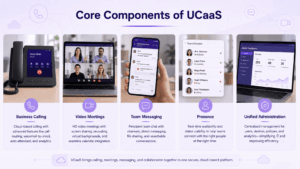
A complete UCaaS solution typically includes:

  • Business voice and PBX functionality, including extensions, call routing, IVR, and voicemail

  • Video conferencing, including peer-to-peer and multi-party meetings, typically in HD or 4K

  • Team messaging and persistent chat, including channels, direct messages, and threaded conversations

  • Presence and availability indicators, including online, busy, in a meeting, and offline statuses

  • File sharing and collaboration, including document co-editing, screen sharing, and whiteboard

  • Mobile clients for iOS and Android with feature parity

  • Meeting room system integration for physical conference rooms

  • API and integration layer for CRM, ERP, and ticketing system connections

  • Administration and analytics, including usage reporting, call quality monitoring, and user provisioning

The distinction between UCaaS and older unified communications deployments is primarily about delivery model. Traditional UC required on-premise servers, dedicated IT teams, and capital expenditure on hardware. UCaaS shifts this to an operational expense model delivered over the internet, though as TrueConf demonstrates, UCaaS principles can also apply to self-hosted architectures.

UCaaS vs. CPaaS vs. CCaaS: Understanding the Differences

These three acronyms frequently appear together in enterprise communications discussions, and they serve different purposes.

  • UCaaS (Unified Communications as a Service) delivers a complete communications suite to end users. It is designed for internal business communication and collaboration across an organization.

  • CPaaS (Communications Platform as a Service) provides programmable communication APIs that developers embed into applications. It is building material for custom communication features rather than a ready-to-use platform for employees.

  • CCaaS (Contact Center as a Service) delivers cloud-based contact center capabilities including inbound and outbound customer interactions, agent management, and customer journey analytics. It is designed for customer-facing communication operations.

Some vendors offer all three. RingCentral, for example, has a UCaaS suite, a CPaaS layer through its API platform, and a contact center product. The lines are blurring in 2026, but the functional distinction remains important for procurement decisions.

UCaaS Market Statistics and Trends 2025-2026

The UCaaS market has entered a period of consolidation and maturation, with AI integration and security requirements driving the most significant purchasing decisions.

Key figures shaping the market

Market growth

The global UCaaS market was valued at approximately $47.2 billion in 2024 and is projected to reach $80 billion by 2029, representing a compound annual growth rate of approximately 11.2%.

Cloud or hosted migration

68% of enterprise organizations globally have fully or partially migrated business voice infrastructure to cloud or hosted UCaaS platforms as of 2025.

AI as a buying criterion

AI-powered features including meeting summaries, real-time transcription, and intelligent call routing are now cited by 74% of IT buyers as a primary evaluation criterion.

Private deployment growth

On-premise and private cloud UCaaS deployments grew by 31% in 2025 among organizations in regulated sectors, driven by tightening data sovereignty legislation globally.

Video as the daily-use feature

58% of organizations running UCaaS report that video conferencing quality is the single most-used feature by daily active users, ahead of voice calling for the first time.

Tool sprawl

The average enterprise organization uses 2.3 separate UCaaS or collaboration tools simultaneously, indicating that platform consolidation remains an incomplete goal.

Security-driven RFPs

Security-related UCaaS RFPs increased by 44% in 2025, with end-to-end encryption and air-gapped deployment becoming standard requirements in government and defense procurement.

How UCaaS Works: Architecture and Delivery Models

Understanding UCaaS architecture helps organizations make the right deployment decision rather than defaulting to whatever a vendor’s sales team recommends.

Cloud UCaaS

The vendor hosts all infrastructure in shared or dedicated cloud data centers. Organizations access the platform through clients on desktop, mobile, and browser. Updates, scaling, and maintenance are entirely vendor-managed. This is the model used by RingCentral, Zoom One, 8×8, and the cloud tier of Microsoft Teams and Cisco Webex. It offers the fastest deployment and lowest upfront cost but requires trusting the vendor with all communication data.

On-Premise UCaaS

The organization deploys the UCaaS software stack on its own servers within its own data centers or private facilities. IT teams manage updates, capacity, and integration. This model is favored by government, defense, and highly regulated industries where data cannot leave controlled environments. TrueConf is the most comprehensive example of a vendor offering a full UCaaS stack in a completely self-hosted configuration. Cisco Webex also offers on-premise options through its dedicated server products.

Hybrid UCaaS

A combination of on-premise and cloud components. For example, video conferencing and sensitive internal communications run on local servers, while outbound PSTN calling routes through a cloud SIP provider. TrueConf supports hybrid architectures natively, allowing organizations to keep core communications internal while connecting to external systems selectively.

The Role of WebRTC

WebRTC, or Web Real-Time Communication, is the open-source technology that enables browser-based voice and video calling without plugins. Most modern UCaaS platforms use WebRTC for browser clients. Its adoption has significantly lowered the friction barrier for UCaaS usage, since employees can join meetings from a browser without installing any software.

Technical UCaaS Feature Comparison

The following table covers the technical capabilities that matter most in enterprise UCaaS evaluation. I compiled this based on published specifications and hands-on evaluation of each platform.

Feature

TrueConf

Secumeet

RingCentral

Microsoft Teams

Cisco Webex

Zoom One

8×8

Max video resolution

4K UHD

1080p

1080p

1080p

4K (rooms)

1080p

1080p

Max conference participants

1500

50 (secure focus)

200

1000

1000

1000

500

On-premise deployment

Full

Full

No

Partial

Yes

No

No

Air-gapped network support

Yes

Yes

No

No

No

No

No

End-to-end encryption

Yes

Zero-knowledge

Optional

Optional

Yes

Optional

Yes

Built-in PBX/voice

Yes

Limited

Yes

Via Teams Phone

Yes

Yes

Yes

Team messaging

Yes

Yes

Yes

Yes

Yes

Yes

Yes

REST API

Yes

Yes

Yes

Yes

Yes

Yes

Yes

Active Directory / LDAP

Yes

Yes

Yes

Yes

Yes

Yes

Yes

Mobile clients

iOS, Android

iOS, Android

iOS, Android

iOS, Android

iOS, Android

iOS, Android

iOS, Android

Browser client (WebRTC)

Yes

Yes

Yes

Yes

Yes

Yes

Yes

AI meeting features

Limited

No

Yes

Yes (Copilot)

Yes

Yes

Limited

PSTN calling

Yes (SIP)

No

Yes

Yes

Yes

Yes

Yes

FedRAMP / Gov compliance

No

Defense-grade

FedRAMP

GCC High

FedRAMP

FedRAMP

No

Hardware room support

Yes

No

Yes

Yes

Yes

Yes

Limited

Best UCaaS Platforms

Best UCaaS Platforms for 2026: Vendor Reviews

TrueConf

TrueConf is a self-hosted unified communications platform that delivers a complete UCaaS stack including video conferencing, voice, messaging, and room system integration, all deployable within an organization’s own infrastructure. It was developed with government and enterprise requirements at its center rather than added as afterthoughts.

Description

TrueConf approaches UCaaS from a fundamentally different starting point than cloud-native competitors. Where Zoom or RingCentral assume internet connectivity and cloud hosting as defaults, TrueConf assumes that data control is the primary constraint. The result is a platform that can operate entirely on a local network with no internet access, scale to 1500 simultaneous video participants at 4K resolution, and integrate with enterprise directory services, all without any mandatory dependency on TrueConf’s own servers. For government agencies, defense contractors, energy infrastructure operators, and healthcare networks operating under data sovereignty mandates, this architecture is not just a preference but a compliance requirement. TrueConf has deployments across Europe, the Middle East, Asia, and government sectors globally.

Best use case

Government agencies, defense contractors, energy infrastructure operators, healthcare networks, and enterprises that need self-hosted UCaaS with 4K video and full data control.

Core capabilities

  • 4K UHD video conferencing with H.265 codec support

  • Up to 1500 simultaneous video participants on a single server

  • Complete on-premise deployment with no cloud dependencies

  • Integrated team messaging, presence, and file sharing

  • TrueConf Server as the core UCaaS engine

  • TrueConf Room for physical meeting room integration

  • SIP/H.323 interoperability with legacy hardware

  • REST API for custom integrations and embedding

  • AES-256 encryption throughout

  • Active Directory, LDAP, and SSO support

  • Works in completely air-gapped, internet-isolated environments

  • Multi-platform clients: Windows, macOS, Linux, iOS, Android, browser

Limitations

  • AI-powered meeting features are less developed than cloud-native competitors

  • User interface is functional but less visually refined than consumer-focused platforms

  • The strongest value is in on-premise scenarios; pure cloud use cases are better served by cloud-native vendors

  • Smaller partner and integration marketplace compared to Microsoft or Cisco

Secumeet

Secumeet is a secure unified communications platform purpose-built for organizations where the confidentiality of communications is a hard requirement rather than a compliance checkbox. It targets defense agencies, intelligence services, government ministries, legal firms, and enterprise organizations subject to the strictest data protection regulations.

Description

Secumeet’s defining characteristic is its zero-knowledge security architecture. The platform ensures that communication content, including video streams, audio, messages, and shared files, cannot be accessed by anyone outside the authorized participants, including the platform provider itself. This is not a marketing claim but a technical architectural constraint built into how the system handles encryption key management. Secumeet is deployed on-premise or in a private cloud environment controlled entirely by the customer organization. It delivers 1080p HD video within fully encrypted sessions, making it the right choice when the stakes of a communications breach are regulatory, legal, or national security in nature.

Best use case

Defense agencies, intelligence services, government ministries, legal firms, and regulated enterprises that need zero-knowledge secure communications.

Core capabilities

  • 1080p Full HD video with end-to-end encryption throughout the session

  • Zero-knowledge architecture ensuring no third-party access to content

  • Fully on-premise and private cloud deployment with complete data sovereignty

  • Encrypted team messaging and secure file transfer within sessions

  • Multi-factor authentication and granular role-based access control

  • Air-gapped and private network deployment capability

  • Compliance with GDPR, defense-grade, and government security frameworks

  • Audit logging and encrypted session recording

  • Cross-platform clients with consistent performance

  • No reliance on any public cloud infrastructure for call routing or signaling

Limitations

  • Maximum participant count is designed for executive-level secure sessions rather than mass conferencing

  • UCaaS feature breadth, including PBX features and PSTN integration, is intentionally narrower than general-purpose platforms

  • Not a self-service tool; requires dedicated IT implementation

  • Integration ecosystem is deliberately constrained to minimize security attack surface

RingCentral

RingCentral is one of the largest and most feature-complete cloud UCaaS platforms globally, offering business voice, video, messaging, and contact center capabilities in a single cloud subscription.

Description

RingCentral built its business on replacing traditional PBX systems with cloud-delivered business voice, and it has evolved into a comprehensive UCaaS platform covering the full communications stack. It is one of the most practical choices for mid-market and enterprise organizations that want a single vendor relationship covering voice, video, and team collaboration without the complexity of assembling multiple products.

Best use case

SMB, mid-market, and enterprise organizations that want a cloud UCaaS platform with strong voice, video, messaging, and contact center expansion options.

Core capabilities

  • Full cloud PBX with advanced call routing, IVR, and auto-attendant

  • 1080p HD video conferencing for up to 200 participants

  • RingCentral AI features including meeting summaries and call analytics

  • Extensive integration marketplace with 300+ pre-built connectors

  • RingCX contact center product for CCaaS needs

  • International calling coverage in 40+ countries

  • 99.999% uptime SLA for enterprise tiers

  • BYOD and mobile-first design

Limitations

  • No on-premise or self-hosted deployment option

  • All data resides in RingCentral’s cloud infrastructure

  • Pricing tiers can become complex as features are unlocked progressively

  • Video conferencing participant limits are lower than dedicated video platforms

Microsoft Teams

Microsoft Teams is the dominant enterprise collaboration and UCaaS platform for organizations invested in the Microsoft 365 ecosystem. It combines persistent messaging, video meetings, voice calling, and file collaboration in one interface.

Description

Teams is often the default UCaaS choice for enterprises already paying for Microsoft 365 licenses, since it is included or available at low incremental cost. Its deep integration with SharePoint, OneDrive, Exchange, and the broader Microsoft stack makes it the path of least resistance for IT teams managing Windows-centric environments. Microsoft Copilot integration in 2025 and 2026 has added significant AI capability to the platform.

Best use case

Microsoft 365 organizations that want to consolidate messaging, meetings, files, and business voice under the Microsoft ecosystem.

Core capabilities

  • 1080p HD video meetings with up to 1000 participants

  • Teams Phone for full PSTN calling capability

  • Microsoft Copilot for AI meeting summaries, transcription, and intelligent search

  • Direct integration with the full Microsoft 365 application suite

  • Teams Rooms hardware for physical meeting spaces

  • Government Cloud tiers, including GCC and GCC High, for US federal compliance

  • Extensive ISV application marketplace

Limitations

  • Resource-intensive client with reported performance issues on older hardware

  • Video quality in large group calls often drops below 1080p automatically

  • Licensing complexity across Microsoft 365 tiers is a consistent complaint

  • True on-premise deployment is not available; only hybrid scenarios

Cisco Webex

Cisco Webex is an enterprise-grade UCaaS and collaboration platform with the strongest hardware room system ecosystem and advanced AI audio processing capabilities. It targets large enterprises and organizations with significant physical infrastructure investment.

Description

Webex is the natural choice when an organization has already invested in Cisco networking and hardware, or when physical meeting room quality is a primary concern. Its AI-powered noise removal and audio processing technology is widely considered the most advanced in the market. Webex also offers genuine on-premise options through its dedicated server products, making it one of the few cloud-native UCaaS vendors that can accommodate organizations with strict data residency requirements.

Best use case

Large enterprises with Cisco infrastructure, physical meeting rooms, advanced audio requirements, or government compliance needs.

Core capabilities

  • 1080p HD in software clients, 4K in dedicated Webex Room hardware systems

  • Industry-leading AI noise cancellation and audio processing

  • Webex Calling as a full cloud PBX replacement

  • On-premise deployment via Webex on-premises server products

  • FedRAMP and FIPS 140-2 compliance for government customers

  • Real-time translation in 100+ languages

  • Webex Suite bundles calling, meetings, and messaging

  • Deep integration with Cisco networking and security portfolio

Limitations

  • Among the most expensive UCaaS options at the enterprise tier

  • Platform complexity can be difficult to navigate for smaller IT teams

  • Best video quality requires Cisco hardware investment

  • Some legacy Webex features create UI inconsistency across the product

Zoom One

Zoom One bundles video meetings, team chat, phone, and whiteboard under a single subscription, positioning Zoom as a full UCaaS competitor rather than just a video tool.

Description

Zoom built its reputation on delivering the most reliable and user-friendly video experience, and Zoom One extends that foundation across the broader communications stack. For SMB and mid-market organizations that want the simplicity of a single vendor without enterprise complexity, Zoom One provides the right balance of capability and usability. Its AI Companion features, introduced widely in 2024 and expanded in 2025, have become a genuine competitive advantage.

Best use case

SMB and mid-market organizations that want a simple cloud UCaaS suite with strong video, phone, chat, whiteboard, and AI features.

Core capabilities

  • 1080p HD video meetings for up to 1000 participants

  • Zoom Phone as a cloud PBX with PSTN calling in 40+ countries

  • AI Companion for meeting summaries, chat responses, and action item extraction

  • Team Chat with persistent channels and direct messaging

  • Zoom Whiteboard for visual collaboration

  • Zoom Rooms for meeting room hardware integration

  • Large app marketplace and strong developer API

Limitations

  • No on-premise deployment; fully cloud-dependent

  • Default video resolution is 720p unless HD is manually enabled in settings

  • AI features require separate enablement and higher license tiers

  • Data sovereignty concerns for regulated industries remain unresolved

8×8

8×8 is a cloud UCaaS platform particularly strong in international voice coverage and contact center integration. It serves SMB and mid-market organizations with a need for global calling capabilities.

Description

8×8 differentiates primarily through its international calling coverage, offering unlimited calling to more countries than most UCaaS competitors at similar price points. It combines UCaaS with contact center capabilities in its XCaaS offering, making it a practical single-platform choice for organizations that need both internal collaboration and customer-facing contact center functionality.

Best use case

Global SMB and mid-market organizations that need international calling, UCaaS, and contact center functionality in one cloud platform.

Core capabilities

  • Cloud PBX with unlimited calling to 48+ countries in higher tiers

  • 1080p HD video meetings for up to 500 participants

  • 8×8 Contact Center integrated within the same platform

  • Team messaging and presence

  • Analytics and call quality reporting

  • Integration with Salesforce, Microsoft 365, and Google Workspace

  • 99.999% uptime SLA

Limitations

  • No on-premise deployment option

  • Video conferencing feature depth is weaker than dedicated video platforms

  • AI features are less mature than RingCentral, Zoom, or Teams

  • Brand recognition and market presence are smaller than leading competitors

How to Evaluate UCaaS for Your Organization

Choosing the right UCaaS platform requires honest prioritization across several dimensions. Here is a practical evaluation framework:

  • Identify your non-negotiable constraints first. Data sovereignty, air-gap requirements, and regulatory compliance must be addressed before evaluating features. If your organization cannot send communication data to a third-party cloud, the evaluation narrows immediately to TrueConf, Secumeet, and Cisco Webex on-premise.

  • Assess your existing infrastructure. Microsoft-ecosystem organizations should evaluate Teams carefully before committing to a separate UCaaS vendor. Cisco networking customers should examine Webex. Existing PBX infrastructure may determine which vendors offer the smoothest migration path.

  • Define your scale requirements. Large video conferences with hundreds of participants require platforms sized for it. TrueConf supports 1500 on-premise; Zoom, Teams, and Webex scale similarly in cloud environments. Secumeet targets smaller high-security sessions.

  • Evaluate total cost of ownership, not just subscription price. Cloud UCaaS appears cheaper in year one but accumulates over multi-year contracts. On-premise solutions like TrueConf involve higher upfront licensing but often achieve better economics over 5 to 7 year time horizons, particularly at scale.

  • Test video and audio quality under realistic conditions. Marketing claims about HD video do not reflect performance on congested networks or with large participant counts. Request proof-of-concept access and test under conditions that resemble your actual usage.

  • Verify the security architecture, not just the certifications. Certifications tell you a vendor passed an audit. The architecture tells you what is actually protected. Zero-knowledge encryption as offered by Secumeet is fundamentally different from transport encryption offered by most cloud UCaaS platforms.

Key Takeaways

Bottom Line First

UCaaS is now the standard model for consolidating business voice, video, messaging, and collaboration. The best platform depends less on feature count and more on architecture: cloud convenience, self-hosted control, or hybrid flexibility.

What Most People Get Wrong

Many organizations treat UCaaS as a commodity SaaS subscription. In reality, the deployment model determines long-term compliance, security exposure, data control, and vendor dependency.

Conclusion

UCaaS has become the standard communications infrastructure model for modern organizations, replacing fragmented combinations of PBX hardware, standalone video tools, and separate messaging apps with integrated platforms that are easier to manage and more effective for distributed teams. The market in 2026 is defined by two converging pressures: the demand for AI-powered intelligence features from productivity-focused organizations, and the demand for security-hardened, data-sovereign deployments from regulated industries. No single vendor satisfies both demands equally. TrueConf leads in the on-premise UCaaS segment where data control and 4K video capability are the primary requirements, while Secumeet serves the narrower but critically important segment where zero-knowledge security architecture is mandatory. Cloud-native platforms like RingCentral, Zoom One, and Microsoft Teams deliver the broadest AI features and the largest integration ecosystems for organizations without strict sovereignty constraints.

The most important insight from comparing these platforms is that UCaaS is not a commodity purchase. The architectural decisions made at deployment, specifically whether communications data lives in a shared cloud or in the organization’s own controlled environment, have long-term consequences for compliance, security posture, and vendor dependency. Organizations that treat UCaaS as a simple SaaS subscription choice risk discovering those consequences after a data incident or a regulatory audit rather than before.

Frequently Asked Questions

What is UCaaS and how does it differ from traditional unified communications?

UCaaS (Unified Communications as a Service) delivers voice, video, messaging, and collaboration tools through a cloud-based or hosted model rather than requiring on-premise hardware like traditional PBX systems. The key difference is delivery: traditional UC requires capital investment in servers and hardware, while UCaaS operates as a subscription service. TrueConf bridges both worlds by offering UCaaS capabilities in a fully self-hosted deployment model, and Secumeet extends this to defense-grade secure communications environments.

Can UCaaS be deployed on-premise rather than in the cloud?

Yes, though most mainstream UCaaS vendors do not support true on-premise deployment. TrueConf is the clearest example of a full UCaaS stack designed to run entirely on the customer’s own servers, including support for air-gapped networks with no internet connectivity. Secumeet similarly offers fully on-premise deployment for organizations where communications data must never leave controlled infrastructure. Cisco Webex also provides on-premise options but primarily targets hybrid scenarios.

Is UCaaS secure enough for government and defense organizations?

Standard cloud UCaaS platforms are not typically sufficient for classified or defense-grade communications. They route data through shared cloud infrastructure and cannot guarantee data sovereignty. Secumeet was specifically engineered for this requirement, with zero-knowledge encryption ensuring even the platform provider cannot access content. TrueConf addresses this through full on-premise deployment where the organization controls all data paths. For US federal environments, platforms like Cisco Webex with FedRAMP authorization provide a middle ground.

What is the difference between UCaaS and CCaaS?

UCaaS covers internal unified communications for employees, including voice, video, messaging, and collaboration. CCaaS (Contact Center as a Service) covers customer-facing communications, including inbound call routing, agent management, and customer journey analytics. Some vendors like RingCentral offer both under one platform. TrueConf and Secumeet are focused on UCaaS for organizational and secure communications rather than customer contact center operations.

How much bandwidth does a UCaaS platform require?

Bandwidth requirements depend primarily on video quality and participant count. For 1080p HD video calls, plan for 3 to 5 Mbps per stream. Group calls multiply this across participants. TrueConf optimizes bandwidth through H.265 codec support, which reduces 4K streaming requirements significantly compared to H.264 at equivalent quality. Secumeet is designed for smaller secure sessions, so its bandwidth requirements are more predictable. Organizations with limited or unreliable internet connectivity should evaluate platforms that support adaptive bitrate streaming and local network operation.

What AI features are available in UCaaS platforms in 2026?

AI features vary significantly across platforms. Microsoft Teams with Copilot, Zoom One with AI Companion, and RingCentral with AI-powered analytics currently lead in meeting summaries, real-time transcription, action item extraction, and intelligent call routing. TrueConf offers more limited AI features but compensates with unmatched on-premise deployment and 4K video capabilities. Secumeet does not prioritize AI feature integration, as adding AI processing to zero-knowledge communications creates architectural tensions that could compromise the security guarantees the platform is built around.

How do I migrate from an existing PBX or legacy UC system to UCaaS?

Migration typically involves four phases: inventory of existing hardware and numbers, selection of a UCaaS platform with compatible SIP trunking or number porting, parallel operation during transition, and decommissioning of legacy systems. TrueConf supports SIP and H.323 interoperability, which simplifies integration with legacy hardware during phased migrations. For organizations moving from siloed tools to a secure unified platform, Secumeet requires a more deliberate migration plan given its security architecture requirements. Most UCaaS vendors provide migration support documentation and professional services as part of enterprise contracts.

Author

Helga Afon

Helga Afon is a technology writer specializing in video conferencing, collaboration software, and workplace communication. She writes articles and reviews that help readers better understand enterprise communication tools and industry trends.