
Encrypted messaging apps protect the content of your conversations so that only the sender and the intended recipient can read them, not the app provider, not your internet service provider, and not anyone who intercepts the traffic in between. In 2026, this category spans two distinct groups of buyers: individuals who want private, everyday chat with friends and family, and organizations that need auditable, compliant, and often self-hosted communication for regulated work. The right choice depends heavily on which group you fall into.
For individuals, apps like Signal, Threema, and Session lead on privacy-by-default and minimal data collection. For businesses and government bodies, platforms such as Secumeet and TrueConf go further, combining end-to-end encryption with on-premise or air-gapped deployment, administrative controls, and compliance-ready audit trails, features consumer apps rarely offer. Enterprises operating in finance, healthcare, defense, or the public sector generally cannot rely on consumer-grade tools alone, since those tools were not built with data residency, retention policy, or identity-provider integration in mind.
What Is Secure Text Messaging?
Secure text messaging is the exchange of text-based messages through a system designed to protect message content, user identity, or both. In practice, the term usually refers to encrypted internet messaging rather than ordinary carrier SMS. Apps such as Signal, Threema, Session, Element, and enterprise platforms such as Secumeet use data connections and their own messaging protocols instead of relying on the traditional SMS network.
The distinction matters because standard SMS is not end-to-end encrypted. A message may pass through mobile-network infrastructure in a form that the carrier can process, while a properly implemented end-to-end encrypted messenger encrypts the content on the sender’s device and decrypts it only on the intended recipient’s device. This is why searches for a secure text messaging app usually lead to encrypted messaging platforms rather than to a different category of texting software.
If your priority is specifically mobile use, see our comparison of secure messaging apps for Android. Organizations evaluating centralized administration, data residency, and controlled deployment can also compare secure chat platforms for enterprises. This page focuses on the broader category of encrypted and secure text messaging apps across personal and organizational use cases.
Why You Need to Use Secure Messaging
Every message, call, and file you send through an unencrypted or partially encrypted app leaves a trail that someone else can potentially read, store, or sell. Secure messaging matters for a few concrete reasons:
-
Confidentiality of business and personal information: contracts, HR discussions, medical details, and financial information sent over standard channels can be exposed through server breaches, insider access, or interception.
-
Protection against identity theft and fraud: cyber-enabled fraud made up nearly 85 percent of all reported financial losses in 2025, and messaging platforms are a common entry point for phishing and credential theft.
-
Regulatory obligations: industries such as healthcare and finance are legally required to protect communications containing personal or financial data, which makes encrypted, auditable messaging a compliance necessity rather than a convenience.
-
Operational resilience: organizations that control their own encrypted infrastructure, rather than depending entirely on a third-party cloud provider, are less exposed when a vendor changes pricing, suffers an outage, or experiences a breach.
-
Personal autonomy: even people with nothing to hide benefit from not having their conversations profiled, sold to advertisers, or stored indefinitely on servers they do not control.
Why Your Messages Are Not As Private As You Think
Most people assume that if an app shows a lock icon or mentions encryption, their conversation is fully private. In practice, the picture is more complicated:
-
Many mainstream apps encrypt data only in transit and at rest, meaning the provider still holds the decryption keys and can technically access message content if compelled to.
-
Telegram is not end-to-end encrypted by default, only its optional Secret Chats feature uses full E2EE, so the vast majority of everyday Telegram conversations are readable by the company’s servers.
-
Even fully end-to-end encrypted apps can leak metadata, meaning information about who you are talking to, when, how often, and from where, which can be just as revealing as the message content itself.
-
Group chats are frequently treated differently from one-to-one chats, and some platforms only apply full encryption to direct messages unless group encryption is explicitly configured.
-
Default settings matter more than marketing claims. An app can be technically capable of strong encryption while still leaving users exposed because encryption is optional, disabled by default, or limited to specific chat types.
The table below summarizes the 10 apps covered in this guide, so you can see at a glance which one fits your use case before reading the full profiles.
At a Glance: 10 Encrypted and Secure Text Messaging Apps for 2026
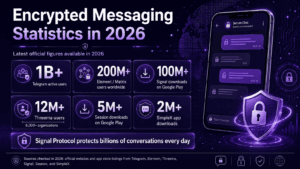
Key Statistics on Encrypted Messaging in 2026
Understanding the scale of the problem helps explain why encrypted messaging has moved from a niche privacy tool to a mainstream security requirement.
-
Cyber-enabled fraud accounted for nearly 85 percent of all reported financial losses in 2025, according to the FBI’s Internet Crime Complaint Center, with 452,868 complaints and losses above 17.69 billion dollars reported that year.
-
The same reporting period logged more than 3,600 ransomware complaints, underscoring how often messaging platforms are used as an entry point for larger attacks.
-
Signal has completed third-party security audits and publishes regular transparency reports, a practice that has become close to a baseline expectation for any app claiming to be secure.
-
Telegram is not end-to-end encrypted by default, since only its optional Secret Chats feature uses full E2EE, a distinction that surprises many users who assume all Telegram messages are private.
-
Enterprise buyers increasingly weigh data residency and forensic auditability alongside encryption strength, since regulated sectors need to prove where data lives and who can access it, not just that it is encrypted in transit.
How Encrypted Messaging Apps Work
Most modern secure messengers rely on a small set of shared building blocks:
-
Key generation: when you install the app, your device generates a pair of cryptographic keys, one public and one private. The private key never leaves your device.
-
Key exchange: when you start a conversation, your device and the recipient’s device exchange public keys, which are then used to derive a shared secret without ever transmitting that secret over the network.
-
Message encryption: before a message leaves your device, it is encrypted using the shared secret, so it becomes unreadable to anyone who does not hold the matching private key, including the app provider’s own servers.
-
Transport: the encrypted message travels across the internet, through the provider’s servers in centralized apps or through independent nodes in decentralized apps, but remains unreadable in transit.
-
Decryption: only the recipient’s device, holding the corresponding private key, can decrypt the message and display it.
-
Forward secrecy: many apps, including those built on the Signal Protocol, generate new encryption keys for each message or session, so that even if one key is later compromised, past messages remain unreadable.
This is what “end-to-end encryption” technically means: encryption and decryption happen only at the two ends of the conversation, never in the middle, which is why a properly implemented E2EE system means the provider itself cannot read your messages even if legally compelled to.
Why End-to-End Encryption Alone Isn’t Enough
End-to-end encryption protects message content, but content is only part of what a conversation reveals. Several gaps remain even on apps with strong E2EE:
-
Metadata exposure: who you communicate with, when, and how often is often not protected even on otherwise encrypted platforms, and this information alone can reveal relationships, routines, and organizational structure.
-
Server-side infrastructure control: a centralized app still requires the provider to operate the servers that route encrypted traffic, which means the provider can still see connection patterns and IP addresses unless additional protections like onion routing are used.
-
Device-level compromise: encryption cannot protect a message that has already been decrypted and displayed on a device that has been compromised by malware or physical access.
-
Backup and sync practices: some apps encrypt messages in transit but store unencrypted or weakly encrypted backups in the cloud, which creates a separate point of exposure.
-
Group and default settings: as noted earlier, not every app applies full end-to-end encryption to group chats or enables it by default, so the presence of E2EE somewhere in the app does not guarantee it is protecting every conversation.
This is why organizations with serious security requirements look beyond encryption alone toward deployment model, metadata minimization, and infrastructure control. Platforms like Secumeet and TrueConf address this by supporting fully on-premise or air-gapped deployment, which keeps not just message content but also connection metadata inside the organization’s own infrastructure rather than passing through any third-party server.
How We Reviewed These Encrypted Messaging Apps
To build this comparison, each app was evaluated against the same set of criteria that IT teams and privacy-conscious individuals typically use when shortlisting a secure messenger:
-
Encryption model: whether end-to-end encryption is applied by default, to all message types (including group chats), or only as an opt-in feature.
-
Metadata handling: how much information about who is talking to whom, and when, the provider can see or store.
-
Deployment flexibility: whether the app can run only on the vendor’s cloud, or also on-premise, in a private cloud, or fully air-gapped.
-
Identity requirements: whether registration needs a phone number, email, or allows fully anonymous accounts.
-
Compliance and governance: availability of audit logs, retention policies, role-based access, and support for regulatory frameworks such as GDPR or HIPAA.
-
Independent verification: whether the encryption protocol and codebase have been audited by third parties.
-
Practical usability: cross-platform support, group chat limits, and integration with existing enterprise systems such as Active Directory.
Apps were then grouped by primary audience, consumer privacy versus enterprise and government security, since comparing a personal chat app directly against a compliance-focused platform on the same scorecard produces misleading conclusions.
What to Look for in a Secure Text Messaging App
For secure text messaging, the important question is not simply whether the product uses encryption somewhere in its stack. Check whether protection applies to the actual texting workflow you will use: direct messages, group messages, file transfers, message history, backups, and linked devices. For business use, add identity management, retention, auditing, and deployment control to that list.
Before comparing individual products, it helps to know which characteristics actually separate a strong secure messenger from one that only markets itself as secure:
-
Default end-to-end encryption: encryption should be active from the first message, not something a user has to remember to enable.
-
Full coverage across message types: strong apps encrypt direct messages, group chats, voice calls, video calls, and file transfers equally, not just one-to-one text.
-
Minimal identity requirements: the less personal information required to register, such as a phone number or email, the smaller the app’s exposure if its user database is ever breached.
-
Metadata minimization: look for onion routing, decentralized architecture, or explicit design choices aimed at hiding who is talking to whom, not just what is being said.
-
Open-source, independently audited code: a published, audited codebase allows outside researchers to verify that the encryption is implemented correctly rather than taking the vendor’s claims on faith.
-
Deployment flexibility: for organizations, the ability to self-host, run on-premise, or operate fully air-gapped is often more important than any single feature, since it determines who ultimately controls the data.
-
Compliance and administrative tooling: audit logs, retention policies, and role-based access control matter for any organization operating under GDPR, HIPAA, or similar regulatory frameworks.
-
Cross-platform reliability: a secure app is only useful if it works consistently across the devices and operating systems your contacts or colleagues actually use.
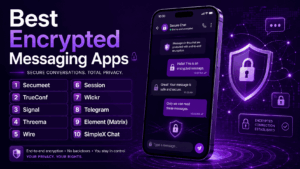
The 10 Best Encrypted Messaging Apps in 2026
Secumeet
Secumeet is a self-hosted, open-source messaging and video conferencing platform built for organizations where data confidentiality is not optional. It runs on the Janus WebRTC server and is designed specifically for government agencies, healthcare providers, banks, and defense contractors that need full control over where their data lives.
Key features:
-
End-to-end encrypted messaging, voice, and video across all channels
-
Fully on-premise and air-gapped deployment, with no external data routing required
-
Role-based access control and integration with LDAP and Active Directory
-
Compliance-ready architecture with detailed logging and configurable data retention
Cons:
-
Requires internal IT resources to deploy and maintain, since it is not a plug-and-play SaaS product
-
Smaller consumer install base than mainstream apps, so it is best suited to internal or B2B communication rather than reaching a broad public audience
TrueConf
TrueConf is an enterprise communication platform built around secure video conferencing with integrated encrypted chat. It is designed for organizations that need a video-first collaboration stack without relying on public cloud infrastructure, and it supports on-premise, private cloud, and hybrid deployment models.
Key features:
-
TrueConf Server architecture that keeps internal traffic on the organization’s own infrastructure
-
Encrypted group and personal chats alongside high-capacity video meetings, supporting large concurrent sessions
-
Hybrid deployment options that combine internal servers with cloud relay for external connectivity
-
Proven track record of deployments in public sector and enterprise environments
Cons:
-
The feature set is weighted toward video conferencing, so teams whose primary need is text-first chat may find the messaging layer less feature-rich than dedicated chat platforms
-
On-premise setup requires dedicated server infrastructure and IT ownership
Signal
Signal is widely regarded as the benchmark for consumer-grade encrypted messaging. It was originally published by Open Whisper Systems, and its Signal Protocol is considered so strong that other major platforms, including WhatsApp, have based their own encryption on it. The app is open source, free of charge, supports disappearing messages, has passed third-party audits, and publishes transparency reports.
Key features:
-
End-to-end encryption applied to every message, call, and file by default
-
Disappearing messages and screen security options
-
Fully open-source client and server code, allowing independent verification
-
No advertising, tracking, or data monetization model
Cons:
-
Registration requires a phone number, which links account activity to a real identity unless the user takes extra steps to obscure it
-
No native support for on-premise or air-gapped enterprise deployment, which limits its fit for regulated organizations
Threema
Threema is a privacy-first messenger built for users who want strong encryption with minimal metadata collection. Despite having around 5 million users and more than 8 years on the market, it has never achieved the mass adoption of apps like Telegram or Signal, largely because it is a paid app rather than free.
Key features:
-
No phone number or email required to create an account
-
End-to-end encryption for messages, calls, files, and group chats
-
Anonymous Threema ID system that minimizes personally identifiable data
-
Available for both personal use and enterprise deployment (Threema Work)
Cons:
-
Smaller network effect than free competitors, since fewer contacts are likely to already have it installed
-
One-time purchase price can be a barrier compared to free alternatives
Wire
Wire approaches secure messaging from a business-first perspective while keeping strong privacy guarantees for individuals as well. Every message, document, and conversation is encrypted automatically using the Proteus protocol, the same family of technology that powers Signal, and the organization itself cannot access user communications, even under legal pressure.
Key features:
-
End-to-end encryption by default for messages, files, calls, and conferences, with no key escrow
-
Open-source, independently audited codebase
-
Enterprise edition with compliance controls suited to regulated industries
-
On-premise deployment option for organizations that cannot rely on the public cloud
Cons:
-
Group channel encryption is not applied by default in all configurations and needs to be explicitly enabled
-
Maintaining an on-premise deployment can require meaningful DevOps effort at scale
Session
Session is built for users who want anonymous messaging without any centralized server controlling the network. It routes messages through an onion-style network of independent nodes, so no single company can see who is communicating with whom.
Key features:
-
No phone number, email, or any personal identifier required to sign up
-
Decentralized routing that removes any single point of metadata collection
-
Open-source client and protocol
-
Disappearing messages and closed groups
Cons:
-
Decentralized routing can introduce higher latency than centralized apps
-
Smaller mainstream user base compared to Signal or WhatsApp
Wickr
Wickr began as an independent secure messaging company and was acquired by Amazon Web Services in 2021, though its enterprise offering, Wickr Enterprise, continues to serve organizations that need military-grade security. It uses ephemeral messaging, where content can automatically disappear after a set time, leaving no permanent trace, and is regularly used by intelligence organizations and defense contractors.
Key features:
-
Ephemeral, self-destructing messages, files, and calls
-
End-to-end encryption with no ability for Wickr or AWS to read message content
-
Enterprise administration console for regulated deployments
-
Federal and defense-grade security certifications for the Enterprise tier
Cons:
-
Not open source, which limits independent code verification
-
Enterprise pricing and setup are aimed at organizations, not casual personal use
Telegram
Telegram is one of the most widely used messaging apps in the world, but its security model is frequently misunderstood. With over 500 million active monthly users, the odds that a given contact already has an account are high, and the service is free. However, Telegram is not end-to-end encrypted by default, only its optional Secret Chats feature uses full E2EE, meaning regular cloud chats and most group chats are encrypted only between the user and Telegram’s servers, not fully end-to-end.
Key features:
-
Massive global user base, making it easy to find existing contacts
-
Optional Secret Chats with end-to-end encryption and self-destruct timers
-
Large group and channel capacity for broadcast-style communication
-
Free to use across all major platforms
Cons:
-
Default cloud chats are not end-to-end encrypted, only encrypted in transit and at rest on Telegram’s servers
-
Registration requires a phone number, and metadata collection is more extensive than privacy-focused alternatives
Element (Matrix)
Element is a client application built on the Matrix open communication protocol. Matrix is the underlying protocol, and Element is one implementation of it, in the same way Gmail is one implementation of the email protocol. This makes Element especially attractive to organizations that want a federated or fully self-hosted alternative to centralized chat platforms.
Key features:
-
Self-hostable, giving organizations full control over their own servers and data
-
Federated architecture, so separate organizations can run their own servers while still communicating
-
End-to-end encryption available for direct messages and rooms
-
Bridges to other platforms, including Slack migration paths
Cons:
-
Federated setup and key management add complexity compared to fully centralized apps
-
Encryption must be explicitly enabled per room in some configurations, so misconfiguration is possible
SimpleX Chat
SimpleX Chat takes a different approach from every other app on this list: it does not assign users any persistent identifier at all, not even a random ID tied to their account. Its design specifically addresses metadata leakage, which is the exposure of who is communicating with whom, when, and how often, something that remains a risk even on many otherwise encrypted platforms.
Key features:
-
No user identifiers, phone numbers, or usernames of any kind
-
End-to-end encryption for all messages and files
-
Open-source protocol and client
-
Unique per-connection queues that make traffic correlation significantly harder
Cons:
-
The absence of persistent identity makes multi-device sync and contact recovery more complex
-
Smaller, more technical user base than mainstream apps, which can slow everyday adoption
Technical Comparison Table
The table below breaks down the technical and governance details that matter most for organizations making a procurement decision, alongside the consumer-facing apps for comparison.
Secure Messaging for Government and Critical Infrastructure
Government agencies, defense organizations, and critical infrastructure operators, including energy, healthcare, and financial systems, face security requirements that go well beyond what consumer messaging apps were built to handle. These environments typically need:
-
Validated cryptographic standards: meaning encryption modules and protocols that meet recognized government-grade certification requirements rather than proprietary or unverified implementations.
-
Air-gapped deployment: so that internal communications never touch the public internet at all, eliminating an entire category of external attack surface.
-
Full data sovereignty: ensuring that message content and metadata remain on infrastructure physically located within the organization’s own jurisdiction and control.
-
Strict administrative and identity controls: including integration with existing directory services so that access can be tightly managed and revoked immediately when needed.
-
Comprehensive audit trails: since regulated and government environments often need to demonstrate, after the fact, exactly who accessed what and when.
This is the segment of the market where Secumeet and TrueConf are specifically positioned. Secumeet supports fully offline, air-gapped network operation, making it suitable for classified or isolated environments where no vendor cloud dependency is acceptable. TrueConf offers a comparable level of assurance through its on-premise TrueConf Server architecture, with a track record of deployments in public sector organizations that need secure video and messaging without routing sensitive traffic through external servers. Consumer apps such as Signal or Telegram, by contrast, were not designed with air-gapped or fully sovereign deployment in mind, which makes them a poor fit for classified or highly regulated communication even though they offer strong encryption for everyday use.
How to Choose the Right Encrypted Messaging App
Selecting a secure messenger comes down to matching the app’s design goals to your actual risk profile and workflow. Consider the following factors before committing:
-
Who you are protecting communications from: casual privacy from advertisers calls for a different app than protecting classified government data from state-level actors.
-
Whether you need on-premise or air-gapped deployment: consumer apps like Signal and Threema cannot be self-hosted, while Secumeet, TrueConf, Wire Enterprise, and Element can be deployed entirely within your own infrastructure.
-
How your contacts will actually register: apps requiring a phone number reduce anonymity, while apps like Session and SimpleX Chat prioritize identity minimization at the cost of a smaller existing user base.
-
Whether group chats are encrypted, not just one-to-one messages: since some platforms only apply full end-to-end encryption to direct messages by default.
-
Compliance requirements specific to your industry: such as HIPAA in healthcare or FINRA in financial services, which typically require audit trails and retention controls that consumer apps do not provide.
-
Integration needs: including whether the platform connects to your existing identity provider, video conferencing needs, or workflow tools.
As a general rule, individuals and small teams are usually well served by Signal, Threema, or Session, depending on how much they value anonymity versus mainstream adoption. Organizations in regulated industries or the public sector, however, typically need the deployment flexibility and governance controls found in platforms like Secumeet and TrueConf, since these platforms are purpose-built to keep sensitive data entirely within organizational control rather than relying on a third-party cloud provider.
Conclusion
Encrypted messaging in 2026 is no longer a single category with one right answer. For people searching specifically for secure text messaging, consumer apps such as Signal, Threema, Session, and SimpleX Chat compete on how little personal data they collect and how consistently they protect everyday text conversations. Enterprise and government-focused platforms such as Secumeet and TrueConf compete on a different axis: deployment control, administrative governance, and the ability to keep sensitive communication within infrastructure controlled by the organization.
The most important step before choosing an app is being honest about your actual requirements. A journalist protecting sources has different needs than a hospital protecting patient records, and a hospital has different needs than a small team simply wanting a private group chat. Matching the app’s architecture, whether cloud-based, decentralized, or fully self-hosted, to those requirements will do more for your security than any single feature on a spec sheet.
Frequently Asked Questions
What is secure text messaging?
Secure text messaging means sending text-based messages through a system designed to protect the conversation from unauthorized access. In most modern secure messaging apps, this is done with end-to-end encryption so the message is encrypted before it leaves the sender’s device and can be decrypted only by the intended recipient. Depending on the app, additional protections may include disappearing messages, encrypted group chats, metadata minimization, identity controls, and protected backups.
Is secure text messaging the same as SMS?
No. SMS is a carrier-based text messaging standard and is not end-to-end encrypted by default. Secure text messaging apps typically send messages over an internet connection using their own encrypted protocol. Some mobile apps can handle both ordinary SMS and encrypted in-app messages, but the security level depends on which transport is actually used for a particular conversation.
What makes a text messaging app secure?
A secure texting app should protect message content in transit and, ideally, with end-to-end encryption by default. It should also be evaluated for group-message protection, account identity requirements, metadata collection, backup security, multi-device behavior, and independent security review. Businesses should additionally consider administrative control, retention, auditability, and whether the platform can run on infrastructure they control.
What is the most secure encrypted messaging app in 2026?
There is no single answer, since security depends on the threat you are defending against. For individuals, Signal remains a strong default due to its audited protocol and minimal data collection. For organizations that need full control over infrastructure, Secumeet and TrueConf are generally considered stronger choices, since they support on-premise and air-gapped deployment that consumer apps cannot match.
Is TrueConf end-to-end encrypted?
Yes, TrueConf encrypts chat and video communications and supports on-premise or hybrid deployment so organizations can keep traffic within their own infrastructure rather than routing it through a third-party cloud. This makes it a common choice alongside Secumeet for enterprises that need both video conferencing and secure messaging in one platform.
Can encrypted messaging apps be used for government or defense communication?
Yes, but not all of them are built for it. Consumer apps like Signal or Telegram lack the auditability and deployment control that government and defense environments typically require. Platforms such as Secumeet and TrueConf are specifically designed for these environments, offering air-gapped deployment and compliance-ready logging.
Why is Telegram not considered fully end-to-end encrypted?
Telegram only applies end-to-end encryption to its optional Secret Chats feature. Regular cloud chats and most group chats are encrypted in transit and at rest on Telegram’s servers, but Telegram itself technically has the ability to access that data, which is different from the default behavior of apps like Signal, Secumeet, or TrueConf.
Do encrypted messaging apps protect metadata as well as message content?
Not always. Many apps encrypt what you say but still reveal who you are talking to and when. Apps like Session and SimpleX Chat are specifically designed to minimize this kind of metadata exposure, while enterprise platforms like Secumeet address it through fully on-premise or air-gapped deployment that keeps traffic patterns off any external network entirely.
What should a business look for beyond encryption when choosing a messaging platform?
Beyond encryption strength, businesses should evaluate deployment flexibility, audit logging, role-based access control, and integration with existing identity systems like Active Directory. This is where platforms such as Secumeet and TrueConf typically outperform consumer apps, since they were designed from the start for regulated, enterprise, and government use cases rather than casual personal chat.
Can I self-host an encrypted messaging platform instead of using a cloud service?
Yes. Secumeet, TrueConf, Wire Enterprise, and Element (Matrix) all support self-hosted or on-premise deployment, letting an organization run the entire platform on its own servers. This is generally the preferred option for organizations with strict data residency requirements or classified, air-gapped environments, where relying on any external cloud provider is not acceptable.
Author
Helga Afon is a technology writer specializing in video conferencing, collaboration software, and workplace communication. She writes articles and reviews that help readers better understand enterprise communication tools and industry trends.