
Decentralized messaging reduces dependence on a single company, server, or infrastructure operator. Instead of routing every conversation through one centrally controlled service, communication can be distributed across independently operated servers, network nodes, or user devices.
But decentralization does not automatically mean privacy.
A decentralized chat system may still expose metadata. A federated server may store messages. A peer-to-peer application may rely on relay, discovery, notification, or update services. End-to-end encryption is another separate property: it determines who can read message content, not who controls the network.
The most useful way to evaluate decentralized messaging is therefore to separate four questions:
Who controls the infrastructure? → Where are messages stored? → Who can read them? → What metadata remains visible?
Key Findings
-
Decentralized messaging distributes communication across independent servers, nodes, or peers instead of relying entirely on one centrally operated service.
-
Self-hosted messaging is not automatically decentralized. Running your own server changes ownership, but it may still leave one central point of control.
-
Federated, peer-to-peer, and distributed-node systems decentralize communication in different ways.
-
End-to-end encryption protects message content, while decentralization changes infrastructure control. Metadata protection is a separate issue.
-
Organizations searching for decentralized chat do not always need decentralization. Some primarily need private infrastructure, self-hosting, or control over data.
What Is Decentralized Messaging?
Decentralized messaging is a communication model in which messaging does not depend entirely on one centrally controlled service.
Depending on the architecture, messages may move between:
-
independently operated servers;
-
user devices;
-
distributed relay nodes;
-
protocol-based networks.
Decentralized chat is the conversational use case of this broader communication model.
A conventional centralized service normally has one organization responsible for the core infrastructure. A decentralized system distributes at least part of that responsibility among independent participants.
The important point is that decentralization describes network topology and control. It does not automatically describe encryption, anonymity, data retention, or metadata protection.
Decentralized vs Self-Hosted vs Encrypted Messaging
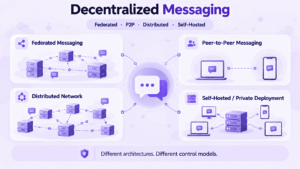
These concepts are often treated as interchangeable, but they solve different problems.
The simplest distinction is:
Self-hosting changes ownership. Decentralization changes topology and control.
A company can operate its own messaging server and retain complete control over where data is stored while still using a centralized architecture for its own users.
Likewise, a decentralized network can still have weak privacy if metadata or unencrypted data remains visible to participating infrastructure.
Decentralization Is Not the Same as Encryption
Encryption and decentralization protect against different risks.
End-to-end encryption protects message contents so that intermediaries cannot normally read protected conversations.
Decentralization reduces dependence on a single infrastructure operator, server, or administrative authority.
A messaging system can therefore be:
-
centralized and end-to-end encrypted;
-
decentralized without universal E2EE;
-
self-hosted but centralized;
-
federated and encrypted;
-
peer-to-peer while still depending on auxiliary infrastructure.
This is why a product should not be evaluated simply by whether it is described as secure, private, encrypted, or decentralized.
How Decentralized Messaging Works
There is no single decentralized messaging architecture. Different systems distribute control in different ways.
Federated Messaging
Federation works similarly to email.
Different organizations or individuals can operate their own servers, while a shared protocol allows those servers to communicate.
A simplified flow looks like this:
User A → Server A → Server B → User B
Matrix and XMPP are well-known examples of federated communication protocols. The original article also notes an important limitation: if one organization self-hosts the only server used by its employees, that server can still remain a single point of failure for those users.
Main advantage: independent organizations can control their own infrastructure while still communicating with one another.
Trade-off: federation increases administrative complexity and does not automatically provide anonymity or metadata protection.
Peer-to-Peer Messaging
Peer-to-peer messaging reduces reliance on a conventional central messaging server.
User devices participate more directly in communication and may rely on distributed discovery, local connectivity, or relay mechanisms.
Products discussed in the original material include Jami, Briar, and Tox.
A simplified architecture looks like:
Device A ↔ Device B
Real-world P2P applications may still use supporting services for functions such as discovery, relay, software updates, or mobile notifications.
Main advantage: fewer central infrastructure dependencies.
Trade-off: offline delivery, multi-device synchronization, message history, and large group communication can be more difficult to implement.
Distributed-Node Messaging
Another approach routes communication through multiple independent network nodes rather than through one central service.
Session is an example discussed in the source material. Its architecture is designed around a decentralized node network and emphasizes anonymity and metadata protection.
A simplified flow might look like:
Sender → Node → Node → Node → Recipient
Main advantage: reduces reliance on one operator and can make communication patterns harder to associate with individual users.
Trade-off: routing complexity, delivery latency, synchronization, and node availability become more important.
Blockchain and Wallet-Native Messaging
Some decentralized messaging systems connect user identity to crypto wallets or decentralized identifiers.
The source article lists XMTP, Status, and OpenChat as examples of this broader model.
Blockchain technology may be used for identity, addressing, governance, or other parts of the system, while message storage and delivery can rely on separate infrastructure.
This model is most relevant when messaging needs to integrate directly with:
-
wallet identities;
-
Web3 applications;
-
decentralized communities;
-
blockchain-based services.
Trade-off: onboarding and identity recovery can be harder for users unfamiliar with wallets and cryptographic keys.
Metadata Is a Separate Privacy Problem
Encrypting message content does not necessarily hide who communicated with whom.
Metadata may include:
-
sender and recipient information;
-
communication timestamps;
-
frequency of interaction;
-
participating servers or nodes;
-
device or network information.
The source material specifically identifies metadata leakage as an important concern and highlights Session and SimpleX Chat as examples of systems that address some forms of metadata exposure.
A useful way to separate the concepts is:
Decentralization answers who controls the network.
Encryption answers who can read the content.
Metadata protection answers who can observe communication patterns.
A secure messaging architecture should evaluate all three separately.
When Does Decentralized Messaging Make Sense?
Decentralization is most useful when the problem is specifically dependence on one infrastructure operator.
Typical scenarios include:
Independent organizational control. Multiple organizations want to operate their own communication infrastructure while still communicating with one another.
Reduced single-provider dependency. Communication should not stop because one cloud provider or central service becomes unavailable.
Censorship resistance. Removing a single infrastructure target makes complete network shutdown more difficult.
Peer-to-peer communication. Users want to minimize reliance on conventional message servers.
Wallet-native identity. Messaging needs to work directly with decentralized identities or Web3 applications.
However, not every privacy-sensitive organization actually needs a decentralized architecture.
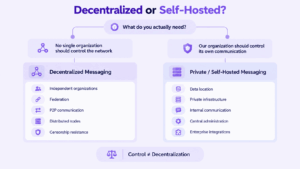
When Private or Self-Hosted Messaging Is Enough
Many organizations search for decentralized messaging because they want:
-
control over where data is stored;
-
private infrastructure;
-
on-premises deployment;
-
internal corporate communication;
-
independence from public SaaS;
-
centralized corporate administration.
These requirements can often be addressed by a self-hosted communication platform.
In this case, decentralizing the entire network may add complexity without solving an additional business problem.
If the requirement is “our organization must control the infrastructure,” self-hosting may be enough. If the requirement is “no single organization should control the network,” decentralization becomes more important.
5 Messaging Platforms for Decentralized or Private Communication
Not every platform in this section uses the same architecture.
Element, Session, and Jami represent different approaches to decentralized communication. Secumeet and TrueConf are included because organizations searching for decentralized messaging often have a related but different requirement: private or self-hosted communication under organizational control.
1. Element / Matrix

Best for: federated messaging between independently managed environments.
Element is a messaging client built around the Matrix ecosystem. Matrix uses federation, allowing separately operated homeservers to communicate with one another.
The source article describes Element as a flexible option in the decentralized messaging ecosystem with both hosted and self-hosted deployment options.
Architecture: Federated
Key strengths:
-
independent server operation;
-
cross-server communication;
-
open protocol;
-
self-hosting;
-
broad client ecosystem.
Best fit: organizations or communities that want control over their own servers without isolating users from other independently managed environments.
Trade-off: federation adds infrastructure and administration complexity, and privacy still depends on encryption, server configuration, and metadata handling.
2. Session
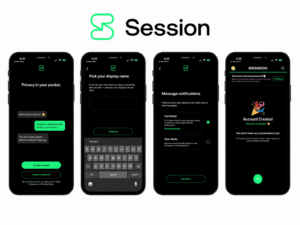
Best for: users who prioritize decentralization, anonymity, and reduced metadata exposure.
Session uses a distributed network of nodes rather than one conventional central messaging server.
The source material notes that Session does not require a phone number or email for registration and places particular emphasis on metadata protection.
Architecture: Distributed-node network
Key strengths:
-
reduced dependence on centralized identity;
-
decentralized message routing;
-
privacy-oriented architecture;
-
metadata protection focus.
Best fit: privacy-sensitive users where minimizing centralized infrastructure and identity exposure matters more than enterprise administration.
Trade-off: the product is less focused on centralized corporate administration and broad workplace collaboration than traditional enterprise communication platforms.
3. Jami
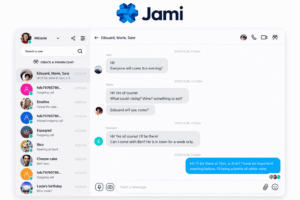
Best for: users who want peer-to-peer communication with minimal dependence on conventional messaging servers.
Jami belongs to the P2P category identified in the original article alongside Briar and Tox.
Architecture: Peer-to-peer / distributed
Key strengths:
-
reduced dependence on central messaging infrastructure;
-
direct communication model;
-
suitable for users specifically seeking P2P architecture.
Best fit: individuals or teams where avoiding a conventional central message server is an important technical requirement.
Trade-off: P2P architectures can make offline delivery, multi-device synchronization, and large group communication harder than in conventional server-based systems.
4. Secumeet

Best for: organizations that need private business messaging and video collaboration inside controlled infrastructure.
Secumeet belongs to a different architectural category than Element, Session, or Jami.
It is better understood as a private communication platform rather than a fully decentralized messenger.
The source material positions Secumeet around private deployment, business messaging, video communication, and infrastructure control.
Architecture: Private / self-hosted communication
Key strengths:
-
personal and group messaging;
-
video meetings;
-
screen sharing;
-
content collaboration;
-
centralized organizational administration;
-
private deployment options.
Best fit: regulated industries and enterprises whose real requirement is keeping business communication inside infrastructure they control.
Trade-off: infrastructure control is concentrated within the organization rather than distributed across independent nodes or peers.
That distinction is important:
Secumeet addresses private organizational communication rather than decentralization for its own sake.
5. TrueConf

Best for: enterprises that need self-hosted messaging combined with video conferencing and broader unified communications.
TrueConf is also better classified as a server-based, self-hosted communication platform rather than a conventional decentralized messenger.
The source article describes it as combining persistent chat, file sharing, video conferencing, and server-based deployment.
Architecture: Self-hosted / server-based
Key strengths:
-
persistent team messaging;
-
file sharing;
-
video conferencing;
-
corporate communication;
-
customer-controlled infrastructure;
-
integration with broader communication environments.
Best fit: organizations that want messaging and video communication under internal administrative and infrastructure control.
Trade-off: self-hosting changes who controls the communication server, but it does not by itself make the architecture decentralized.
Decentralized Messaging Platforms Compared
The table illustrates why architecture should be considered before comparing individual features.
Element, Session, and Jami distribute communication control in different ways.
Secumeet and TrueConf solve another common requirement: placing organizational communication under customer-controlled infrastructure.
Neither approach is universally better. They address different threat models and operational requirements.
Real-World Challenges of Decentralized Chat
Decentralization removes some dependencies but introduces others.
Message Delivery
Peer-to-peer systems may require users to be online simultaneously or rely on relay infrastructure for delayed delivery.
Multi-Device Synchronization
Maintaining consistent message history across phones, desktops, and additional devices is harder without an authoritative central store.
Identity and Key Recovery
Cryptographic identities can increase security but make recovery more complicated.
Losing a device or private key can have greater consequences than resetting a conventional account password.
Moderation
Decentralized communities still need mechanisms for:
-
spam prevention;
-
abuse management;
-
user blocking;
-
room moderation;
-
policy enforcement.
Removing central infrastructure does not remove these operational problems.
Mobile Notifications
Mobile operating systems frequently rely on platform-controlled notification services.
Privacy-focused messaging applications therefore need to balance:
-
notification reliability;
-
metadata exposure;
-
persistent background connections;
-
battery consumption.
Enterprise Administration
Companies frequently require:
-
centralized user management;
-
onboarding and offboarding;
-
directory integration;
-
retention policies;
-
auditability;
-
managed devices;
-
access controls.
Some decentralized architectures intentionally reduce centralized authority, which may conflict with these enterprise requirements.
How to Choose a Decentralized Messaging Platform
Do not begin with the product list.
Begin by identifying what actually needs to be decentralized.
1. What Dependency Are You Trying to Remove?
Is the concern:
-
one cloud vendor;
-
one messaging server;
-
one identity provider;
-
one organization controlling accounts;
-
one storage location?
Each problem can lead to a different architecture.
2. Who Is the Adversary?
This is one of the most useful questions in the original article’s selection framework.
Protecting against a cloud outage requires a different architecture from protecting against metadata analysis or censorship.
3. Do Independent Organizations Need to Communicate?
If multiple organizations need to operate their own infrastructure while communicating with one another, federation can be a strong fit.
If all users belong to one organization, self-hosting may be simpler.
4. Is Metadata Part of the Threat Model?
If the primary concern is message confidentiality, strong end-to-end encryption may solve much of the problem.
If communication relationships are also sensitive, evaluate:
-
identifiers;
-
routing;
-
server visibility;
-
metadata retention.
5. Do You Need Centralized Administration?
Enterprises may need administrators to manage:
-
users;
-
devices;
-
access;
-
retention;
-
policies;
-
compliance controls.
A highly decentralized system can make some of these functions more difficult.
6. Do You Need More Than Chat?
Messaging is often only one part of corporate communication.
If users also require:
-
video conferencing;
-
screen sharing;
-
file exchange;
-
corporate directories;
-
meeting rooms;
-
centralized administration;
a private communication platform such as Secumeet or TrueConf may be more practical than a specialized decentralized messenger.
FAQ
What is decentralized messaging?
Decentralized messaging distributes communication across independently operated servers, network nodes, or user devices instead of depending entirely on one centrally controlled messaging service.
What is decentralized chat?
Decentralized chat is a conversational messaging system in which infrastructure control is distributed across multiple servers, nodes, or peers rather than being concentrated entirely in one service provider.
What is the difference between decentralized and self-hosted messaging?
Self-hosted messaging means an organization operates its own communication server. Decentralized messaging distributes control across multiple independent servers, nodes, or peers. A self-hosted system can therefore remain centralized if one server still controls communication for the organization.
Is end-to-end encryption the same as decentralization?
No. End-to-end encryption protects message content. Decentralization describes how infrastructure and control are distributed. A centralized platform can use strong E2EE, while a decentralized system does not automatically guarantee end-to-end encryption.
What is the difference between federated and P2P messaging?
Federated messaging uses multiple independently operated servers that communicate with one another. Peer-to-peer messaging allows user devices to participate more directly in communication and reduces reliance on conventional central messaging servers.
Does decentralized messaging automatically protect metadata?
No. Messages can be encrypted while information about communication patterns remains visible. Metadata protection depends on the protocol’s identity, routing, storage, and server architecture.
Conclusion
Decentralized messaging is not simply another name for secure, encrypted, private, or self-hosted chat.
The key distinction is where control sits.
Federated systems distribute control among independent servers. Peer-to-peer systems reduce dependence on conventional messaging servers. Distributed-node networks spread routing or storage across multiple participants.
Self-hosted platforms such as Secumeet and TrueConf solve a related but different problem: they allow an organization to control its own communication infrastructure without necessarily decentralizing the network.
That difference should shape the selection process.
If multiple independent parties must control different parts of the network, consider federation, P2P, or distributed-node architectures.
If the main requirement is:
“Our organization must control its communication, data, and infrastructure,”
a private self-hosted platform may be the more practical solution.
The right choice therefore starts not with the longest feature list, but with four questions:
What must be decentralized? What must remain private? What metadata matters? Who needs operational control?
Once those requirements are clear, the choice between decentralized chat and private self-hosted messaging becomes much easier.
Author
Helga Afon is a technology writer specializing in video conferencing, collaboration software, and workplace communication. She writes articles and reviews that help readers better understand enterprise communication tools and industry trends.