
Scalable enterprise software helps organizations grow without repeatedly replacing the systems that support their core operations.
That growth may mean more employees, customers, transactions, offices, business units, workflows, or integrations. The right platform depends on which part of the organization needs to scale.
An ERP must accommodate more transactions, entities, and operational processes. A CRM needs to handle more customers, records, and sales workflows. Communication software must support more employees, meetings, messages, branches, and devices. Workflow platforms need to coordinate more departments and business processes.
This is why there is no single category of “scalable enterprise software.”
Instead, enterprises choose scalable platforms for different business functions.
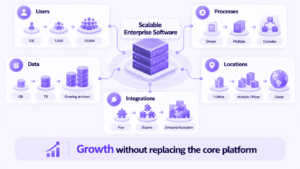
Scalable enterprise software allows an organization to expand users, processes, data, locations, and integrations without repeatedly replacing its core platform.
Best Scalable Enterprise Software at a Glance
1. SAP S/4HANA Cloud
SAP S/4HANA Cloud is designed for enterprises that need to scale core business operations across finance, procurement, manufacturing, supply chain, sales, and other functions. It is particularly relevant when growth means more transactions, additional legal entities, new markets, and greater process complexity rather than simply adding more users.
Its main advantage is the ability to expand within a broad ERP environment instead of replacing separate systems as the organization grows. SAP is best suited to large and multinational companies that need standardized operations, centralized data, and room to add new processes, regions, and business units over time.
2. TrueConf Server
TrueConf Server is a self-hosted enterprise communications platform that combines messaging, video conferencing, centralized administration, and integration with corporate infrastructure. It can connect with directories such as AD/LDAP and work with SIP/H.323 endpoints, PBX systems, meeting rooms, and private networks.
Its scalability is most relevant to organizations that need to expand communications across more users, offices, meeting rooms, and endpoints while keeping the environment under their own control. TrueConf is a strong fit for enterprises, government organizations, and regulated environments where communications infrastructure must remain self-hosted or operate inside private networks.
3. Oracle Fusion Cloud Applications
Oracle Fusion Cloud Applications combines ERP, HCM, supply chain, procurement, sales, and service functions in a broad cloud suite. This makes it suitable for enterprises that need to scale several business areas at the same time rather than deploy isolated applications for finance, workforce management, or operations.
The platform is best suited to large organizations that want to keep major enterprise processes within a connected cloud environment. Its scalability comes from supporting more employees, transactions, operational units, and business functions while maintaining shared data and administration across the suite.
4. Microsoft Dynamics 365
Microsoft Dynamics 365 combines CRM and ERP applications for sales, customer service, finance, supply chain, commerce, field service, and related business processes. Organizations can adopt individual applications first and expand into additional functions as their requirements become more complex.
This makes Dynamics 365 particularly suitable for companies already using Microsoft 365, Azure, or Power Platform. Its scalability is not limited to adding users: enterprises can expand customer operations, financial processes, service workflows, automation, and integrations without moving each new requirement to a separate platform.
5. Salesforce
Salesforce is a cloud CRM platform built around sales, customer service, marketing, commerce, automation, and customer data. It is designed for organizations that need to manage growing numbers of customers, sales representatives, service interactions, and automated workflows within the same ecosystem.
Its strongest scalability advantage is in customer-facing operations. Salesforce is well suited to organizations where growth creates more customer records, territories, service cases, sales processes, and integrations, while the platform remains the central environment for managing those interactions.
6. ServiceNow
ServiceNow is an enterprise workflow platform focused on areas such as IT service management, employee workflows, customer operations, and business process automation. It is particularly useful when organizational growth creates more service requests, approvals, incidents, and cross-department processes that become difficult to manage manually.
Its scalability is therefore primarily operational rather than transactional. ServiceNow is a strong fit for large organizations that need to standardize and automate workflows across multiple departments while keeping service management, governance, and administrative processes centralized.
7. Workday
Workday focuses on human capital management and financial management, making it especially relevant to organizations where growth creates more employees, organizational structures, HR processes, and financial complexity. It provides a shared environment for workforce planning, recruiting, compensation, reporting, and finance.
The platform is best suited to large and distributed organizations that need HR and finance processes to remain consistent as the workforce expands across departments and regions. Its scalability comes from supporting more employees and more complex organizational structures without turning workforce administration into a collection of disconnected systems.
8. Secumeet
Secumeet is a private enterprise collaboration platform that brings together messaging, video meetings, file exchange, screen sharing, and centralized administration. It is designed for organizations that want internal communication and collaboration to remain within a controlled environment rather than depend entirely on public cloud services.
Its scalability is most relevant when the number of employees, teams, conversations, meetings, and shared files grows together. Secumeet is a good fit for privacy-sensitive and regulated organizations that need a consistent collaboration environment while retaining greater control over infrastructure and internal communications.
Scalability Means Different Things for Different Enterprise Software
The eight platforms above solve very different business problems.
That is intentional.
There is no meaningful single feature table that can compare SAP ERP with Salesforce CRM or TrueConf communications.
The better comparison is what each type of platform needs to scale.
This distinction is important because scalability requirements should come from the business function.
A scalable CRM does not need to solve the same problems as scalable communication software.
Similarly, an ERP designed for multinational operations would be unnecessary for a company whose main scaling challenge is internal communication.
Which Type of Scalable Enterprise Software Do You Need?
The first step is to identify which part of the organization is becoming difficult to manage.
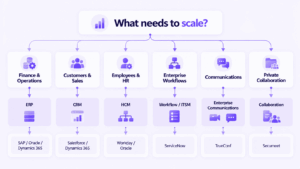
If finance and operations are growing
Consider:
-
SAP S/4HANA Cloud;
-
Oracle Fusion Cloud;
-
Microsoft Dynamics 365.
These platforms are designed around operational processes such as finance, procurement, supply chain, and business management.
If customer operations are growing
Consider:
-
Salesforce;
-
Microsoft Dynamics 365.
The main scaling requirements are likely to involve customer records, sales teams, service workflows, and automation.
If employee and financial management are growing
Consider:
-
Workday;
-
Oracle Fusion Cloud.
These platforms are more appropriate when workforce structure, HR processes, and finance are creating operational complexity.
If internal workflows are growing
Consider:
-
ServiceNow.
This is particularly relevant when the organization needs to standardize processes across departments.
If enterprise communications are growing
Consider:
-
TrueConf Server;
-
Secumeet.
TrueConf is a stronger fit when communications need to expand across self-hosted infrastructure, corporate directories, meeting rooms, SIP/H.323 systems, and multiple locations.
Secumeet is more appropriate when the main requirement is private internal messaging, meetings, files, and collaboration.
What Makes Enterprise Software Scalable?
The specific requirements differ by category, but scalable enterprise software usually has five characteristics.
It supports more users without proportionally more administration
Adding employees should not mean repeating every administrative task manually.
Enterprise systems commonly use:
-
groups;
-
roles;
-
directory integrations;
-
centralized administration;
-
automated provisioning.
The more the organization grows, the more important this becomes.
It can expand functionally
Scalable software should provide a growth path beyond the initial use case.
An ERP may add new modules.
A CRM may expand from sales into service.
A communication platform may expand from employee clients into meeting rooms and enterprise infrastructure.
The question is whether this expansion can happen without replacing the underlying platform.
It can integrate with other enterprise systems
Growing organizations usually add more applications rather than fewer.
APIs and standard integrations therefore become increasingly important.
Typical connections include:
-
identity providers;
-
ERP;
-
CRM;
-
HR systems;
-
communication platforms;
-
analytics;
-
security tools.
It supports organizational complexity
Large organizations have more than additional users.
They have:
-
departments;
-
subsidiaries;
-
administrators;
-
policies;
-
geographic regions;
-
external partners.
Scalable software needs an administrative model that reflects that structure.
It has a clear capacity growth path
Finally, the underlying system must be able to handle larger workloads.
The exact metric depends on the product.
For one platform it may be transactions.
For another it may be concurrent meetings, API requests, customer records, or employee accounts.
Cloud vs Self-Hosted Scalable Enterprise Software
Scalability does not require a single deployment model.
Many enterprise platforms, including Salesforce, Workday, and large parts of Oracle Fusion and Dynamics 365, are cloud-oriented.
Cloud delivery can make capacity growth easier because much of the infrastructure is operated by the vendor.
However, some organizations need more direct infrastructure control.
TrueConf Server, for example, can be deployed on an organization’s own physical or virtual infrastructure and integrated with internal directories and networks.
SAP also offers different deployment models across public cloud, private cloud, and on-premises S/4HANA environments.
The important question is therefore not:
“Is cloud more scalable?”
It is:
“Can this deployment model scale in the way our organization requires?”
For one company that may mean rapidly adding cloud users.
For another it may mean expanding infrastructure across private networks or additional data centers.
How to Choose Scalable Enterprise Software
Start with the business process rather than the software brand.
Identify what needs to scale
Ask what is actually growing:
-
employees;
-
customers;
-
transactions;
-
departments;
-
locations;
-
meetings;
-
workflows;
-
data.
This immediately narrows the relevant software category.
Consider the next stage of growth
Do not choose only for today’s requirements.
Estimate what the organization may look like several years from now.
A platform that works for one office and 300 employees may not be the right platform for ten offices and 5,000 employees.
Review administration
Ask how the platform manages larger environments.
Look at:
-
users;
-
groups;
-
roles;
-
permissions;
-
organizational structures;
-
administrative delegation.
A platform can have high technical capacity but poor enterprise scalability if administration becomes too manual.
Check integrations
Make a list of systems the platform must connect to.
Then consider what will probably be added later.
Supported APIs and standard enterprise integrations are generally more sustainable than custom point-to-point connections.
Understand how costs scale
Technical scalability is only part of the decision.
Pricing may change according to:
-
users;
-
modules;
-
infrastructure;
-
storage;
-
API consumption;
-
usage.
A platform that scales technically may still become economically difficult to expand.
Choose the right deployment model
Determine whether the organization needs:
-
SaaS;
-
public cloud;
-
private cloud;
-
self-hosted infrastructure;
-
hybrid deployment.
This decision can eliminate unsuitable platforms early in the evaluation process.
Meetings with 1,500 users
Let your team naturally flow from a chat conversation to an immersive 4K meeting in just one click! Bring up to 1,500 participants to your call.
Team messaging
Connect with colleagues and teams before, during and after meetings in personal and group chats.
Collaboration Tools & AI
Collaborate on projects with AI: share a screen with sound, show presentations and manage remote computers.
Scalable Enterprise Software Checklist
FAQ
What is scalable enterprise software?
Scalable enterprise software is software that can support growth in users, business processes, data, locations, and integrations without requiring the organization to repeatedly replace its core platform.
What are examples of scalable enterprise software?
Examples include SAP S/4HANA Cloud for ERP, TrueConf Server for self-hosted enterprise communications, Oracle Fusion Cloud for integrated business operations, Dynamics 365 for CRM and ERP, Salesforce for CRM, ServiceNow for enterprise workflows, Workday for HCM and finance, and Secumeet for private collaboration.
Why is scalability important for enterprise software?
Enterprise systems are often expensive and disruptive to replace. Scalability allows an organization to expand while continuing to use the same core software environment.
Is scalable software only for large enterprises?
No. Growing midsize companies can also benefit from scalable software because it reduces the likelihood that they will need to migrate platforms as their requirements become more complex.
Is cloud software always more scalable?
No. Cloud services can simplify capacity expansion, but scalability also depends on product architecture, administration, limits, integrations, and business requirements. Self-hosted platforms can also be designed for enterprise-scale deployments.
How is scalable ERP different from scalable CRM?
ERP scalability focuses on transactions, financial processes, entities, supply chains, and operations. CRM scalability focuses on customers, sales teams, service processes, customer data, and related workflows.
What should companies look for in scalable enterprise software?
Look for sufficient capacity, centralized administration, flexible integrations, a clear functional growth path, support for organizational complexity, appropriate deployment options, and predictable costs as usage increases.
How can communication software scale in an enterprise?
Enterprise communication software may need to scale across employee accounts, simultaneous meetings, messages, office locations, room systems, endpoints, and integrations with corporate directories or telephony infrastructure.
Conclusion
Scalable enterprise software is not a single product category.
It is a characteristic of systems that remain useful as the business around them becomes larger and more complex.
For an ERP platform, scalability may mean supporting additional entities, transactions, and countries.
For Salesforce, it may mean more customers and sales workflows.
For ServiceNow, it may mean more processes and departments.
For TrueConf, it may mean expanding users, meetings, offices, room systems, and communications infrastructure while keeping the platform under organizational control.
The right platform therefore depends on a simple starting question:
What part of our business needs to scale?
Once that is clear, comparing scalable enterprise software becomes much more meaningful than choosing a platform simply because it supports a large number of users.
Author
Helga Afon is a technology writer specializing in video conferencing, collaboration software, and workplace communication. She writes articles and reviews that help readers better understand enterprise communication tools and industry trends.