
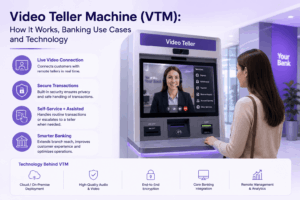
A video teller machine (VTM) is a banking terminal that combines self-service transaction capabilities with real-time video access to a remote bank employee.
To a customer, it may look similar to an ATM. The difference appears when the transaction requires human assistance.
Instead of walking into a branch and speaking with a teller across a counter, the customer uses the terminal to connect by video with an employee working from another branch or centralized service center.
This allows financial institutions to provide teller-assisted services without placing a teller at every physical location.
But a VTM should not be understood simply as:
ATM + video call
A complete video teller system has two parallel workflows:
transaction path → banking system → cash, document or payment operation
and
human-assistance path → video communication → remote teller
The banking hardware and software determine what transactions can be completed.
The video communication layer determines how the customer reaches a remote employee.
A VTM only becomes useful when those two paths work together.
What Is a Video Teller Machine?
A video teller machine is an electronic banking endpoint that allows a customer to complete transactions while receiving real-time assistance from a remote teller through video communication.
Banks and technology vendors use several names for similar systems:
-
Video Teller Machine, or VTM
-
Interactive Teller Machine, or ITM
-
Virtual Teller Machine
-
Personal Teller Machine
-
Interactive banking kiosk
The terminology is not completely standardized.
In North America, ITM is particularly common for advanced ATMs that include live video teller functionality. VTM is also widely used internationally and by banks describing remote teller service through a video-enabled terminal.
The important distinction is functional rather than linguistic.
A conventional ATM primarily executes predefined self-service transactions.
A VTM adds a human service channel that can extend the range of operations available at the terminal.
BankFirst, for example, describes its VTMs as supporting many services available from a drive-through teller, including check cashing, deposits, withdrawals, transfers and payments. When the live teller service is unavailable, the machine can continue operating as an ATM.
Source: BankFirst Video Teller Machines
Central Bank similarly uses remote video tellers for deposits, check cashing, withdrawals, loan payments, transfers and other banking services.
Source: Central Bank Video Teller Machines
How a Video Teller Machine Works
A typical VTM session follows a process such as:
customer → terminal → identity and transaction request → remote teller → banking system → transaction completion
The video call is only one part of that process.
1. The Customer Starts a Session
The customer approaches the terminal and chooses either a self-service transaction or an option to contact a live teller.
Many systems support two modes:
ATM mode: the terminal handles standard automated transactions.
Video teller mode: a remote employee joins the transaction through video.
This dual-mode approach allows the same device to continue operating outside staffed teller hours.
2. A Remote Teller Joins
The terminal establishes a video session with an employee located elsewhere.
The teller may work from:
-
another branch;
-
a centralized video banking center;
-
a remote office;
-
a contact center;
-
another location inside the bank’s private network.
One employee team can therefore serve customers using multiple terminals.
The customer location and the teller location no longer need to be the same.
3. The Customer Is Identified
The exact identity-verification process depends on the bank and terminal configuration.
Possible mechanisms include:
-
bank card;
-
PIN;
-
government-issued ID;
-
document scanner;
-
security questions;
-
biometric devices;
-
manual teller verification.
The remote teller can then use the bank’s customer and transaction systems to verify the request.
4. The Transaction Is Performed
The physical terminal handles the parts of the transaction that require hardware.
Depending on the configuration, that may include:
-
accepting banknotes;
-
dispensing cash;
-
receiving checks;
-
reading cards;
-
scanning documents;
-
printing receipts;
-
printing other banking documents.
The remote teller handles the parts of the workflow that require explanation, authorization, validation or human decision-making.
5. The Session Ends
When the transaction is complete, the video session closes and the device returns to its initial screen or ATM mode.
The bank’s policies and implementation determine which transaction, communication and audit records are retained.
The Two Paths Inside a Video Teller Machine
A VTM is easier to understand when it is separated into two technical paths.
Transaction Path
The transaction path connects the customer-facing terminal to the systems that perform the banking operation.
A simplified flow is:
identity or card input → transaction application → banking system → terminal hardware
This path determines whether the terminal can:
-
accept deposits;
-
dispense cash;
-
process checks;
-
transfer funds;
-
process payments;
-
print documents;
-
update banking information.
Human-Assistance Path
The human-assistance path connects the customer with a remote employee.
A simplified flow is:
camera and microphone → video communication platform → routing → teller workstation
This path determines whether the customer can:
-
speak with an employee;
-
receive instructions;
-
show documents or information visually;
-
ask questions;
-
complete teller-assisted procedures;
-
receive remote support during a transaction.
A good video call does not automatically create a complete VTM.
Likewise, a sophisticated self-service banking kiosk is not a video teller machine if it has no live remote-service layer.
A complete implementation needs both paths.
VTM vs ATM vs ITM
The main terminology question is VTM vs ITM.
In practice, the terms often overlap.
A useful distinction is:
-
ATM emphasizes automated self-service.
-
VTM emphasizes live video access to a teller.
-
ITM commonly describes an advanced teller-enabled terminal combining ATM functionality with remote employee assistance.
Adrenaline notes that ITM, VTM, Personal Teller Machine and interactive banking kiosk are all used for related categories of technology.
Source: ITMs: Bridging Digital and Physical Worlds
For banks evaluating the technology, actual transaction coverage matters more than the label.
What Transactions Can a Video Teller Machine Handle?
There is no universal transaction list that applies to every VTM.
Available operations depend on:
-
terminal hardware;
-
transaction software;
-
core banking integration;
-
bank policy;
-
employee permissions;
-
identity-verification procedures.
Cash Withdrawals and Deposits
Terminals equipped with cash-handling modules can accept and dispense banknotes.
A remote teller may guide the customer or authorize a transaction when human review is required.
Check Deposits and Check Cashing
Some VTMs include check scanners and allow remote tellers to assist with deposits or check-cashing workflows.
This moves the terminal beyond the basic functions associated with a conventional ATM.
Account Transfers
Customers may move funds between eligible accounts, with the remote teller providing assistance when required.
Loan and Credit Card Payments
Several banks use VTMs to accept loan or credit card payments.
Account Service
Depending on banking integration, a teller may also help with:
-
balance inquiries;
-
account questions;
-
updating customer information;
-
stop-payment requests;
-
check orders;
-
other service procedures.
Central Bank currently lists cash and check deposits, check cashing, withdrawals, transfers, loan and credit card payments, check ordering and stop payments among its video teller services.
Source: Central Bank VTM Services
However, some procedures may remain outside the VTM channel.
Land of Lincoln Credit Union, for example, distinguishes transactions available through its VTMs from procedures that still require another banking channel.
Source: Land of Lincoln Credit Union VTM FAQ
This leads to a more useful question than simply asking what VTMs can do:
Which branch transactions can this specific VTM configuration move into a remotely assisted channel?
The Transaction Delegation Boundary
Every bank has a different point at which a transaction can move from branch staff to self-service or remote service.
A useful way to model this is the transaction delegation boundary.
The objective of a VTM deployment is not necessarily to eliminate the branch or move every transaction into a machine.
It is to identify which frequent transactions can be delegated safely and efficiently.
For one bank, the priority may be cash and check operations.
For another, it may be remote identity verification and consultation.
For another, the terminal may act as a compact remote branch.
This explains why two systems both marketed as VTMs can provide very different business value.
The screens may look similar.
Their transaction coverage may be completely different.
Why Banks Deploy Video Teller Machines
Centralized Teller Workforce
A centralized remote teller team can serve customers using multiple terminals.
Employees are no longer tied to one counter or one physical branch.
Extended Teller Hours
A bank can operate remote teller services before or after the normal opening hours of individual locations.
BankFirst and Central Bank both describe extended service availability as part of their VTM model.
Smaller Banking Locations
Video teller systems can provide assisted service in places where a full conventional branch may not be practical.
Examples include:
-
small branches;
-
drive-through lanes;
-
shopping locations;
-
corporate campuses;
-
remote communities;
-
standalone banking points.
Human Assistance Without Full Branch Staffing
Some customers can complete a transaction independently.
Others may need explanation or authorization.
A VTM provides access to an employee without requiring that employee to be physically located beside the machine.
Centralized Access to Specialists
A remote-service model can also make it easier to route customers to employees with appropriate expertise, permissions or language skills.
What a VTM System Actually Needs
The physical terminal is only one part of a VTM deployment.
A complete system usually includes four major layers.
Banking Terminal Hardware
The customer-facing endpoint may contain:
-
touchscreen;
-
camera;
-
microphone;
-
speakers or handset;
-
card reader;
-
encrypted PIN pad;
-
cash recycler;
-
check scanner;
-
receipt printer;
-
document scanner;
-
biometric or identity peripherals.
Manufacturers such as GRG provide modular banking terminals that combine video interaction with transaction hardware.
Source: GRG Bank Automation
Transaction Software and Banking Integration
The terminal needs software that connects its physical devices with banking applications.
This layer may interact with:
-
core banking systems;
-
payment systems;
-
customer information;
-
CRM;
-
identity verification;
-
transaction authorization;
-
audit systems.
Without these integrations, a terminal can provide a video consultation but cannot become a complete teller endpoint.
Video Communication Layer
The video layer connects the customer-facing terminal with the remote teller.
It may provide:
-
one-touch calling;
-
audio and video;
-
operator availability;
-
call queues;
-
remote teller routing;
-
session management;
-
screen or content exchange;
-
API or SDK integration;
-
centralized administration.
This layer can be supplied by the VTM manufacturer or integrated as a separate communication platform.
Remote Teller Workstation
The employee needs access to both the communication session and the relevant banking systems.
A workstation may therefore combine:
-
customer video;
-
audio controls;
-
queue information;
-
customer context;
-
transaction applications;
-
identity tools;
-
banking software.
Where Video Conferencing Fits in a VTM Architecture
Video conferencing does not replace the banking transaction system.
It provides the human-assistance path.
A simplified VTM architecture can be represented as:
Customer-facing endpoint
camera, microphone, touchscreen, cash and document hardware
↓
VTM application layer
identity workflow, transaction logic, device control
↓
Video communication layer
call initiation, audio/video media, routing, session control
↓
Remote teller workstation
customer video, teller interface, banking applications
↓
Banking systems
core banking, CRM, payments, identity, audit
The video platform therefore sits between the kiosk experience and the remote teller.
This distinction is important when comparing communication technologies.
A video conferencing platform does not need to process cash or communicate directly with every banking device to be useful inside a VTM.
Its responsibility is to provide reliable, manageable communication between the terminal and the employee.
Video Communication Platforms for VTM Deployments
Several communication platforms can provide the video layer inside a VTM or video banking application.
They should not be treated as complete VTM products.
Their role is to support the communication workflow between the customer-facing endpoint and the remote employee.
The correct platform depends on whether the bank needs a ready kiosk workflow, a developer API, contact-center routing or a customer-operated video infrastructure.
TrueConf for Video Teller and Banking Kiosk Deployments
TrueConf can provide the video communication layer inside a VTM deployment rather than the banking transaction layer itself.
TrueConf Kiosk is designed for interactive kiosks, ATMs and similar customer-facing endpoints.
Current TrueConf materials describe capabilities such as:
-
one-touch video calling;
-
automatic connection with available operators;
-
kiosk-oriented interfaces;
-
document and content exchange;
-
PDF document printing;
-
centralized management;
-
branding and interface customization.
TrueConf VideoSDK can be used when a bank wants to integrate video communication into its own application rather than use a standalone kiosk interface.
TrueConf Server provides the server-side communication environment and can be deployed on customer-controlled infrastructure.
This makes an architecture such as the following possible:
banking terminal + banking application + TrueConf Kiosk or VideoSDK + TrueConf Server + teller workstation
The transaction components still need to be supplied by the bank, the VTM manufacturer or the banking software provider.
Cash handling, card processing, check scanning and core banking integration are not replaced by the video platform.
TrueConf also publishes a banking deployment involving Commercial Bank of Kuwait, where customer-facing kiosks were used to connect bank customers with remote employees.
Sources: TrueConf Video Banking · TrueConf Kiosk · TrueConf VideoSDK
Zoom Video SDK for Custom Video Banking Applications
Zoom Video SDK is more relevant to VTM deployments as a programmable video component than as a conventional Zoom Meeting.
Developers can embed Zoom’s video and audio technology into a custom application and create their own interface and session workflow.
In a banking environment, this could allow a VTM application to control:
-
when a session starts;
-
how the customer interface looks;
-
how users enter the video session;
-
how the application connects video with the surrounding transaction workflow.
The SDK does not provide the banking transaction layer.
The bank or integrator still needs to build the teller workflow, routing logic and integration with banking systems.
Source: Zoom Video SDK
Vonage Video API for Developer-Built Teller Applications
Vonage Video API is designed for embedding real-time video into custom applications.
This makes it relevant when a bank or VTM integrator wants to build its own remote teller interface rather than deploy a predefined conferencing client.
The application can define the user interface, video session flow and surrounding business logic.
This type of API model can work well when the VTM software already controls:
-
authentication;
-
transaction state;
-
operator availability;
-
customer data;
-
banking workflow.
The video API then becomes one service inside the larger application.
Source: Vonage Video API
Cisco Webex for Contact-Center-Oriented Video Service
Cisco Webex is relevant where remote teller service is organized more like a contact center than a standalone video meeting.
Banks already using Cisco communications or contact-center technologies may be able to connect video interaction with existing routing, agent-management and enterprise communication workflows.
This model is particularly relevant when customer video requests need to be routed to different groups of employees rather than to a single fixed teller.
The exact architecture depends on the Cisco products used and the bank’s existing communications environment.
Source: Cisco Webex Contact Center
Pexip for Private Video Infrastructure
Pexip is relevant when the bank needs a private or infrastructure-oriented video environment.
Instead of treating the communication layer as a fixed public meeting service, Pexip can be deployed as part of private or distributed video infrastructure.
This can be useful where the VTM environment also needs to connect:
-
private networks;
-
multiple data centers;
-
professional video systems;
-
SIP/H.323 endpoints;
-
custom enterprise applications.
Pexip is less of a ready-made banking kiosk product and more of an infrastructure component that can support a custom remote-service architecture.
Source: Pexip Infinity
How to Choose the Video Layer for a VTM
The best conferencing platform for a VTM is not necessarily the platform with the most meeting features.
The video layer needs to match the teller workflow.
Kiosk or Embedded Mode
Determine whether the platform provides:
-
a dedicated kiosk client;
-
an embeddable SDK;
-
APIs;
-
browser-based video;
-
a customizable customer interface.
A conventional desktop meeting application is usually not enough for a banking kiosk.
One-Touch Calling
A VTM should not require the customer to create a meeting, enter an ID or manage a normal conferencing interface.
The expected workflow is closer to:
select help → connect to teller
The communication platform needs to support this model directly or through application logic.
Teller Routing
A bank may have several operators serving many terminals.
The system may therefore need:
-
operator availability;
-
queue logic;
-
automatic routing;
-
skill-based routing;
-
failover;
-
multiple teller groups.
This is closer to contact-center behavior than to an ordinary scheduled video meeting.
SDK and API Integration
The VTM application needs to coordinate video with the rest of the transaction.
For example, the application may need to:
-
identify the customer;
-
determine the requested banking operation;
-
start the teller session;
-
pass transaction context to the employee;
-
close the video session after completion.
SDKs and APIs allow the video layer to participate in this workflow.
Deployment Model
Banks should also determine where the video infrastructure needs to run.
Options may include:
-
vendor-operated cloud;
-
customer data center;
-
private cloud;
-
hybrid environment.
The appropriate model depends on the bank’s infrastructure and operational requirements.
Teller Workstation Integration
The teller should not need to manually correlate an anonymous video caller with a completely separate banking transaction.
Ideally, the communication workflow can provide enough context for the teller to understand:
-
which terminal is calling;
-
what service was requested;
-
which customer is being served;
-
what stage the transaction has reached.
The exact integration depends on the banking application and communication platform.
Video Teller Machine vs Video Banking
The two terms are related but not identical.
A video teller machine is a physical customer-facing banking endpoint.
Video banking is a broader service model.
It can include:
-
VTMs;
-
video-enabled ATMs;
-
remote banking kiosks;
-
video consultation from a website;
-
mobile video banking;
-
remote financial advisory;
-
video contact centers.
A bank can therefore provide video banking without installing a VTM.
But every VTM includes some form of video banking interaction.
How to Evaluate a Complete VTM
The most useful way to evaluate a VTM is to map an actual banking procedure.
For example:
A customer wants to cash a check.
Then ask:
-
How is the customer identified?
-
How is the check captured?
-
Which system validates it?
-
At what point does a remote teller join?
-
What information does the teller receive?
-
What can the teller authorize?
-
How is the cash dispensed?
-
What happens if the video connection fails?
-
Which systems retain records after the transaction?
The same exercise can be repeated for deposits, withdrawals, transfers and other high-frequency transactions.
This exposes integration gaps that are easy to miss in a generic feature comparison.
A complete VTM should therefore be evaluated across four layers:
transaction coverage → terminal hardware → remote teller workflow → banking integration
The strongest system is not necessarily the terminal with the largest display or the conferencing platform with the longest feature list.
It is the architecture that allows the required banking transactions to move into the remote-service channel without breaking the customer or teller workflow.
Frequently Asked Questions
What is a video teller machine?
A video teller machine is a banking terminal that combines self-service transaction functions with a live video connection to a remote teller.
The customer can perform banking operations while receiving assistance from an employee located somewhere else.
Is a VTM the same as an ATM?
No.
An ATM is primarily an automated self-service device.
A VTM adds real-time human assistance and can support teller-assisted procedures that a conventional ATM may not provide.
Many VTMs can also operate in ordinary ATM mode when the teller service is unavailable.
What is the difference between VTM and ITM?
The terms frequently overlap.
VTM emphasizes the video connection with a remote employee, while ITM is widely used for advanced teller-enabled terminals combining ATM functions with live assistance.
The exact functionality is more important than the product label.
What can I do at a video teller machine?
Depending on the bank and terminal, customers may be able to:
-
withdraw cash;
-
make cash or check deposits;
-
cash checks;
-
transfer funds;
-
make loan or credit card payments;
-
ask account questions;
-
complete other teller-assisted procedures.
Not every VTM supports every transaction.
Does a VTM use a real bank employee?
Usually, yes.
The conventional VTM model connects the customer with a live remote teller or service employee.
Can a VTM work outside teller service hours?
Many systems can continue operating as ordinary ATMs when remote tellers are unavailable.
The exact functionality depends on the terminal and bank configuration.
What role does video conferencing software play in a VTM?
The video platform provides the communication path between the customer-facing terminal and the remote teller.
It may handle audio, video, call initiation, teller routing and session management.
It does not replace cash-handling hardware, transaction software or core banking integration.
Which video communication platforms can be used for VTM systems?
Depending on the architecture, banks can use dedicated kiosk communication products, embedded video SDKs, contact-center platforms or private video infrastructure.
Examples include TrueConf Kiosk and VideoSDK, Zoom Video SDK, Vonage Video API, Cisco Webex technologies and Pexip.
The correct choice depends on whether the bank needs a ready kiosk workflow, a programmable video component, contact-center routing or customer-operated infrastructure.
Conclusion
A video teller machine is best understood as a layered remote banking system, not simply an ATM with a camera.
It combines two critical paths:
the transaction path, which connects the terminal with banking systems and transaction hardware;
and
the human-assistance path, which connects the customer with a remote teller.
Video conferencing technology powers the second path.
Platforms such as TrueConf, Zoom Video SDK, Vonage Video API, Cisco Webex and Pexip can provide different forms of that communication layer, but they do not replace the banking hardware and transaction systems that make the endpoint a functioning VTM.
The most useful evaluation question is therefore:
Which banking transactions need to move into the remote channel, and which combination of hardware, banking software and video communication can support that workflow?
That question reveals far more about a VTM deployment than comparing screen size, camera specifications or conferencing features in isolation.
Author
Helga Afon is a technology writer specializing in video conferencing, collaboration software, and workplace communication. She writes articles and reviews that help readers better understand enterprise communication tools and industry trends.