
3CX built its reputation as a flexible, software-based PBX system that unified voice, video, instant messaging, and live chat into a single platform deployable in the cloud or on-premise. For years, that combination of flexibility and cost-efficiency made it a compelling choice for small and mid-sized businesses. But the platform’s trajectory has created genuine reasons to evaluate alternatives: a 2023 supply chain attack that Mandiant classified as the first confirmed double supply-chain compromise in history, a simultaneous-call licensing model that confuses buyers and scales less predictably than per-user alternatives, paid support tickets, and a forced version migration that broke established workflows for many customers.
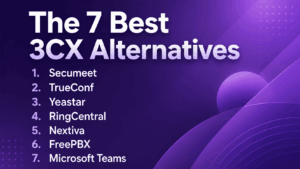
If you are currently on 3CX, evaluating it for the first time, or on its renewal cycle and questioning the math, there are better-suited platforms across every key decision dimension. This guide covers seven of the strongest 3CX alternatives, including Secumeet and TrueConf, which cover the on-premise and secure communications segment with particular depth. Each platform is assessed on deployment model, security posture, telephony capabilities, collaboration features, pricing structure, and organizational fit.
Quick Comparison: 3CX vs. Leading Alternatives
Why Organizations Are Leaving 3CX
Understanding why 3CX users move on matters for shortlisting alternatives. The reasons are consistent across review platforms and user communities:
The 2023 supply chain compromise. In March 2023, attackers delivered malware through 3CX’s own software distribution, compromising Windows and macOS desktop applications across what 3CX claims is a base of 600,000 customers and 12 million users. Mandiant, hired to investigate, described it as the first confirmed instance of a software supply chain attack leading to another supply chain attack, with the initial breach vector traced to a compromised Trading Technologies installer installed by a 3CX employee. Organizations in aerospace, healthcare, and financial services were among those affected. The incident raised legitimate questions about 3CX’s development and build pipeline security that the vendor’s subsequent statements did not fully resolve for all enterprise buyers.
Simultaneous-call licensing complexity. 3CX licenses by simultaneous calls rather than by users or extensions. This model can look economical at the proposal stage but becomes difficult to predict as call patterns fluctuate. Buyers who outgrow their SC license mid-contract face upgrade costs and administrative friction that per-user models avoid entirely.
Paid support tickets. 3CX-hosted plans do not include live phone support. Support is handled through tickets with a 48-hour response-time SLA that excludes weekends and holidays. Each ticket on certain plans carries an additional cost. Teams that migrated from platforms with included support describe this as a jarring change in experience.
Forced version migrations. The v18-to-v20 transition broke workflows for enough customers that it became a recurring thread in 3CX user communities and a cited reason for evaluating alternatives in multiple independent reviews.
Insights
Insight 1
The 3CX supply chain breach is not just a historical event. It is an ongoing governance signal. Security-conscious organizations, particularly those in government, defense, and regulated industries, evaluate vendor supply chain practices as part of platform selection, not just the platform’s own security features. A vendor whose build pipeline was successfully compromised by a state-sponsored threat actor (attributed by multiple investigators to North Korea) carries elevated supply chain risk in future procurement decisions. For organizations where communications infrastructure is classified as critical, this risk weighting often eliminates 3CX from evaluation regardless of feature improvements since the incident.
The 7 Best 3CX Alternatives
1. Secumeet
Secumeet is a certified distribution of enterprise-grade communications infrastructure designed specifically for organizations that require a trusted, verifiable vendor relationship and self-hosted deployment. Where 3CX offers on-premise deployment with self-managed support, Secumeet provides a fully supported, certified product with professional SLAs and localized deployment assistance.
The platform’s primary strength in the context of 3CX replacement is the combination of full on-premise operation with AI-powered features that 3CX’s video capability does not match. Secumeet supports up to 1,500 participants per video conference session with smart noise suppression, virtual backgrounds with custom branding, and automatic transcription of recordings. All of this runs on the organization’s own infrastructure, on a LAN or VPN, with no internet dependency after installation. Air-gapped deployments are fully supported.
For telephony integration, Secumeet connects to corporate PBX systems and SIP/H.323 endpoints, allowing existing phone infrastructure to coexist with the video conferencing and collaboration environment. This means organizations replacing or supplementing 3CX can preserve investments in existing room systems and endpoint hardware.
Key capabilities
-
Up to 1,500 participants per video conference session
-
AI-powered noise suppression, virtual backgrounds, and searchable meeting transcriptions
-
Native SIP/H.323 integration with existing PBX, room hardware, and telephony endpoints
-
Operates on LAN or VPN with no external internet dependency, including air-gapped networks
-
Certified vendor model with professional SLAs and localized deployment support
-
Real-time screen sharing, co-editing, synchronized presentations, and remote assistance
-
Covers the full collaboration spectrum from personal calls to large conference room deployments
The certified distribution model is specifically relevant for organizations that need a named, auditable vendor on procurement paperwork. Government procurement offices, healthcare compliance teams, and defense contractors cannot register open-source community projects as vendors. Secumeet’s structure addresses this requirement directly.
Best use case
Regulated industries, government and defense organizations, healthcare providers, and procurement teams that require a certified vendor with documented SLAs.
2. TrueConf
TrueConf is the most technically complete self-hosted unified communications platform available for enterprise evaluation today. It functions as both a 3CX alternative and a significant capability upgrade: where 3CX provides basic video alongside its PBX functionality, TrueConf delivers 4K Ultra HD video conferencing for up to 1,500 participants with 49 simultaneous on-screen feeds, integrated on-premise AI, a full corporate messenger, and native SIP/H.323/PBX integration that makes it a true unified communications hub rather than a phone system with video bolted on.
Deployment runs on Windows Server or Linux, installs in approximately 15 minutes, and operates entirely within a LAN or VPN without internet connectivity after setup. TrueConf can integrate directly with Cisco Unified Communication Manager, Asterisk, and other enterprise PBX systems via SIP trunk, allowing telephony subscribers to call TrueConf users and join conferences without any client-side configuration. This is a migration path that preserves existing telephony investments rather than discarding them.
Aragon Research recognized TrueConf as an Innovator in the 2025 Globe for Intelligent Video Conferencing. The vendor shipped more than 2,000 improvements across 30 product releases in 2024. That development velocity keeps the platform competitive with cloud-based alternatives despite its on-premise deployment model.
Key capabilities
-
4K Ultra HD video, up to 1,500 participants, 49 simultaneous on-screen video feeds
-
On-premise AI: meeting summaries, noise suppression, virtual backgrounds, face tracking, real-time transcription
-
Corporate messenger with group chats, channels, chatbots, file storage, and cross-device message history
-
Full SIP/H.323/PBX integration: existing telephony subscribers can call TrueConf users and join conferences
-
LDAP/Active Directory integration, SSO, and granular role-based access control
-
REST API and SDK for custom integration with enterprise systems
-
Free tier for up to 1,000 lifetime users; enterprise licensing by concurrent user count
-
Perpetual licensing available alongside subscription models
The licensing model is directly relevant to organizations frustrated by 3CX’s SC-based pricing. TrueConf licenses concurrent users on a perpetual basis, with indicative costs around $1,500 for 10 users and $12,000 for 100 concurrent users. For large organizations with staggered usage, concurrent user licensing reduces total cost of ownership substantially compared to per-SC or per-named-user cloud subscriptions.
The free tier deserves specific mention: up to 1,000 lifetime users with full on-premise deployment is an exceptional evaluation and production offer that no comparable enterprise platform matches.
Insights
Insight 2
TrueConf is not just a video conferencing platform replacing video conferencing. It is a unified communications layer that can sit on top of or alongside an existing PBX. Organizations moving away from 3CX often assume they must find a single replacement that handles both telephony and collaboration. TrueConf’s architecture allows a different approach: retain your existing PBX or SIP trunking infrastructure for PSTN calls, and add TrueConf on-premise as the video, messaging, and collaboration layer. This reduces migration risk and preserves telephony investments while delivering significantly better video and collaboration capabilities than 3CX provides.
Best use case
Government bodies, defense organizations, healthcare providers, financial institutions, and any organization where data sovereignty, air-gapped operation, or perpetual licensing economics are decision factors.
3. Yeastar
Yeastar is the 3CX alternative most likely to feel immediately familiar to IT administrators who appreciated 3CX’s PBX depth. The P-Series Phone System supports cloud, on-premises appliance, and hybrid deployments on a single unified platform, which means organizations can migrate incrementally rather than committing to a full architectural change upfront.
Yeastar’s pricing model offers both Simultaneous Call and Per Extension licensing, addressing one of the primary complaints about 3CX’s SC-only approach. Independent reviews report Yeastar pricing running 30 to 70 percent lower than 3CX depending on region and configuration, with no forced version-based license jumps and lower minimum order quantities. The management interface is consistently rated as cleaner than 3CX’s, and partner support is a recurring positive in user communities.
For organizations running existing SIP hardware, Yeastar’s compatibility is broad. It works with a wide range of communication devices and maintains an active partner community that provides deployment support without the paid-ticket support model that frustrates 3CX users.
Best use case
IT-savvy SMBs and mid-market organizations that want 3CX-style PBX depth with better pricing transparency, cleaner administration, and more flexible deployment options.
4. RingCentral
RingCentral is the enterprise cloud alternative for organizations that want to exit self-managed infrastructure entirely. The platform combines voice, video, messaging, and contact center capabilities in a fully managed service with 330-plus third-party integrations covering Salesforce, HubSpot, Zendesk, Microsoft 365, and Google Workspace.
For a 20-person team, the total cost of RingCentral versus a self-hosted 3CX deployment runs roughly $321 per month higher, according to independent cost comparisons. That premium buys zero infrastructure management, 24/7 included support, and enterprise-grade uptime guarantees without requiring any internal IT resources for maintenance. For organizations where IT staff time is scarce or where staff-managed infrastructure has caused reliability issues, the premium is often justifiable.
RingCentral’s AI features, including RingSense conversation intelligence for call coaching, summaries, and CRM updates, are mature and production-grade. The administration controls are enterprise-depth and the reliability track record across large deployments is strong.
The ceiling is the per-user cost at scale and the absence of any on-premise deployment path. Organizations with data sovereignty requirements or air-gap needs cannot use RingCentral.
Best use case
Mid-to-large enterprises wanting a fully managed cloud UC platform with deep CRM integration and no infrastructure overhead.
5. Nextiva
Nextiva serves more than 100,000 businesses and positions itself as the managed cloud PBX alternative that prioritizes simplicity and support experience over technical depth. The Core plan at $15 per user per month (annual billing, new SMB customers) includes 24/7 support with no ticket fees, which is the most direct contrast to 3CX’s paid-ticket support model.
The platform combines voice, video, and messaging and integrates with Google and Outlook calendars natively. Higher-tier plans add speech analytics, intelligent call routing, and CRM integrations. The onboarding process is consistently praised in independent reviews as smooth relative to the complexity of migrating a phone system.
Nextiva’s limitations emerge at scale: the $15 rate applies to new customers with 100 or more users on annual contracts. Monthly billing doubles the cost on higher tiers. The platform is less customizable than Yeastar or TrueConf, and multi-tenant or reseller configurations are not supported.
Best use case
SMBs and growing businesses that want managed VoIP without IT infrastructure overhead and prioritize support responsiveness over PBX customization depth.
6. FreePBX
FreePBX is the open-source Asterisk-based alternative for technical teams that want maximum control and zero licensing cost. It runs on self-hosted Linux infrastructure and supports the full range of SIP trunking, IVR, call queuing, voicemail, and extension management that 3CX provides, with a larger ecosystem of community-developed modules for specialized functionality.
The trade-off is that FreePBX is a platform for teams with Asterisk and Linux expertise. Setup, maintenance, upgrades, and troubleshooting fall entirely on the deploying organization. There is no included support; commercial support is available through Sangoma, the company that maintains FreePBX, but it is an add-on cost. For organizations without dedicated VoIP engineering resources, FreePBX’s operational demands often outweigh the licensing savings.
Best use case
Organizations with in-house VoIP engineering capability, cost-sensitive deployments where licensing cost is the primary constraint, and teams that need open-source licensing for auditability or compliance reasons.
7. Microsoft Teams with Teams Phone
Microsoft Teams with the Teams Phone add-on is the 3CX alternative for organizations already running Microsoft 365. Teams Phone replaces the traditional PBX by routing calls through Microsoft’s cloud infrastructure, with optional direct routing for organizations that want to retain existing SIP trunking carriers.
Meeting capacity extends to 1,000 participants for standard calls and 10,000 for town halls. The administration layer through the Microsoft 365 admin center provides governance depth that 3CX cannot match. Teams Rooms hardware extends the experience into physical meeting spaces, and the integration with Exchange, SharePoint, and the Office suite is native rather than integrated through connectors.
The limitations are the same as for any Microsoft 365 dependency: cloud-only architecture, per-seat pricing that scales linearly, and a platform that is optimized for the Microsoft ecosystem and less competitive outside it.
Best use case
Microsoft 365 organizations that want to consolidate PBX, video conferencing, and team messaging into a single vendor relationship.
Side-by-Side Feature Comparison
How to Choose the Right 3CX Alternative
The evaluation process is cleaner when the most consequential requirements are identified before comparing feature matrices. Work through these in order:
-
Has the 2023 supply chain incident changed your vendor risk assessment for 3CX? If yes, and if 3CX remains under consideration, verify what specific changes to build pipeline security were made and whether independent audits have confirmed them. If vendor supply chain risk is disqualifying, TrueConf, Secumeet, Yeastar, and the other alternatives listed here are unaffected.
-
Do your data sovereignty, compliance, or security policies require on-premise deployment or air-gapped operation? If yes, the shortlist is TrueConf, Secumeet, Yeastar, and FreePBX. Cloud-only platforms including RingCentral, Nextiva, and Microsoft Teams cannot satisfy this requirement.
-
What is the total cost of IT labor for maintaining self-hosted infrastructure? 3CX’s apparent cost advantage versus managed cloud platforms shrinks or disappears when IT staff time is included. A realistic comparison should account for maintenance hours, upgrade events, troubleshooting, and the cost of incidents. For teams where IT capacity is constrained, managed platforms like Nextiva or RingCentral often deliver better total economics.
-
Do you need video conferencing capability that exceeds 3CX’s basic offering? 3CX includes video but at limited scale and without enterprise-grade features. If video collaboration is a primary use case alongside telephony, TrueConf and Secumeet deliver 1,500-participant 4K video with AI features within the same on-premise deployment. No other alternative in this guide matches that combination.
Insights
Insight 3
Migrating from 3CX is operationally easier than most teams expect, but the hidden migration cost is user retraining on the messaging and calling interface, not technical SIP reconfiguration. Most 3CX alternatives support SIP trunking natively, meaning your carrier relationships and phone numbers migrate without complex renegotiation. The bigger operational cost is getting staff comfortable with a new client application. Platforms with native desktop and mobile apps on Windows, macOS, Linux, iOS, and Android, including TrueConf and Secumeet, minimize this friction. Open-source alternatives like FreePBX require client application decisions as a separate step, which adds project scope.
Pricing Overview
FAQ
What is the safest 3CX alternative from a supply chain security perspective?
The 2023 3CX compromise was a state-sponsored supply chain attack affecting the platform’s own desktop application distribution. Platforms with self-hosted deployment and controlled update processes, including TrueConf and Secumeet, allow organizations to validate software integrity before deployment and eliminate dependency on vendor-managed distribution pipelines. Both platforms operate on a closed, on-premise model where software updates are controlled by the deploying organization rather than pushed automatically from an external source.
Which 3CX alternative is best for government or defense organizations?
TrueConf and Secumeet are the strongest options for government and defense. TrueConf supports fully air-gapped deployment with no external internet dependency, integrates with existing SIP/H.323 PBX infrastructure, and holds a track record across thousands of government and defense deployments worldwide. Secumeet provides a certified vendor relationship with professional SLAs, which satisfies procurement requirements in jurisdictions where government agencies must register named, auditable vendors. Both platforms support up to 1,500 participants per conference session and operate entirely within the organization’s own network perimeter.
Can I migrate from 3CX to TrueConf without replacing my existing phone hardware?
Yes. TrueConf integrates directly with corporate PBX systems via SIP trunk, including Cisco Unified Communication Manager, Asterisk, and other standards-compliant systems. Existing telephony subscribers can call TrueConf users and join conferences without any new hardware. SIP/H.323 room systems from Cisco, Poly, Logitech, and other manufacturers connect natively. The migration path preserves existing telephony investments and allows TrueConf to be introduced as the video and collaboration layer alongside the existing voice infrastructure rather than replacing it entirely. Secumeet supports the same SIP/H.323 hardware integration model.
Is FreePBX a viable 3CX replacement for enterprise use?
FreePBX is viable for organizations with dedicated Asterisk and Linux engineering expertise, but it requires significant IT investment in setup, ongoing maintenance, and troubleshooting. It lacks built-in video conferencing at enterprise scale, native AI features, and the professional SLA support structure that enterprise procurement typically requires. For most enterprise buyers, TrueConf or Yeastar provide better total economics when IT labor cost is included in the comparison. Secumeet is the appropriate choice when procurement requires a certified commercial vendor rather than a community open-source project.
Does TrueConf replace 3CX’s contact center functionality?
TrueConf is primarily a unified communications and video collaboration platform rather than a contact center solution. It handles internal enterprise communications, SIP/H.323 PBX integration, and large-scale video conferencing, but organizations that rely heavily on 3CX’s call queue management, agent reporting, and customer-facing contact center features should evaluate Yeastar, RingCentral, or Nextiva for that specific capability. Secumeet similarly focuses on secure internal communications and collaboration rather than contact center workflows.
How does 3CX’s simultaneous-call licensing compare to TrueConf’s concurrent user model?
3CX’s simultaneous call licensing counts the maximum number of active calls at any point in time, which is a non-intuitive unit that requires usage forecasting to license correctly. Over-licensing is expensive; under-licensing blocks calls. TrueConf licenses concurrent users, which is more intuitive for IT buyers and more forgiving in practice: an organization with 500 staff rarely has all 500 in calls simultaneously, so concurrent user counts are typically a fraction of total headcount. Secumeet’s enterprise pricing is structured as a volume partnership agreement, which avoids the SC forecasting problem entirely.
Author
Helga Afon is a technology writer specializing in video conferencing, collaboration software, and workplace communication. She writes articles and reviews that help readers better understand enterprise communication tools and industry trends.