Video teleconferencing is no longer a supplementary communication tool. In 2026, it is core enterprise infrastructure, sitting at the intersection of security policy, IT architecture, hybrid work strategy, and regulatory compliance. Whether you are an IT director choosing a platform for 5,000 employees, a procurement lead in a government agency, or a CTO evaluating data sovereignty requirements, the decision you make about video teleconference software has long-term consequences.
This guide covers what video teleconferencing actually means at a technical level, who needs which type of solution, and provides a detailed comparison of seven vendors shaping the market in 2026: Secumeet, TrueConf, Zoom, Microsoft Teams, Cisco Webex, Google Meet, and Pexip.
Executive Summary
|
Vendor |
Deployment |
Best For |
Max Participants |
Pricing Model |
|---|---|---|---|---|
|
Secumeet |
On-premise / private cloud |
Regulated sectors, data sovereignty |
1,500+ |
Enterprise quote |
|
TrueConf |
On-premise / cloud / hybrid |
Government, defense, enterprise |
1,500 (server), 1M users |
Free tier + paid |
|
Zoom |
Cloud |
General business, SMB, education |
1,000 (paid) |
Per user/month |
|
Microsoft Teams |
Cloud / hybrid |
Microsoft 365 organizations |
1,000 |
M365 bundle |
|
Cisco Webex |
Cloud / on-premise |
Enterprise, US federal |
1,000+ |
Per user/month |
|
Google Meet |
Cloud |
Google Workspace users |
500 (Enterprise) |
Workspace bundle |
|
Pexip |
On-premise / private cloud |
Legacy room system integration |
Varies |
Enterprise quote |
Key Takeaways
Bottom Line First
The most important axis of differentiation in 2026 is not feature count. It is deployment architecture and data sovereignty.
What Most People Get Wrong
Cloud platforms optimize for speed, ecosystem integration, and AI features. On-premise platforms optimize for control, security, and regulatory compliance. The right answer depends on your organization’s threat model and compliance requirements.
What Is Video Teleconferencing?
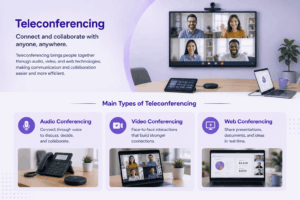
Video teleconferencing is the real-time transmission of audio, video, and supplementary data (screen sharing, documents, chat) between two or more participants across a network. Unlike recorded video content or asynchronous messaging, video teleconferencing is synchronous: all parties are present simultaneously, and interaction is bidirectional.
At a technical level, a modern video teleconference system includes:
-
A signaling layer (SIP, H.323, or proprietary protocols) that establishes and manages sessions
-
A media transport layer (RTP/SRTP) that carries encrypted audio and video streams
-
A multipoint control unit (MCU) or selective forwarding unit (SFU) that routes streams between participants
-
Client applications (desktop, mobile, browser, room system) that encode and decode media
-
An administrative layer for user management, scheduling, recording, and policy enforcement
The distinction between cloud and on-premise matters here because it determines where each of these components runs. In a cloud deployment, all of these layers run on the vendor’s infrastructure. In an on-premise deployment, they run on servers the customer controls. Hybrid deployments split the architecture, usually keeping media on-premise while using cloud for signaling or identity management.
Key Video Teleconference Terminology
-
SVC (Scalable Video Coding): A compression approach that encodes video at multiple quality levels simultaneously, allowing the server to deliver the appropriate quality to each participant based on bandwidth.
-
E2EE (End-to-End Encryption): Encryption where only the communicating endpoints can read the content, meaning even the platform vendor cannot access meeting data.
-
SIP/H.323: Legacy interoperability protocols used by hardware conference room systems. Support for these protocols allows a modern software platform to connect to existing room equipment.
-
Air-gapped network: A network physically isolated from the internet. Only platforms with full on-premise capability can operate in air-gapped environments.
-
Data sovereignty: The legal and organizational requirement that data remain within a specific geographic or administrative boundary.
Video Teleconference Market in 2026: Key Statistics
The video teleconference market has reached commercial maturity while continuing to expand. Below are the most relevant figures for B2B decision-makers in 2026.
|
Metric |
Value |
Source |
|---|---|---|
|
Global market size (2025) |
~$10 billion (software/services segment) |
Multiple analyst firms |
|
Global market size (2026 estimate) |
~$12 billion |
Market.us, electroiq |
|
Projected market size by 2032 |
~$21 billion |
Market.us |
|
CAGR 2026-2034 |
7.35% – 12% (varies by segment scope) |
Polaris, Precedence Research |
|
North America market share |
~30-42% of global revenue |
Fortune Business Insights |
|
Cloud vs on-premise split |
73% cloud / 27% on-premise |
Various |
|
Zoom global user base |
300+ million users |
SQ Magazine |
|
Remote workers in the US |
~32.6 million (~22% of workforce) |
SQ Magazine |
|
Enterprise spend per year (1,000+ employees) |
~$242,000 on video calling tools |
electroiq |
|
Paid subscriptions globally (2025) |
89 million |
electroiq |
|
Meetings spent by fully remote leaders daily |
3+ hours for 52% of respondents |
SQ Magazine |
Market Insight
The market is splitting into two categories
The most significant structural trend in 2026 is the bifurcation of the market. High-volume consumer and SMB demand continues to flow to cloud-first platforms. Meanwhile, regulated industries (government, defense, financial services, healthcare) are driving renewed investment in on-premise and sovereign infrastructure, with vendors like TrueConf and Secumeet reporting growth in these segments during 2024-2026.

How to Choose a Video Teleconference Platform: Decision Framework
Before evaluating vendors, answer these questions in order:
-
Can your data leave your infrastructure? If no (due to regulation, contractual obligation, or security policy), eliminate every cloud-first platform immediately. You are looking at TrueConf Server, Secumeet Server, Pexip, or Jitsi.
-
Do you need to operate without internet connectivity? If yes, only fully on-premise platforms with no cloud dependency will work. TrueConf and Secumeet are the primary enterprise-grade options here.
-
Do you need to interoperate with legacy hardware room systems? SIP/H.323 support is required. TrueConf, Webex, and Pexip support this natively. Zoom and Teams offer it through third-party connectors.
-
What is your existing ecosystem? Microsoft 365 shops typically see the most value from Teams. Google Workspace organizations naturally gravitate toward Meet.
-
What is your participant scale? Most platforms handle standard meetings well. Webinars, all-hands, and large-scale events require purpose-built architecture.
Vendor Profiles: 7 Video Teleconference Platforms for 2026

1. Secumeet
Secumeet operates as a certified distribution partner for professional video conferencing infrastructure, with a specific focus on organizations that need enterprise-grade self-hosted communication without managing a direct vendor relationship. The platform’s defining architectural characteristic is that the Secumeet vendor itself never touches customer meeting content. Video streams, audio, screen sharing, and recordings stay entirely within the customer’s own network perimeter or private cloud.
Core strengths
-
Full on-premise and private cloud deployment with no third-party cloud dependency
-
Support for group video calls and one-on-one meetings with up to 1,500+ participants
-
AI-powered features including noise suppression, virtual backgrounds, and automatic transcription
-
Screen sharing up to 4K, collaborative document presentation, and remote desktop access
-
Multi-device access: Windows, macOS, Linux desktops; iOS and Android mobile; browser-based joining; Android TV and room system clients
-
Native SIP/H.323 interoperability for integration with existing conference room hardware
-
Meeting summaries and unified messaging within a single platform
GDPR and compliance posture: Because Secumeet’s architecture places all data processing within the customer’s own infrastructure, there is no Article 28 processor relationship with the vendor for meeting content, and no cross-border transfer question under Articles 44-49 of GDPR. This makes the compliance story straightforward for European organizations with data residency requirements.
Best use case
Government bodies, defense contractors, healthcare providers, financial firms, and any enterprise operating under strict data sovereignty rules. Also suited for organizations that want the operational model of a trusted local partner rather than a direct software vendor.
Pricing: Enterprise licensing by quote.

2. TrueConf
TrueConf is aт enterprise video conferencing platform founded in 2003, with tens of thousands of deployments globally across government, education, financial institutions, and large enterprises. The platform is recognized by Aragon Research as an Innovator in the 2025 Globe for Intelligent Video Conferencing. In 2024 alone, the company shipped over 2,000 improvements and 30 product releases.
TrueConf’s technical foundation is its proprietary SVC (Scalable Video Coding) technology, which dynamically optimizes video streams for each participant’s network conditions. A mobile user on limited bandwidth receives a compressed stream while a desktop user with high-speed connectivity sees the same conference in 4K resolution, simultaneously, without manual intervention.
Core strengths
-
4K Ultra HD video with proprietary SVC optimization
-
End-to-end encryption in both transport and conference modes (the latter being relatively rare among competitors)
-
Full air-gapped operation: no internet connection required at any stage
-
Active Directory and LDAP integration
-
SIP/H.323 interoperability with legacy room systems
-
PTZ camera control
-
On-premises AI: meeting transcription, noise suppression, virtual backgrounds, meeting summaries
-
Comprehensive SDK and API for third-party integration
-
Polling, annotations, screen sharing, remote desktop control
Platforms supported: Windows, macOS, Linux, iOS, Android, Android TV, browser
Best use case
Organizations requiring complete data sovereignty, air-gapped environments, government and defense, healthcare, and large enterprises running hybrid work at scale.
Pricing: Free tier available. Paid server licensing by quote based on user count.

3. Zoom
Zoom remains the most widely deployed video conferencing platform globally, with over 300 million users and approximately 55% market share in the standalone video conferencing category. In 2026, Zoom has moved well beyond its original meeting-first positioning into a broader collaboration platform with AI features, phone system integration, and developer APIs.
Core strengths
-
Reliability and ease of use: guests can join without accounts in most configurations
-
Strong webinar and large-event infrastructure
-
AI Companion for meeting transcription, summaries, and action items
-
Zoom Phone for integrated telephony
-
Broad third-party app integrations via the Zoom App Marketplace
-
Strong performance for external meetings with participants outside the organization
Limitations for enterprise security use cases
-
Cloud-only by default; data sovereignty is limited to region selection, not full on-premise control
-
Compliance posture depends on Zoom’s own certifications and DPA agreements
-
Not suitable for air-gapped or classified environments without significant third-party workarounds
Pricing: Free tier (40-minute limit on group calls). Paid plans start around $15/user/month.
Best use case
SMB teams, education, recurring client-facing meetings, webinars, and organizations that prioritize ease of use and guest accessibility over data sovereignty.

4. Microsoft Teams
Microsoft Teams is the dominant collaboration hub for organizations running Microsoft 365. As of 2026, it holds a leading market position driven by bundled licensing and deep integration with the Microsoft ecosystem: Outlook calendars, SharePoint files, OneDrive storage, Microsoft Copilot AI, and Azure identity management.
Core strengths
-
Deep Microsoft 365 ecosystem integration: files, calendar, chat, and video in one environment
-
Microsoft Copilot in Teams for real-time transcription, summaries, and action extraction
-
Strong enterprise administration through Microsoft Entra ID (formerly Azure AD)
-
Support for large meetings and town halls
-
FedRAMP authorization for US government deployments (via Microsoft 365 Government plans)
-
New in 2026: interoperability with Google Meet hardware for cross-platform room joining
Limitations
-
Feature value is highest only within the Microsoft ecosystem
-
External collaboration with non-Microsoft users adds friction
-
True on-premise deployment is not available; hybrid options exist but retain cloud dependency
-
Per-user cost can escalate in large organizations if not managed through bundled M365 licensing
Pricing: Included in Microsoft 365 Business plans from ~$6/user/month (Basic) upward; standalone Teams Essentials at ~$4/user/month.
Best use case
Organizations already standardized on Microsoft 365 that want a single platform for collaboration, messaging, file sharing, and video meetings.

5. Cisco Webex
Cisco Webex is the enterprise-grade video teleconference platform with the longest institutional history, strong positioning in regulated industries, and the only major cloud platform with FedRAMP High authorization for US federal use. In 2026, Webex has invested heavily in hardware room systems, AI features, and cross-platform interoperability.
Core strengths
-
FedRAMP High authorization: the strongest US federal compliance certification in this category
-
Real-time translation in 100+ languages
-
Webex AI Assistant for meeting intelligence
-
Native integration with Cisco hardware room systems
-
End-to-end encryption for meetings and messaging
-
Strong administrative controls and compliance archiving
Limitations
-
Pricing complexity: licensing tiers are not always straightforward and can escalate quickly at scale
-
Cloud dependency for most advanced features
-
Integration with non-Cisco infrastructure can require additional configuration
Pricing: Free tier available. Paid plans start around $15/user/month; enterprise pricing by quote.
Best use case
US federal agencies, large regulated enterprises, and organizations with existing Cisco hardware infrastructure.

6. Google Meet
Google Meet is the video conferencing component of Google Workspace, positioned as a lightweight, browser-first platform optimized for simplicity and zero-friction joining. In 2026, Meet has added Gemini AI integration for captions, translated captions, and meeting summaries.
Core strengths
-
No download required for guests: fully browser-based joining
-
Deep integration with Google Calendar and Gmail
-
Gemini AI for transcription, summaries, and translated captions
-
Simple, low-learning-curve interface
-
In 2026: interoperability with Microsoft Teams Rooms hardware (rolled out February 2026)
Limitations
-
Recording and advanced features require paid Workspace plans
-
Breakout room functionality is more limited compared to Zoom on lower tiers
-
No on-premise deployment option
-
Data sovereignty limited to Google’s infrastructure and regional data center selections
Pricing: Free (limited). Google Workspace plans from $6/user/month (Starter) to $18/user/month (Business Plus); Enterprise by quote.
Best use case
Teams already using Google Workspace who want a seamlessly integrated, low-friction meeting tool without managing a separate application.

7. Pexip
Pexip is an enterprise video conferencing infrastructure platform built specifically for organizations with existing hardware video systems and stringent requirements for private cloud or on-premise deployment. It occupies a distinct niche: connecting legacy SIP/H.323 room systems with modern software clients through a self-hosted or cloud media gateway.
Core strengths
-
Purpose-built for hybrid deployment: private cloud, on-premise, or EU data center options
-
Interoperability with virtually all hardware room systems via SIP and H.323
-
Strong compliance posture with EU data residency options
-
Microsoft Teams integration through Microsoft’s certified cloud video interoperability (CVI) program
-
Scalable architecture for large enterprise deployments
Limitations
-
Not a consumer or SMB product; requires dedicated IT resources for deployment and management
-
Feature richness in AI and end-user UX is lower compared to cloud-native platforms
-
Higher total cost of ownership than cloud subscriptions in smaller deployments
Pricing: Enterprise licensing by quote.
Best use case
Large enterprises, government bodies, and healthcare organizations with significant existing hardware video infrastructure that need a secure interoperability layer rather than a full replacement.
Technical Comparison: On-Premise vs Cloud Video Teleconference
|
Capability |
Secumeet |
TrueConf |
Zoom |
Microsoft Teams |
Cisco Webex |
Google Meet |
Pexip |
|---|---|---|---|---|---|---|---|
|
On-premise deployment |
Yes |
Yes |
No |
No (hybrid only) |
Partial |
No |
Yes |
|
Air-gapped operation |
Yes |
Yes |
No |
No |
No |
No |
Yes |
|
End-to-end encryption |
Yes |
Yes (transport + conference) |
Partial |
Yes (E2EE option) |
Yes |
Partial |
Yes |
|
SIP/H.323 interoperability |
Yes |
Yes |
Via add-on |
Via third-party |
Yes (native) |
No |
Yes (core feature) |
|
Max conference participants |
1,500+ |
1,500 |
1,000 (paid) |
1,000 |
1,000+ |
500 (Enterprise) |
Varies |
|
4K video |
Yes |
Yes |
Yes |
Yes |
Yes |
Yes |
Yes |
|
AI features on-premise |
Yes |
Yes |
No |
No |
No |
No |
Limited |
|
Active Directory / LDAP |
Yes |
Yes |
Partial |
Yes (Azure AD) |
Yes |
Yes (Google) |
Yes |
|
Free tier |
No |
Yes (1,000 users) |
Yes (limited) |
Yes (limited) |
Yes (limited) |
Yes (limited) |
No |
|
GDPR data sovereignty |
Full |
Full |
Partial |
Partial |
Partial |
Partial |
Full |
|
FedRAMP authorization |
No |
No |
Yes (GovCloud) |
Yes (Gov plans) |
Yes (High) |
No |
No |
Numbered Selection Guide: Matching Your Use Case to the Right Platform
-
You need full data sovereignty, air-gapped operation, or defense-grade security: Start with TrueConf Server or Secumeet Server. Both run entirely on your infrastructure with no cloud dependency.
-
You need a certified distribution partner with localized support rather than a direct vendor relationship: Secumeet is specifically structured for this model and delivers the same enterprise video capabilities with a partner-first approach.
-
You have a very large user base (tens of thousands to millions) requiring enterprise redundancy: TrueConf Enterprise scales to 1,000,000 users with load balancing and fault tolerance built in.
-
Your organization runs Microsoft 365 and you want integrated collaboration: Microsoft Teams is the natural choice, with the strongest ROI for organizations already paying for M365 licenses.
-
You need the simplest possible external-facing meetings with maximum guest accessibility: Zoom remains the default for external collaboration, webinars, and client calls.
-
You are a US federal agency or need FedRAMP High authorization: Cisco Webex is the clear answer in this category.
-
Your infrastructure has significant legacy SIP/H.323 room systems: Pexip specializes in connecting this hardware to modern clients without a full infrastructure replacement.
-
Your team lives in Google Workspace and you want zero-friction internal meetings: Google Meet integrates into your existing calendar, email, and Drive without any additional setup.
Conclusion
The video teleconference market in 2026 is mature, competitive, and more differentiated than it appears at the surface level. The technical capabilities between leading platforms have largely converged: 4K video, AI meeting intelligence, screen sharing, and multi-platform support are now table stakes rather than differentiators.
What actually separates platforms is the architectural question: where does your data go, and who controls it? Cloud-first platforms like Zoom, Microsoft Teams, Google Meet, and Cisco Webex deliver excellent results for the majority of organizations operating under standard enterprise security requirements. But for government agencies, defense contractors, healthcare providers, and any organization facing strict data sovereignty mandates, on-premise platforms are not optional features. They are the only viable category. In that space, TrueConf and Secumeet stand out as the most fully realized enterprise-grade options, each offering complete offline operation, 4K video, AI capabilities on-premise, and legacy hardware interoperability. The decision between the two often comes down to whether you want a direct vendor relationship (TrueConf) or a partner-led deployment model (Secumeet).
Frequently Asked Questions
What is the difference between video teleconferencing and regular video calling?
Video teleconferencing typically refers to a structured, multi-party communication system used in professional or organizational contexts, with administrative controls, recording, scheduling, and security features. Regular video calling (as in consumer apps) is typically two-party, unmanaged, and lacks enterprise controls. TrueConf and Secumeet are purpose-built for the teleconference use case, while platforms like FaceTime or WhatsApp serve the consumer calling use case.
Can video teleconference software work without an internet connection?
Yes, but only specific platforms support this. TrueConf Server and Secumeet Server are both capable of operating entirely within a local area network (LAN) or VPN with no internet connection at any stage. This makes them the primary options for classified environments, industrial facilities, and organizations with air-gapped networks. Cloud platforms like Zoom, Teams, and Google Meet require internet connectivity by design.
Which video teleconference platform is best for GDPR compliance in Europe?
Platforms that run entirely on customer-controlled infrastructure offer the strongest GDPR posture. Secumeet’s architecture means the vendor never processes meeting content, eliminating the Article 28 processor relationship entirely. TrueConf Server provides the same architectural separation. Cloud platforms can be GDPR-compliant through contractual mechanisms and EU data center selection, but they involve a third-party processor relationship that requires ongoing management.
How many participants can enterprise video teleconference systems support?
Most enterprise platforms support 1,000 to 1,500 simultaneous video participants in a single session. TrueConf Server supports up to 1,500 participants per server instance, with multi-server architectures available for larger needs. Secumeet also supports 1,500+ participants. Cloud platforms like Zoom and Teams support up to 1,000 in standard configurations, with large meeting add-ons for higher counts.
What is SVC and why does it matter for video teleconferencing?
SVC (Scalable Video Coding) is a video compression approach that encodes a single video stream at multiple quality levels simultaneously. The server then delivers the appropriate quality layer to each participant based on their bandwidth and device capability. TrueConf uses proprietary SVC technology, which means a mobile participant on a limited connection and a desktop user on high-speed fiber can both participate in the same conference without one degrading the experience of the other.
Is it possible to integrate video teleconferencing software with existing conference room hardware?
Yes, through SIP and H.323 protocol support. TrueConf, Secumeet, Webex, and Pexip all support these interoperability protocols natively, allowing modern software platforms to connect with room systems from manufacturers like Polycom, Tandberg, Cisco, and Lifesize. Zoom and Microsoft Teams offer SIP/H.323 support through certified third-party connectors rather than native protocol stacks.
What are the main risks of using cloud-based video teleconference for sensitive meetings?
The primary risks are data sovereignty exposure (meeting content travels through and may be stored on vendor infrastructure), third-party breach scenarios, and compliance gaps for regulated industries. Organizations in government, defense, and healthcare that have legal obligations around data residency should default to on-premise platforms like TrueConf Server or Secumeet, where meeting content never leaves the organization’s own infrastructure regardless of encryption status.
Author
Helga Afon is a technology writer specializing in video conferencing, collaboration software, and workplace communication. She writes articles and reviews that help readers better understand enterprise communication tools and industry trends.